Su Feng, Beste Lauren A, Green Pamela K, Berry Kristin, Ioannou George N
aDivision of Gastroenterology bHealth Services Research and Development cDivision of General Internal Medicine, Veterans Affairs Puget Sound Health Care System Divisions of dGastroenterology eGeneral Internal Medicine, University of Washington, Seattle, Washington, USA.
Eur J Gastroenterol Hepatol. 2017 Jun;29(6):686-693. doi: 10.1097/MEG.0000000000000858.
The mean age of patients with chronic hepatitis C virus (HCV) infection in the USA has been increasing. Despite the increasing proportion of HCV-infected elderly patients, this group is under-represented in clinical trials of HCV treatment.
We aimed to describe the real-world effectiveness of direct-acting antivirals (DAAs) among elderly patients.
We retrospectively identified 17 487 HCV-infected patients who were started on treatment with sofosbuvir, ledipasvir/sofosbuvir, or paritaprevir/ombitasvir/ritonavir/dasabuvir-based regimens in the Veterans Affairs Healthcare System between 1 January 2014 and 30 June 2015. We ascertained sustained virologic response (SVR) rates in patients aged below 55, 55-59, 60-64, 65-69, 70-74, and 75 years or older and performed multivariable logistic regression to determine whether age predicted SVR.
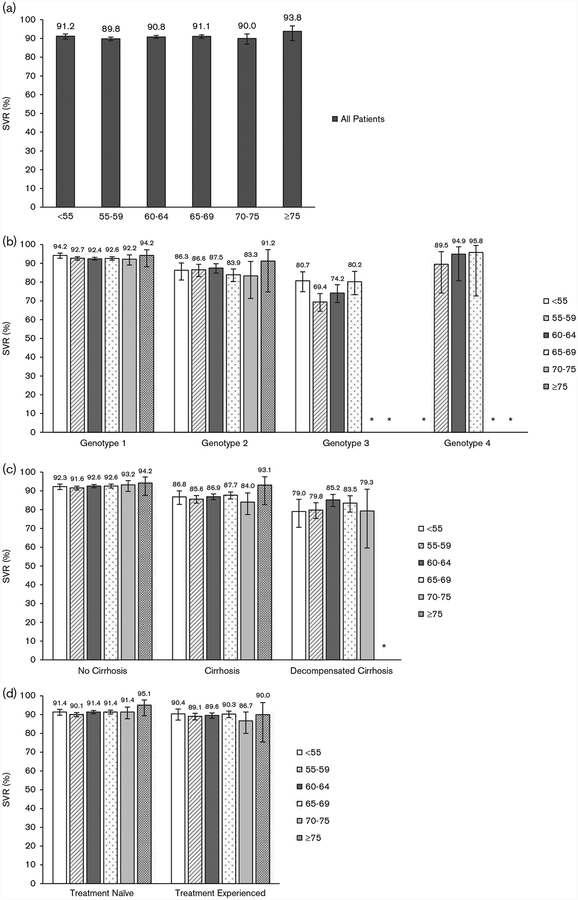
Overall unadjusted SVR rates were 91.2% [95% confidence interval (CI): 89.7-92.4], 89.8% (95% CI: 88.8-90.7), 90.8% (95% CI: 90.1-91.6), 91.1% (95% CI: 90.1-91.9), 90.0% (95% CI: 86.9-92.4), and 93.8% (95% CI: 88.8-96.7) in patients aged below 55, 55-59, 60-64, 65-69, 70-74, and 75 years or older. Unadjusted SVR rates were similar in all age groups after stratifying by genotype, treatment regimen, stage of liver disease, and treatment experience. In multivariate models, age was not predictive of SVR after adjusting for confounders.
DAAs produce high rates of SVR in all age groups, including patients in our oldest age category (≥75 years). Advanced age in and of itself should not be considered a barrier to initiating DAA treatment.
美国慢性丙型肝炎病毒(HCV)感染患者的平均年龄一直在增加。尽管HCV感染的老年患者比例不断上升,但该群体在HCV治疗的临床试验中代表性不足。
我们旨在描述直接作用抗病毒药物(DAA)在老年患者中的实际疗效。
我们回顾性确定了2014年1月1日至2015年6月30日期间在退伍军人事务医疗系统中开始接受索磷布韦、来迪帕司韦/索磷布韦或基于帕利瑞韦/奥比他韦/利托那韦/达沙布韦方案治疗的17487例HCV感染患者。我们确定了年龄在55岁以下、55 - 59岁、60 - 64岁、65 - 69岁、70 - 74岁以及75岁及以上患者的持续病毒学应答(SVR)率,并进行多变量逻辑回归分析以确定年龄是否可预测SVR。
总体未调整的SVR率在55岁以下、55 - 59岁、60 - 64岁、65 - 69岁、70 - 74岁以及75岁及以上患者中分别为91.2%[95%置信区间(CI):89.7 - 92.4]、89.8%(95% CI:88.8 - 90.7)、90.8%(95% CI:90.1 - 91.6)、91.1%(95% CI:90.1 - 91.9)、90.0%(95% CI:86.9 - 92.4)和93.8%(95% CI:88.8 - 96.7)。按基因型、治疗方案、肝病分期和治疗经验分层后,所有年龄组的未调整SVR率相似。在多变量模型中,调整混杂因素后,年龄不能预测SVR。
DAA在所有年龄组中均产生高SVR率,包括我们年龄最大的类别(≥75岁)的患者。高龄本身不应被视为启动DAA治疗的障碍。