Lee Ja-Rang, Park Sang-Je, Kim Young-Hyun, Choe Se-Hee, Cho Hyeon-Mu, Lee Sang-Rae, Kim Sun-Uk, Kim Ji-Su, Sim Bo-Woong, Song Bong-Seok, Jeong Kang-Jin, Lee Youngjeon, Jin Yeung Bae, Kang Philyong, Huh Jae-Won, Chang Kyu-Tae
National Primate Research Center, Korea Research Institute of Bioscience and Biotechnology, Cheongju 28116, Korea.
University of Science & Technology (UST), National Primate Research Center, Korea Research Institute of Bioscience and Biotechnology, Cheongju 28116, Korea.
Mol Cells. 2017 Feb;40(2):100-108. doi: 10.14348/molcells.2017.2204. Epub 2017 Feb 14.
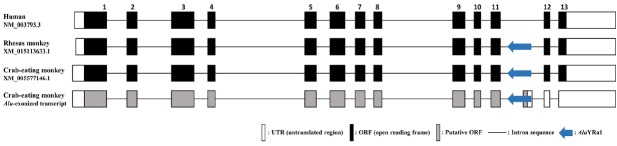
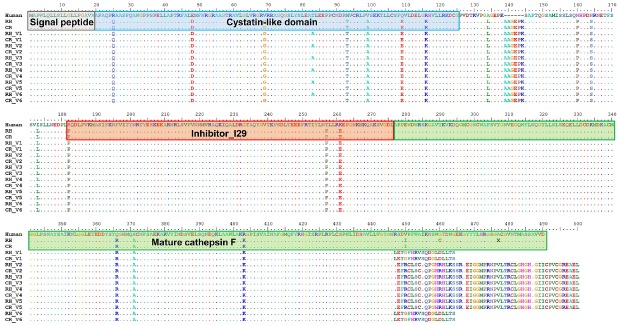
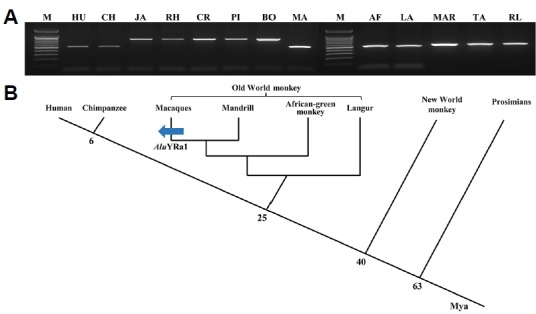
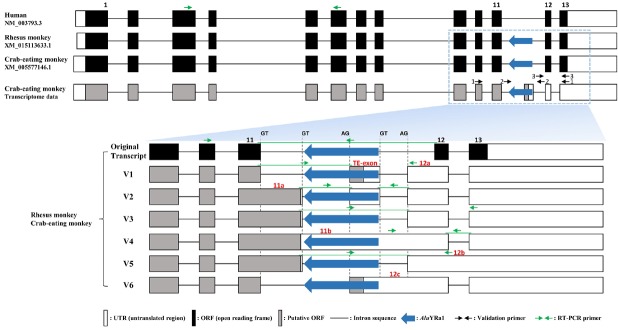
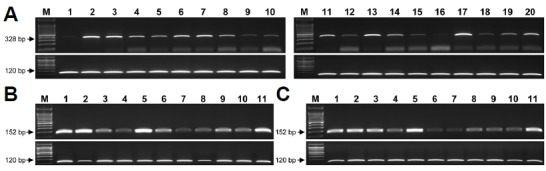
Cathepsin F, which is encoded by , is a cysteine proteinase ubiquitously expressed in several tissues. In a previous study, novel transcripts of the gene were identified in the crab-eating monkey deriving from the integration of an element-YRa1. The occurrence of YRa1-derived alternative transcripts and the mechanism of exonization events in the gene of human, rhesus monkey, and crab-eating monkey were investigated using PCR and reverse transcription PCR on the genomic DNA and cDNA isolated from several tissues. Results demonstrated that YRa1 was only integrated into the genome of species and this lineage-specific integration led to exonization events by producing a conserved 3' splice site. Six transcript variants (V1-V6) were generated by alternative splicing (AS) events, including intron retention and alternative 5' splice sites in the 5' and 3' flanking regions of _YRa1. Among them, V3-V5 transcripts were ubiquitously expressed in all tissues of rhesus monkey and crab-eating monkey, whereas YRa1-exonized V1 was dominantly expressed in the testis of the crab-eating monkey, and V2 was only expressed in the testis of the two monkeys. These five transcript variants also had different amino acid sequences in the C-terminal region of CTSF, as compared to reference sequences. Thus, species-specific -derived exonization by lineage-specific integration of elements and AS events seems to have played an important role during primate evolution by producing transcript variants and gene diversification.
组织蛋白酶F由[具体基因名称未给出]编码,是一种在多种组织中普遍表达的半胱氨酸蛋白酶。在先前的一项研究中,在食蟹猴中鉴定出了[具体基因名称未给出]基因的新转录本,其源于YRa1元件的整合。利用聚合酶链反应(PCR)和逆转录PCR,对从多种组织中分离出的基因组DNA和互补DNA(cDNA)进行研究,以探究人、恒河猴和食蟹猴的[具体基因名称未给出]基因中YRa1衍生的可变转录本的出现情况以及外显子化事件的机制。结果表明,YRa1仅整合到[具体物种名称未给出]物种的基因组中,这种谱系特异性整合通过产生保守的3'剪接位点导致了外显子化事件。通过可变剪接(AS)事件产生了六种转录变体(V1 - V6),包括在YRa1的5'和3'侧翼区域的内含子保留和可变5'剪接位点。其中,V3 - V5转录本在恒河猴和食蟹猴的所有组织中普遍表达,而YRa1外显子化的V1在食蟹猴的睾丸中占主导表达,V2仅在这两种猴子的睾丸中表达。与参考序列相比,这五种转录变体在CTSF的C末端区域也具有不同的氨基酸序列。因此,元件的谱系特异性整合和AS事件导致的物种特异性[具体基因名称未给出]衍生的外显子化似乎在灵长类动物进化过程中通过产生转录变体和基因多样化发挥了重要作用。