Finney Rutten Lila J, Wilson Patrick M, Jacobson Debra J, Agunwamba Amenah A, Radecki Breitkopf Carmen, Jacobson Robert M, St Sauver Jennifer L
Robert D. and Patricia E. Kern Center for the Science of Health Care Delivery, Mayo Clinic, Rochester, Minnesota.
Department of Health Sciences Research, Mayo Clinic, Rochester, Minnesota.
Cancer Epidemiol Biomarkers Prev. 2017 Apr;26(4):533-540. doi: 10.1158/1055-9965.EPI-16-0877. Epub 2017 Feb 14.
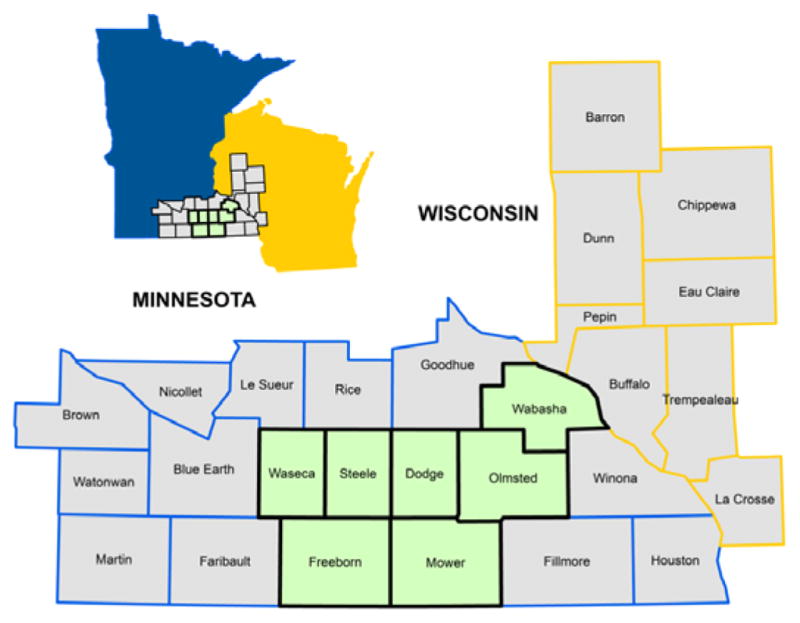
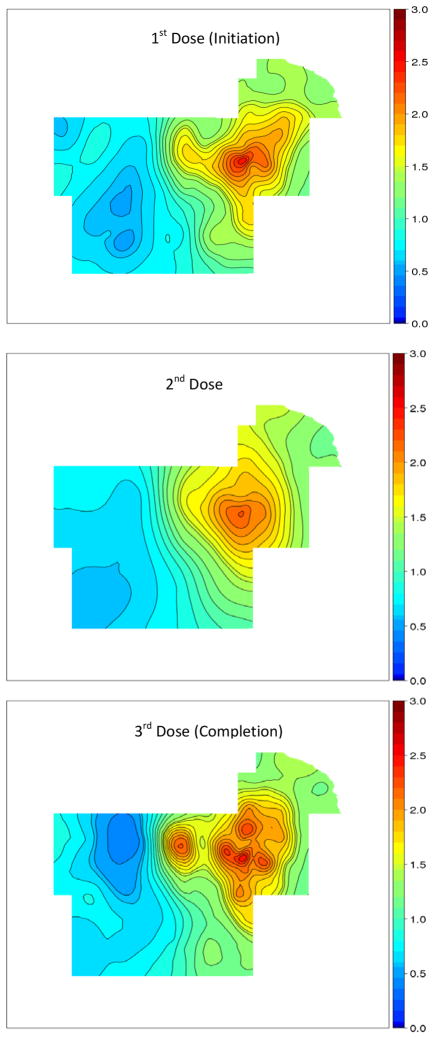
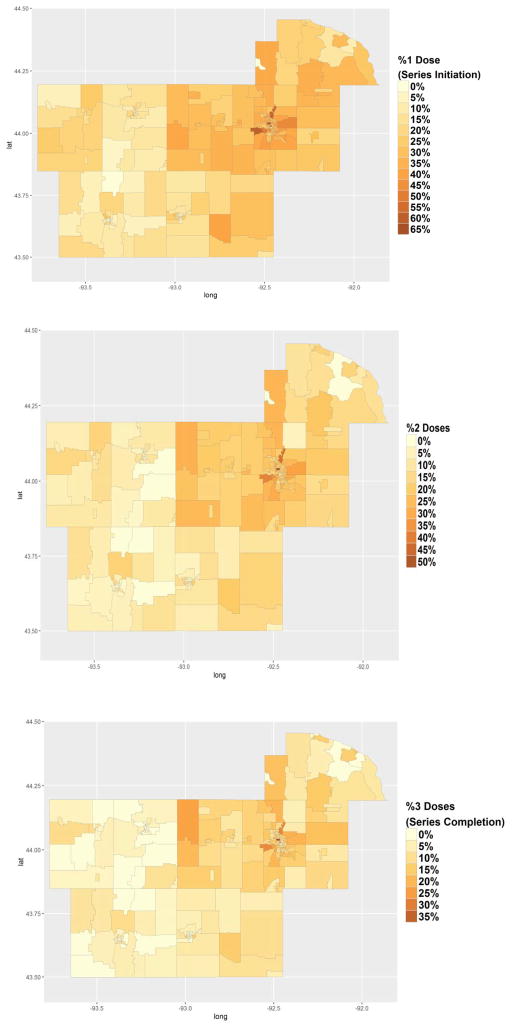
Human papillomavirus (HPV) vaccination rates in the United States remain low and lag behind other recommended adolescent vaccines. Studies evaluating the association of geographic and area-level characteristics with HPV vaccination rates provide a valuable resource for public health planning. We used the Rochester Epidemiology Project data linkage system to ascertain HPV vaccination rates between 2010 and 2015 in a 7-county region of southern Minnesota. Geocoded individual patient data were spatially linked to socioeconomic data from the American Community Survey at the census block group level. Bayesian hierarchical logistic regression was used to model incident vaccination rates, adjusting for individual- and area-level sociodemographic characteristics, and geolocation. Geolocation was modeled as an approximated Gaussian field using a Stochastic Partial Differential Equations approach. All models were estimated using Integrated Nested Laplace Approximations. In adjusted models, increasing age and female sex were associated with increased HPV vaccination. Lower socioeconomic status was associated with decreased rates of initiation [adjusted odds ratio (AOR); 95% confidence interval = 0.90 (0.86-0.95)], completion of the second dose [AOR = 0.88 (0.83-0.93)], and completion of the third dose [AOR = 0.85 (0.80-0.92)]. Geographic spatial analysis demonstrated increased odds of vaccination for the eastern region and in the greater Rochester metropolitan area, showing significant spatial variation not explained by individual level characteristics and ACS block group-level data. HPV vaccination rates varied geographically and by individual and geographically indexed sociodemographic characteristics. Identifying geographic regions with low HPV vaccination rates can help target clinical and community efforts to improve vaccination rates.
美国的人乳头瘤病毒(HPV)疫苗接种率仍然很低,落后于其他推荐的青少年疫苗。评估地理和地区层面特征与HPV疫苗接种率之间关联的研究为公共卫生规划提供了宝贵资源。我们使用罗切斯特流行病学项目数据链接系统,确定了明尼苏达州南部7县地区2010年至2015年期间的HPV疫苗接种率。经过地理编码的个体患者数据在空间上与人口普查街区组层面美国社区调查的社会经济数据相链接。采用贝叶斯分层逻辑回归对首次接种率进行建模,并对个体和地区层面的社会人口特征以及地理位置进行了调整。使用随机偏微分方程方法将地理位置建模为近似高斯场。所有模型均使用集成嵌套拉普拉斯近似法进行估计。在调整后的模型中,年龄增长和女性性别与HPV疫苗接种增加相关。社会经济地位较低与起始接种率降低[调整后的优势比(AOR);95%置信区间 = 0.90(0.86 - 0.95)]、第二剂接种完成率[AOR = 0.88(0.83 - 0.93)]以及第三剂接种完成率[AOR = 0.85(0.80 - 0.92)]相关。地理空间分析表明,东部地区以及大罗切斯特都会区的疫苗接种几率增加,显示出个体层面特征和美国社区调查街区组层面数据无法解释的显著空间差异。HPV疫苗接种率因地理位置以及个体和地理索引的社会人口特征而异。识别HPV疫苗接种率低的地理区域有助于针对临床和社区努力提高疫苗接种率。