Gao Zhao-Wei, Wang Hui-Ping, Lin Fang, Wang Xi, Long Min, Zhang Hui-Zhong, Dong Ke
Department of Clinical Diagnosis, Tangdu Hospital, Fourth Military Medical University, Xinsi, Road, Xi'an, Shanxi, 710038, China.
BMC Cancer. 2017 Feb 15;17(1):135. doi: 10.1186/s12885-017-3128-5.
CD73 has both enzymatic and non-enzymatic functions in cells. As a nucleotidase, CD73 plays its enzymatic function by catalyzing the hydrolysis of AMP into adenosine and phosphate. In addition to this, accumulating data have shown that CD73 is a key regulatory molecule involved in cancer growth and metastasis, but this non-enzymatic function of CD73 in cervical cancer cells has not been well studied.
CD73 was overexpressed by pcDNA-NT5E expression vector transfection in Hela and SiHa cells. Cell's proliferation and migration were evaluated by MTT and scratch healing assay. The CD73 specific antagonist -APCP was used to inhibit CD73 enzymatic activity. And the effect of APCP on CD73 activity was determined by high performance liquid chromatography (HPLC). Expression level was assessed by qRT-PCR and western blotting.
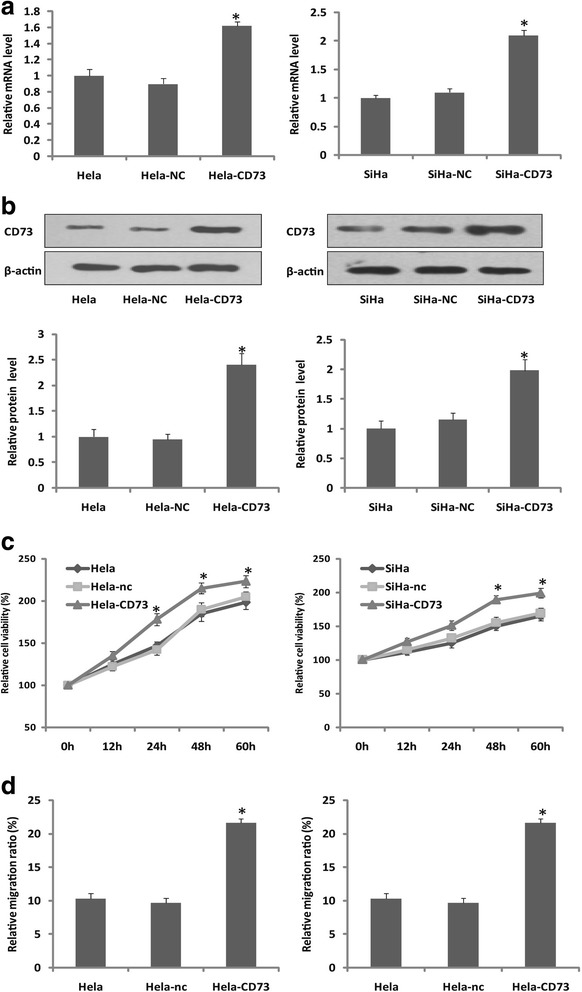
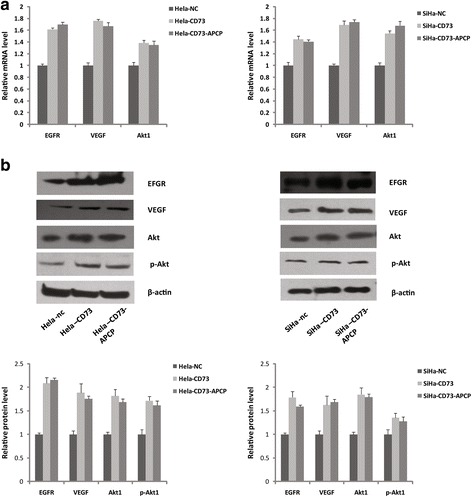
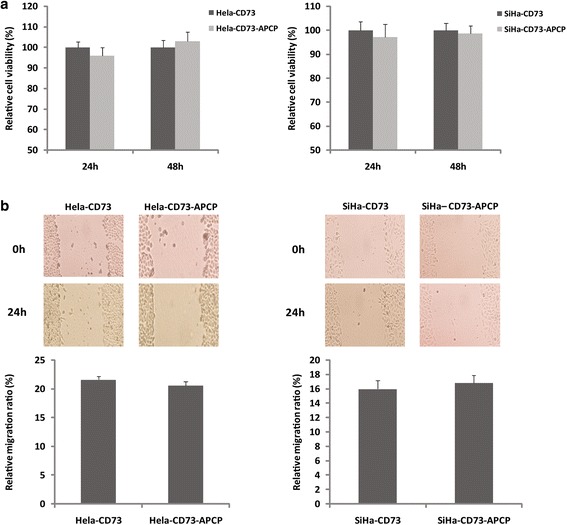
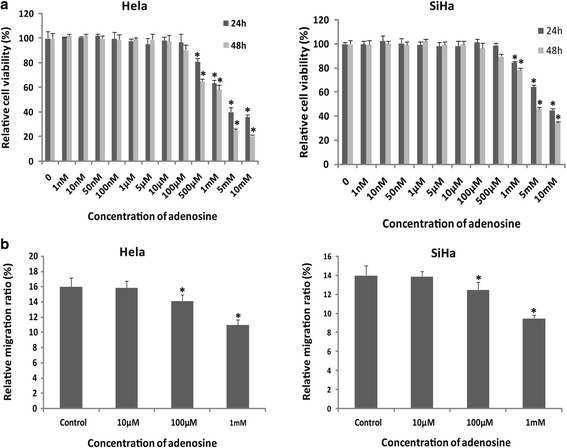
In the present study, we used Hela and SiHa cell lines to evaluate the effects of CD73 on cervical cancer cells proliferation and migration, and further explore the potential regulating mechanisms. Our data showed that CD73 overexpression significantly promoted cervical cancer cells proliferation and migration, and this promotive effect was not reverted by blocking CD73 enzymatic activity, both in Hela and SiHa cells. On the other hand, our data also showed that high concentration of adenosine inhibited Hela and SiHa cells proliferation and migration. These results demonstrated that the promotive effect of CD73 on cervical cancer cells proliferation and migration in vitro was independent from its enzymatic activity (i.e. production of adenosine). Furthermore, the expressions of EGFR, VEGF and Akt were significantly increased in CD73 overexpression Hela and SiHa cells.
Our data suggested that CD73 might promote proliferation and migration via potentiating EGFR/Akt and VEGF/Akt pathway, which was independent of CD73 enzyme activity. These data provide a novel insight into the regulating function of CD73 in cancer cells and suggest that CD73 may be promising therapeutic target in cervical cancer.
CD73在细胞中具有酶促和非酶促功能。作为一种核苷酸酶,CD73通过催化AMP水解为腺苷和磷酸来发挥其酶促功能。除此之外,越来越多的数据表明CD73是参与癌症生长和转移的关键调节分子,但CD73在宫颈癌细胞中的这种非酶促功能尚未得到充分研究。
通过pcDNA-NT5E表达载体转染在Hela和SiHa细胞中过表达CD73。通过MTT和划痕愈合试验评估细胞的增殖和迁移。使用CD73特异性拮抗剂-APCP抑制CD73的酶活性。并通过高效液相色谱(HPLC)测定APCP对CD73活性的影响。通过qRT-PCR和蛋白质印迹评估表达水平。
在本研究中,我们使用Hela和SiHa细胞系评估CD73对宫颈癌细胞增殖和迁移的影响,并进一步探索潜在的调节机制。我们的数据表明,CD73过表达显著促进宫颈癌细胞的增殖和迁移,并且在Hela和SiHa细胞中,这种促进作用不会因阻断CD73的酶活性而逆转。另一方面,我们的数据还表明,高浓度的腺苷抑制Hela和SiHa细胞的增殖和迁移。这些结果表明,CD73对体外宫颈癌细胞增殖和迁移的促进作用与其酶活性(即腺苷的产生)无关。此外,在CD73过表达的Hela和SiHa细胞中,EGFR、VEGF和Akt的表达显著增加。
我们的数据表明,CD73可能通过增强EGFR/Akt和VEGF/Akt途径促进增殖和迁移,这与CD73酶活性无关。这些数据为CD73在癌细胞中的调节功能提供了新的见解,并表明CD73可能是宫颈癌中有前景的治疗靶点。