Mokhtari Tahmineh, Akbari Mohammad, Malek Fatemeh, Kashani Iraj Ragerdi, Rastegar Tayebeh, Noorbakhsh Farshid, Ghazi-Khansari Mahmoud, Attari Fatemeh, Hassanzadeh Gholamreza
Department of Anatomy, School of Medicine, Tehran University of Medical Sciences, Tehran, Iran.
Department of Immunology, School of Medicine, Tehran University of Medical Sciences, Tehran, Iran.
Daru. 2017 Feb 15;25(1):4. doi: 10.1186/s40199-017-0169-x.
Ischemic stroke is a common leading cause of death and disability with lack of effective therapies. In this study, T3 was intra-ventricularly injected to evaluate gene expression and protein concentration of and brain-derived neurotrophic factor (BDNF) and Glial cell-derived neurotrophic factor (GDNF) in hippocampal CA1 region in rat model of brain ischemia/reperfusion (I/R).
In this study, transient middle cerebral artery occlusion (tMCAo) was used as model of ischemic brain stroke. Rats were randomly divided in four groups of Co, Sh, tMCAo and tMCAo + T3. Then, a single dose of intra-ventricular T3 was administered via a Hamilton syringe. Passive avoidance test was used as behavioral investigations. After 21 days, the animals were sacrificed and their brains were used for molecular and histopathological studies.
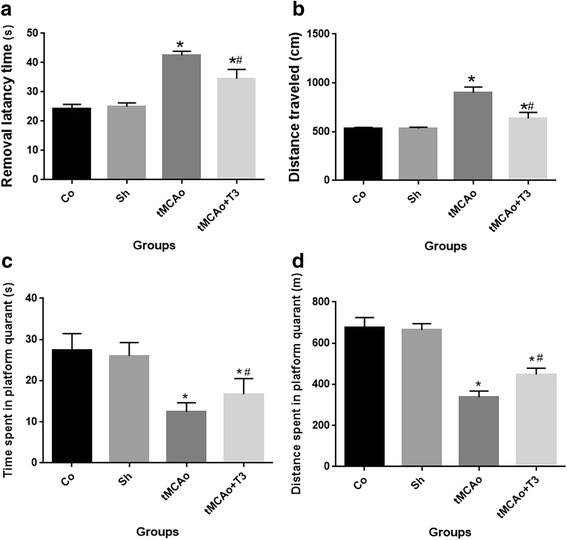
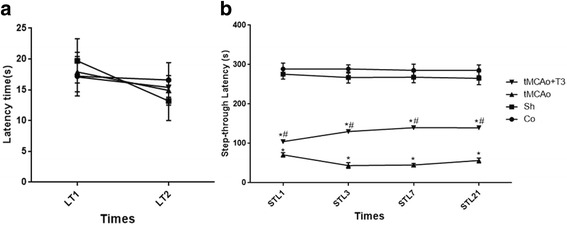
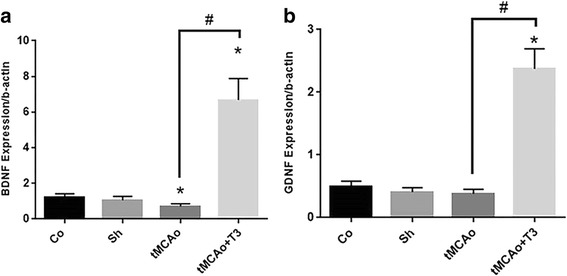
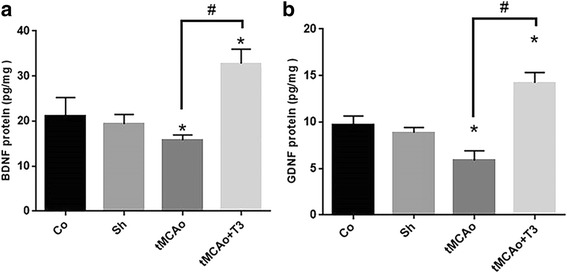
T3 significantly improved the learning and memory compared with tMCAo group according to Morris water maze findings (P < 0.05). Step-through latency (STL) significantly decreased in tMCAo group (P < 0.05). There were significant increase in the STL of T3 group compared with tMCAo group (P < 0.05).A significant reduction in BDNF mRNAs and protein levels were observed in the tMCAo compared with Co and Sh group (P < 0.05). A significant increase of BDNF and GDNF mRNAs and proteins was recorded in tMCAo + T3 group compared with Co, Sh and tMCAO groups (P < 0.05).
The results of current study demonstrated that T3 had therapeutic effects on cerebral ischemic stroke by increasing the neurotrophic factors (BDNF, GDNF) in CA1 region of hippocampus. The effects of intracerebroventricular microinjection of T3on memory and learning in rat model of ischemic brain stroke.
缺血性中风是导致死亡和残疾的常见主要原因,且缺乏有效的治疗方法。在本研究中,通过脑室内注射T3来评估脑缺血/再灌注(I/R)大鼠模型海马CA1区脑源性神经营养因子(BDNF)和胶质细胞源性神经营养因子(GDNF)的基因表达及蛋白浓度。
在本研究中,采用短暂性大脑中动脉闭塞(tMCAo)作为缺血性脑卒模型。将大鼠随机分为四组:对照组(Co)、假手术组(Sh)、tMCAo组和tMCAo + T3组。然后,通过汉密尔顿注射器给予单剂量的脑室内T3。采用被动回避试验进行行为学研究。21天后,处死动物,取脑用于分子和组织病理学研究。
根据莫里斯水迷宫实验结果,与tMCAo组相比,T3显著改善了学习和记忆能力(P < 0.05)。tMCAo组的穿通潜伏期(STL)显著缩短(P < 0.05)。与tMCAo组相比,T3组的STL显著延长(P < 0.05)。与Co组和Sh组相比,tMCAo组的BDNF mRNA和蛋白水平显著降低(P < 0.05)。与Co组、Sh组和tMCAo组相比,tMCAo + T3组的BDNF和GDNF mRNA及蛋白水平显著升高(P < 0.05)。
本研究结果表明,T3通过增加海马CA1区的神经营养因子(BDNF、GDNF)对脑缺血性中风具有治疗作用。脑室内微量注射T3对缺血性脑卒大鼠模型记忆和学习的影响。