Li Jin-Qing, Yu Xing-Juan, Wang Yong-Chun, Huang Li-Yun, Liu Chao-Qun, Zheng Limin, Fang Yu-Jing, Xu Jing
Collaborative Innovation Center of Cancer Medicine, State Key Laboratory of Oncology in South China, Sun Yat-sen University Cancer Center, Guangzhou, 510060, People's Republic of China.
Department of Pathology, Sun Yat-sen University Cancer Center, Guangzhou, 510060, People's Republic of China.
J Transl Med. 2017 Feb 15;15(1):37. doi: 10.1186/s12967-017-1139-2.
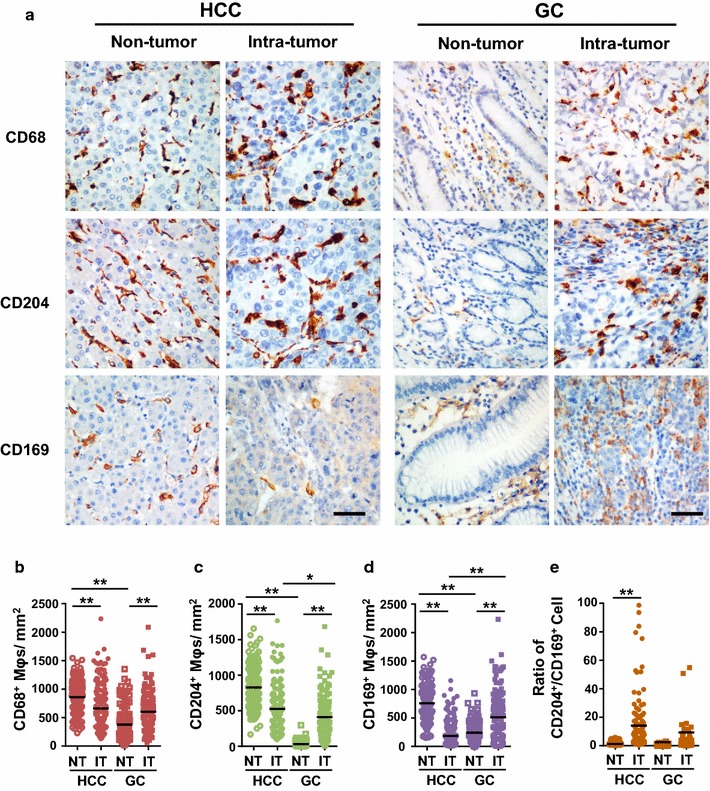
Macrophages (Mφs) constitute a major component of the leukocyte infiltrate and perform distinct roles in different tumor microenvironments. This study aimed to characterize the distribution, composition and prognostic value of Mφs in hepatocellular carcinoma (HCC) and gastric cancer (GC).
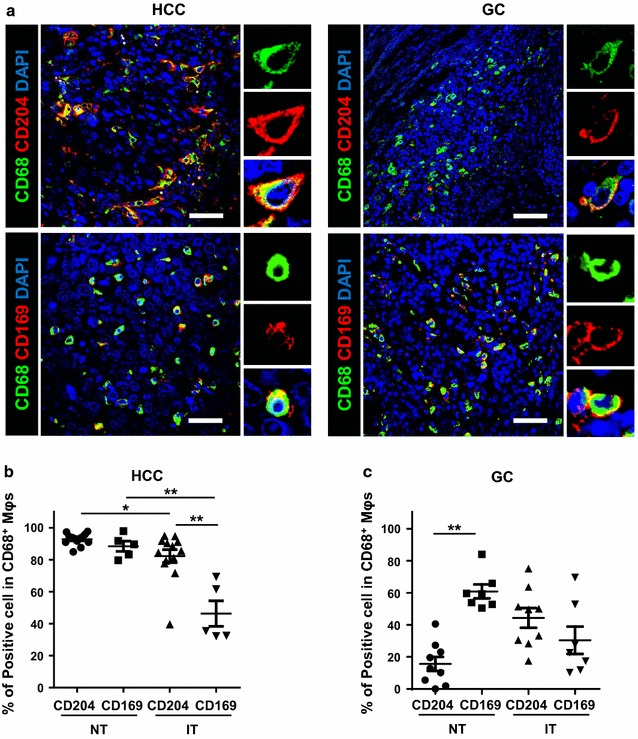
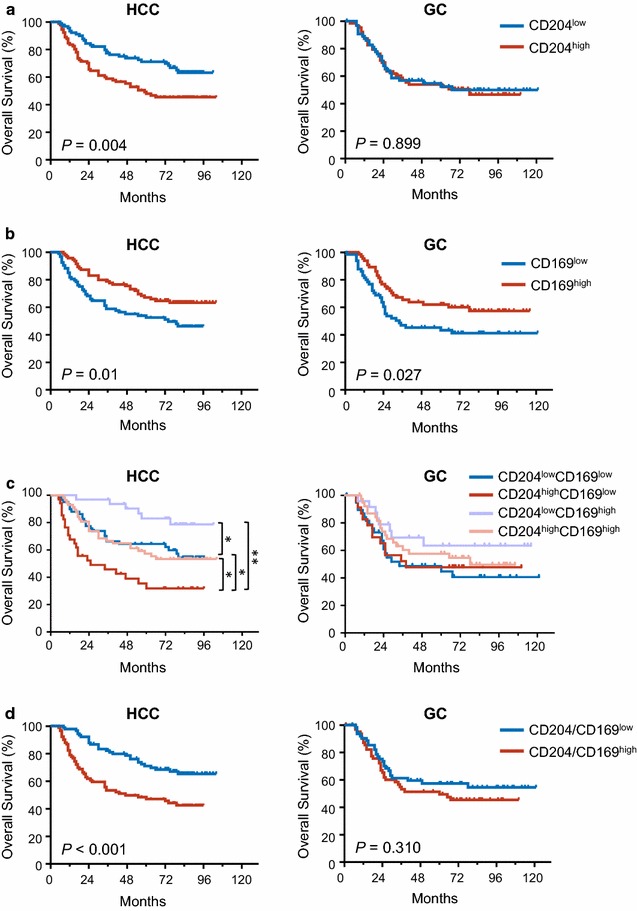
Immunohistochemistry and immunofluorescence were used to identify Mφ subsets in HCC and GC tissues. Kaplan-Meier analysis and Cox regression models were applied to estimate the overall survival (OS) for HCC and GC patients.
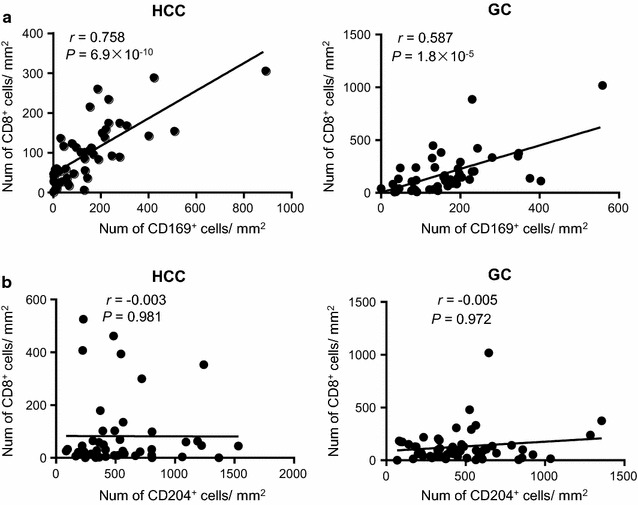
The results showed that the density of Mφs decreased in the intra-tumor region (IT) of HCC, but remarkably increased in the IT of GC, as compared with their non-tumor regions (NT). In HCC, most CD68 Mφs were CD204 and CD169 cells in the NT region; however, there was a significant decrease in the percentage of CD169 Mφ in the IT region. In contrast, CD68 Mφs comprised a smaller percentage of CD204 than the CD169 subpopulation in the NT region, while more CD204 but fewer CD169 cells were present in the IT region of GC. The density of CD204 Mφs correlated with poor prognosis in HCC, and CD169 Mφs were associated with good survival in both HCC and GC. Moreover, the combination of low numbers of CD204 and high numbers of CD169 Mφs was associated with improved OS in both GC and HCC.
Mφs display tissue-specific distributions and distinct composition patterns in HCC and GC tissues. Our results suggested that different types of tumors might use diverse strategies to reconstitute Mφ patterns to promote tumor progression.
巨噬细胞(Mφs)是白细胞浸润的主要组成部分,在不同的肿瘤微环境中发挥着不同的作用。本研究旨在表征巨噬细胞在肝细胞癌(HCC)和胃癌(GC)中的分布、组成及预后价值。
采用免疫组织化学和免疫荧光法鉴定HCC和GC组织中的巨噬细胞亚群。应用Kaplan-Meier分析和Cox回归模型评估HCC和GC患者的总生存期(OS)。
结果显示,与非肿瘤区域(NT)相比,HCC肿瘤内区域(IT)的巨噬细胞密度降低,但GC的IT区域显著增加。在HCC中,大多数CD68巨噬细胞在NT区域为CD204和CD169细胞;然而,IT区域中CD169巨噬细胞的百分比显著降低。相反,在NT区域,CD68巨噬细胞中CD204的比例低于CD169亚群,而在GC的IT区域,CD204细胞较多,CD169细胞较少。CD204巨噬细胞的密度与HCC的不良预后相关,CD169巨噬细胞与HCC和GC的良好生存期相关。此外,低数量的CD204和高数量的CD169巨噬细胞的组合与GC和HCC的OS改善相关。
巨噬细胞在HCC和GC组织中表现出组织特异性分布和不同的组成模式。我们的结果表明,不同类型的肿瘤可能采用不同的策略来重构巨噬细胞模式以促进肿瘤进展。