Jahn Ingeborg, Börnhorst Claudia, Günther Frauke, Brand Tilman
Department Prevention and Evaluation, Leibniz Institute for Prevention Research and Epidemiology - BIPS, Achterstr. 30, 28359, Bremen, Germany.
Department Biometry and Data Management, Leibniz Institute for Prevention Research and Epidemiology - BIPS, Achterstr. 30, 28359, Bremen, Germany.
Health Res Policy Syst. 2017 Feb 15;15(1):11. doi: 10.1186/s12961-017-0174-z.
During the last decades, sex and gender biases have been identified in various areas of biomedical and public health research, leading to compromised validity of research findings. As a response, methodological requirements were developed but these are rarely translated into research practice. The aim of this study is to provide good practice examples of sex/gender sensitive health research.
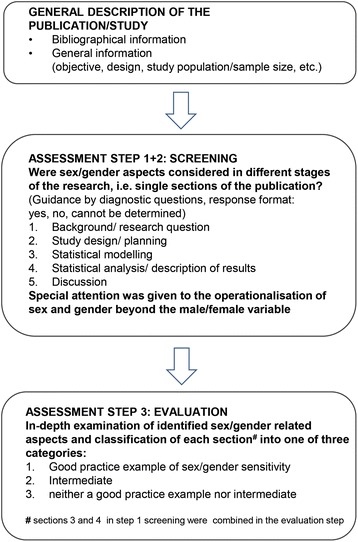
We conducted a systematic search of research articles published in JECH between 2006 and 2014. An instrument was constructed to evaluate sex/gender sensitivity in four stages of the research process (background, study design, statistical analysis, discussion).
In total, 37 articles covering diverse topics were included. Thereof, 22 were evaluated as good practice example in at least one stage; two articles achieved highest ratings across all stages. Good examples of the background referred to available knowledge on sex/gender differences and sex/gender informed theoretical frameworks. Related to the study design, good examples calculated sample sizes to be able to detect sex/gender differences, selected sex/gender sensitive outcome/exposure indicators, or chose different cut-off values for male and female participants. Good examples of statistical analyses used interaction terms with sex/gender or different shapes of the estimated relationship for men and women. Examples of good discussions interpreted their findings related to social and biological explanatory models or questioned the statistical methods used to detect sex/gender differences.
The identified good practice examples may inspire researchers to critically reflect on the relevance of sex/gender issues of their studies and help them to translate methodological recommendations of sex/gender sensitivity into research practice.
在过去几十年中,生物医学和公共卫生研究的各个领域都发现了性别偏见,这导致研究结果的有效性受到损害。作为回应,制定了方法学要求,但这些要求很少转化为研究实践。本研究的目的是提供性别敏感健康研究的良好实践范例。
我们对2006年至2014年期间发表在《流行病学与社区卫生杂志》上的研究文章进行了系统检索。构建了一种工具,用于在研究过程的四个阶段(背景、研究设计、统计分析、讨论)评估性别敏感性。
总共纳入了37篇涵盖不同主题的文章。其中,22篇在至少一个阶段被评估为良好实践范例;两篇文章在所有阶段都获得了最高评分。背景方面的良好范例提及了关于性别差异的现有知识和基于性别的理论框架。与研究设计相关的良好范例计算样本量以能够检测性别差异,选择性别敏感的结局/暴露指标,或为男性和女性参与者选择不同的临界值。统计分析的良好范例使用了与性别相关的交互项或针对男性和女性的估计关系的不同形式。良好讨论的范例将其研究结果与社会和生物学解释模型相关联,或对用于检测性别差异的统计方法提出质疑。
所确定的良好实践范例可能会促使研究人员批判性地反思其研究中性别问题的相关性,并帮助他们将性别敏感性的方法学建议转化为研究实践。