Alahmari Khalid A, Reddy Ravi Shankar, Silvian Paul S, Ahmad Irshad, Kakaraparthi Venkata Nagaraj, Alam Mohammed Mehtab
Department of Medical Rehabilitation Sciences, College of Applied Medical Sciences, King Khalid University, Abha, Saudi Arabia.
J Adv Res. 2017 May;8(3):201-207. doi: 10.1016/j.jare.2017.01.001. Epub 2017 Jan 9.
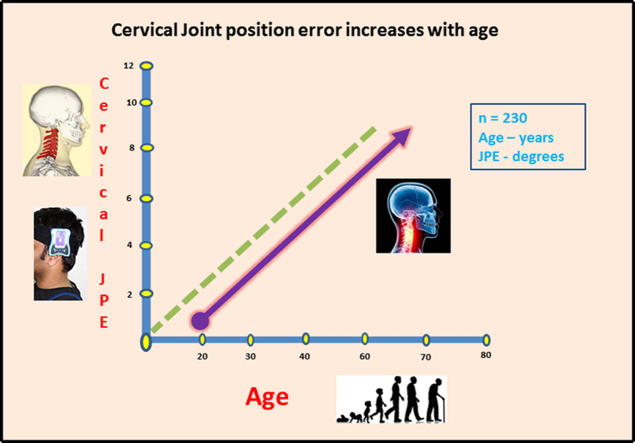
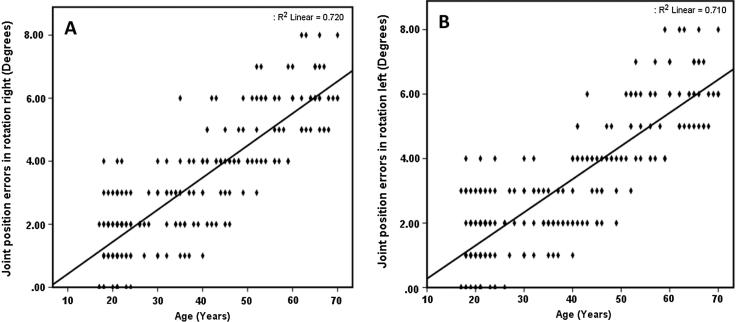
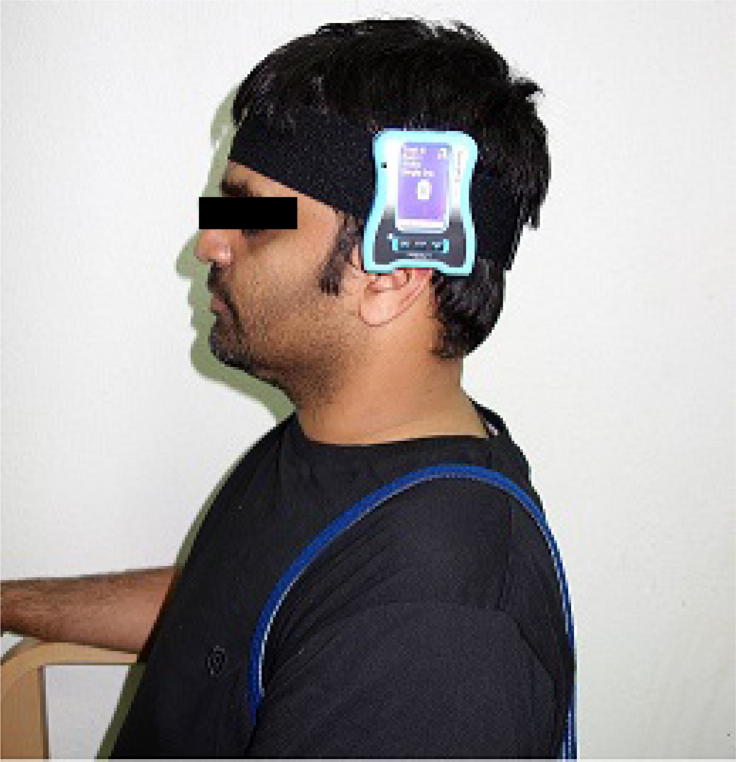
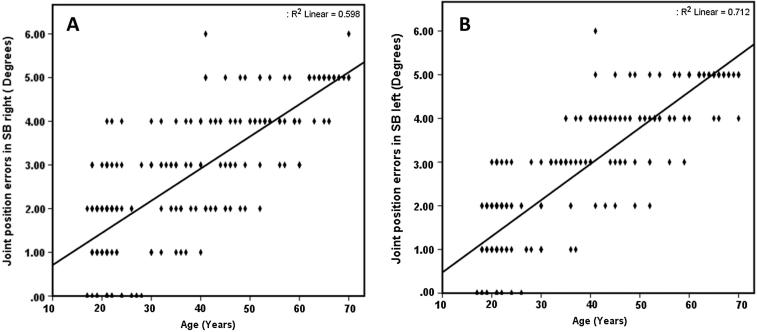
This study quantitatively assesses the association between age and cervical joint position error (JPE) and compares JPE between young and older asymptomatic subjects. Subjects ( = 230) ranging in age from 17 to 70 years volunteered to participate in the study. Cervical JPE was measured for all subjects with the active movement angle reproduction test in degrees using a digital inclinometer; testing was done in all cervical movement directions (flexion, extension, side-bending right and left, rotation right and left). Subjects were divided into two groups: young ( = 169, mean age: 32.4 years; range 17-49 years) and older ( = 61, mean age: 61.9 years; range 50-70 years) and JPE was compared. Pearson's product-moment correlation coefficients were significant and positive for the association of age on cervical JPE in flexion ( = 0.71), extension ( = 0.81), side-bending right ( = 0.77), side-bending left ( = 0.84), rotation right ( = 0.84), and rotation left ( = 0.84). JPE was significantly larger (for all movement directions) in the older subject group ( < 0.001). Advancing age was significantly associated with the increasing cervical JPE and older subjects showed greater errors when compared to younger subjects.
本研究定量评估年龄与颈椎关节位置误差(JPE)之间的关联,并比较年轻和年长无症状受试者之间的JPE。年龄在17至70岁之间的230名受试者自愿参与本研究。使用数字倾角仪以度为单位通过主动运动角度再现测试测量所有受试者的颈椎JPE;测试在所有颈椎运动方向(前屈、后伸、右侧和左侧侧屈、右侧和左侧旋转)进行。受试者分为两组:年轻组(n = 169,平均年龄:32.4岁;范围17 - 49岁)和年长组(n = 61,平均年龄:61.9岁;范围50 - 70岁),并比较JPE。年龄与颈椎JPE在前屈(r = 0.71)、后伸(r = 0.81)、右侧侧屈(r = 0.77)、左侧侧屈(r = 0.84)、右侧旋转(r = 0.84)和左侧旋转(r = 0.84)中的关联,Pearson积矩相关系数均为显著正相关。年长受试者组的JPE在所有运动方向上均显著更大(P < 0.001)。年龄增长与颈椎JPE增加显著相关,与年轻受试者相比,年长受试者表现出更大的误差。