Bradley Mark A, Barst Benjamin D, Basu Niladri
School of Dietetics and Human Nutrition, McGill University, Montréal, QC H3A 0G4, Canada.
Department of Natural Resource Sciences, McGill University, Montréal, QC H3A 0G4, Canada.
Int J Environ Res Public Health. 2017 Feb 10;14(2):169. doi: 10.3390/ijerph14020169.
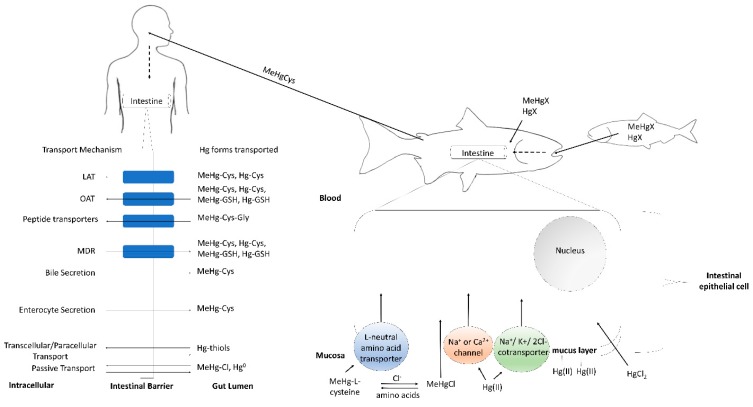
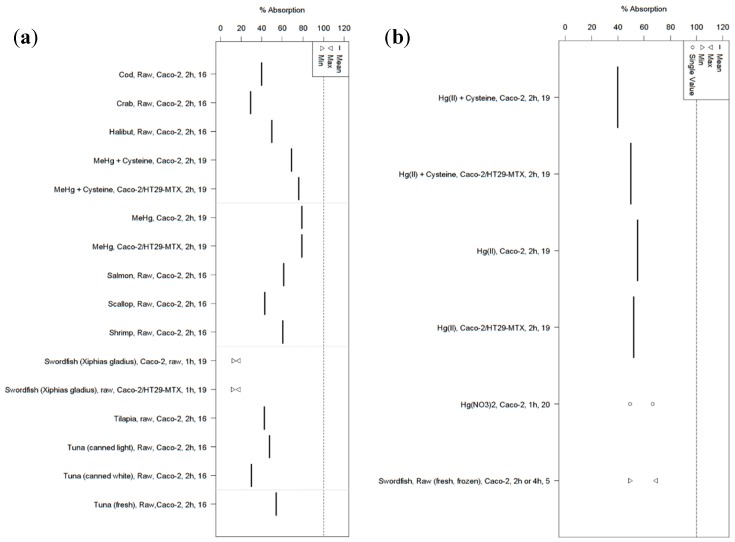
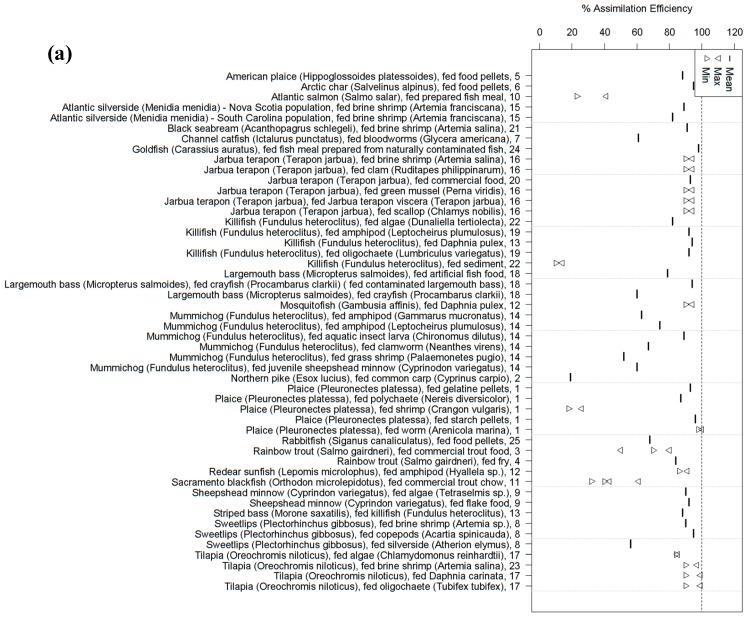
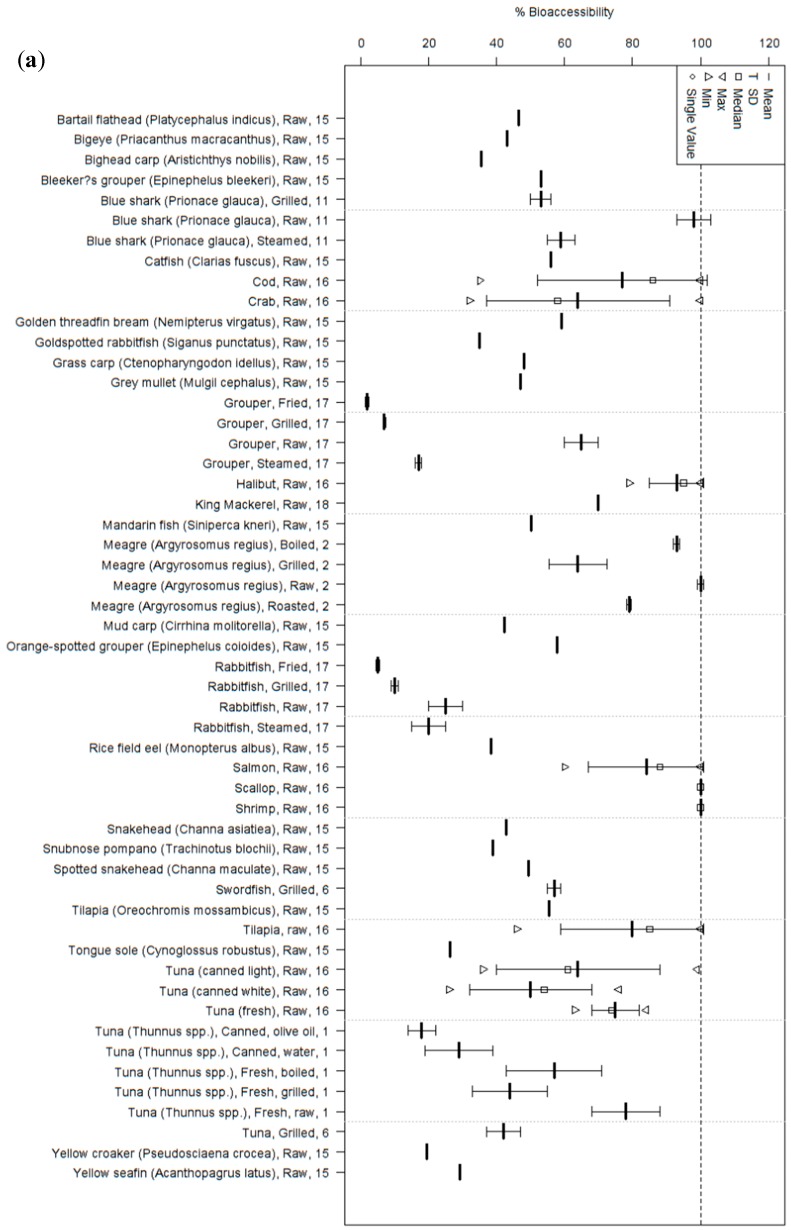
To estimate human exposure to methylmercury (MeHg), risk assessors often assume 95%-100% bioavailability in their models. However, recent research suggests that assuming all, or most, of the ingested mercury (Hg) is absorbed into systemic circulation may be erroneous. The objective of this paper is to review and discuss the available state of knowledge concerning the assimilation or bioavailability of Hg in fish and humans. In fish, this meant reviewing studies on assimilation efficiency, that is the difference between ingested and excreted Hg over a given period of time. In humans, this meant reviewing studies that mostly investigated bioaccessibility (digestive processes) rather than bioavailability (cumulative digestive + absorptive processes), although studies incorporating absorption for a fuller picture of bioavailability were also included where possible. The outcome of this review shows that in a variety of organisms and experimental models that Hg bioavailability and assimilation is less than 100%. Specifically, 25 studies on fish were reviewed, and assimilation efficiencies ranged from 10% to 100% for MeHg and from 2% to 51% for Hg(II). For humans, 20 studies were reviewed with bioaccessibility estimates ranging from 2% to 100% for MeHg and 0.2% to 94% for Hg(II). The overall absorption estimates ranged from 12% to 79% for MeHg and 49% to 69% for Hg(II), and were consistently less than 100%. For both fish and humans, a number of cases are discussed in which factors (e.g., Hg source, cooking methods, nutrients) are shown to affect Hg bioavailability. The summaries presented here challenge a widely-held assumption in the Hg risk assessment field, and the paper discusses possible ways forward for the field.
为了估算人类对甲基汞(MeHg)的暴露量,风险评估者在其模型中通常假定生物利用率为95% - 100%。然而,最近的研究表明,假设摄入的所有或大部分汞(Hg)都被吸收进入体循环可能是错误的。本文的目的是回顾和讨论关于鱼类和人类体内汞的同化或生物利用率的现有知识状况。对于鱼类,这意味着回顾关于同化效率的研究,即给定时间段内摄入汞与排出汞之间的差异。对于人类,这意味着回顾主要研究生物可及性(消化过程)而非生物利用率(累积消化 + 吸收过程)的研究,不过在可能的情况下也纳入了考虑吸收情况以更全面了解生物利用率的研究。本次综述的结果表明,在各种生物体和实验模型中,汞的生物利用率和同化率均低于100%。具体而言,对25项关于鱼类的研究进行了综述,甲基汞的同化效率范围为10%至100%,汞(II)的同化效率范围为2%至51%。对于人类,对20项研究进行了综述,甲基汞的生物可及性估计范围为2%至100%,汞(II)的生物可及性估计范围为0.2%至94%。甲基汞的总体吸收估计范围为12%至79%,汞(II)的总体吸收估计范围为49%至69%,且始终低于100%。对于鱼类和人类,都讨论了一些案例,其中显示某些因素(如汞源、烹饪方法、营养物质)会影响汞的生物利用率。这里给出的综述结果对汞风险评估领域中一个广泛持有的假设提出了挑战,并且本文讨论了该领域可能的前进方向。