Nguyen Hanh T, Madani Navid, Ding Haitao, Elder Emerald, Princiotto Amy, Gu Christopher, Darby Patrice, Alin James, Herschhorn Alon, Kappes John C, Mao Youdong, Sodroski Joseph G
Department of Cancer Immunology and Virology, Dana-Farber Cancer Institute, Department of Microbiology and Immunobiology, Harvard Medical School, 450 Brookline Avenue, CLS 1010, Boston, MA, 02215, USA.
Department of Medicine, University of Alabama at Birmingham, Birmingham, AL, 35294, USA.
Virol J. 2017 Feb 16;14(1):33. doi: 10.1186/s12985-017-0704-x.
The human immunodeficiency virus (HIV-1) envelope glycoprotein (Env), a Type 1 transmembrane protein, assembles into a trimeric spike complex that mediates virus entry into host cells. The high potential energy of the metastable, unliganded Env trimer is maintained by multiple non-covalent contacts among the gp120 exterior and gp41 transmembrane Env subunits. Structural studies suggest that the gp41 transmembrane region forms a left-handed coiled coil that contributes to the Env trimer interprotomer contacts. Here we evaluate the contribution of the gp41 transmembrane region to the folding and stability of Env trimers.
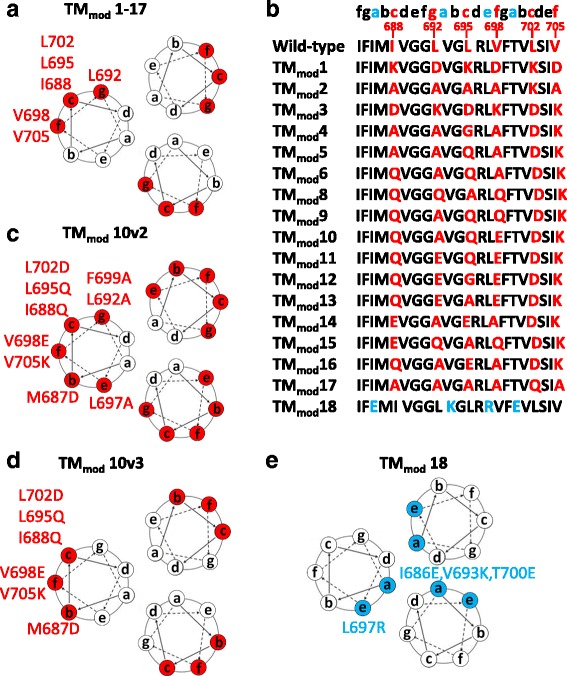
Multiple polar/charged amino acid residues, which hypothetically disrupt the stop-transfer signal, were introduced in the proposed lipid-interactive face of the transmembrane coiled coil, allowing release of soluble cleavage-negative Envs containing the modified transmembrane region (TM). We also examined effects of cleavage, the cytoplasmic tail and a C-terminal fibritin trimerization (FT) motif on oligomerization, antigenicity and functionality of soluble and membrane-bound Envs.
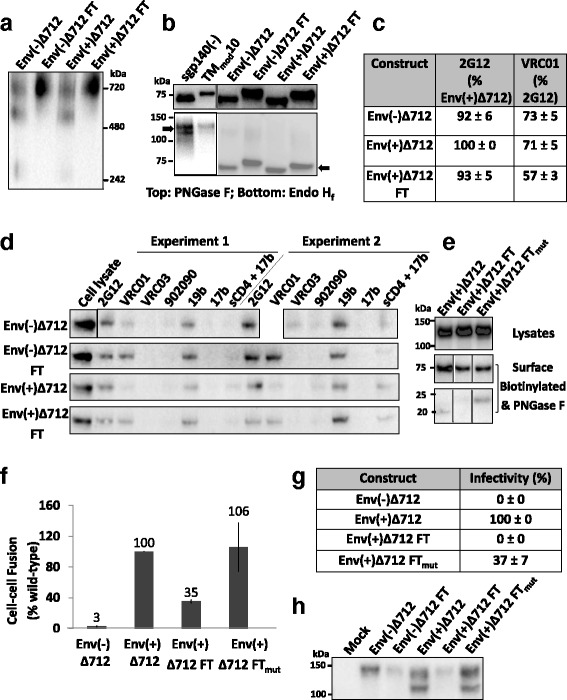
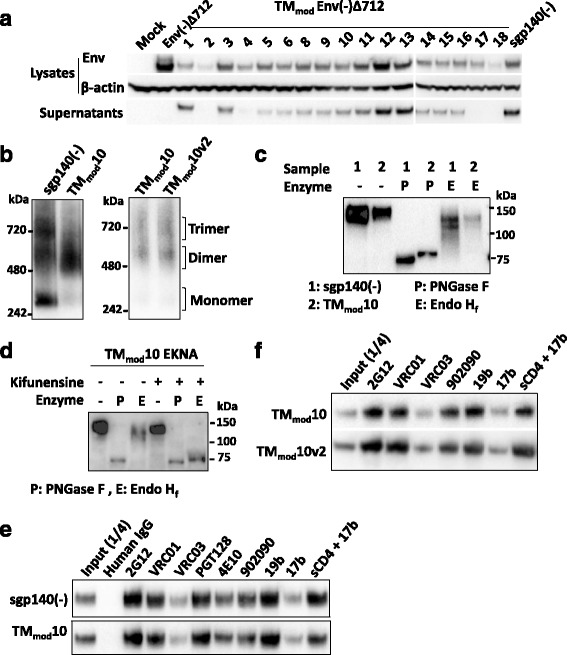
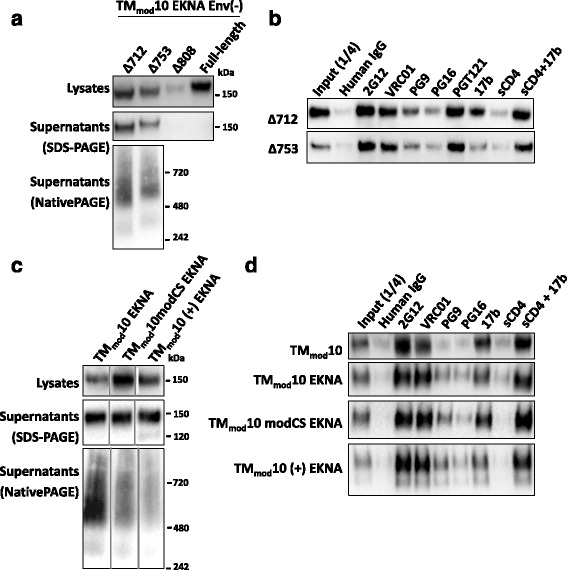
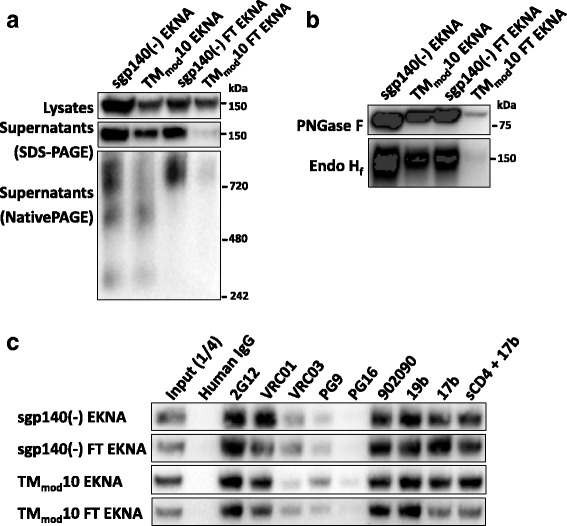
The introduction of polar/charged amino acids into the transmembrane region resulted in the secretion of soluble Envs from the cell. However, these TM Envs primarily formed dimers. By contrast, control cleavage-negative sgp140 Envs lacking the transmembrane region formed soluble trimers, dimers and monomers. TM and sgp140 trimers were stabilized by the addition of a C-terminal FT sequence, but still exhibited carbohydrate and antigenic signatures of a flexible ectodomain structure. On the other hand, detergent-solubilized cleaved and uncleaved Envs isolated from the membranes of expressing cells exhibited "tighter" ectodomain structures, based on carbohydrate modifications. These trimers were found to be unstable in detergent solutions, but could be stabilized by the addition of a C-terminal FT moiety. The C-terminal FT domain decreased Env cleavage and syncytium-forming ability by approximately three-fold; alteration of the FT trimerization interface restored Env cleavage and syncytium formation to near-wild-type levels.
The modified transmembrane region was not conducive to trimerization of soluble Envs. However, for HIV-1 Env ectodomains that are minimally modified, membrane-anchored Envs exhibit the most native structures and can be stabilized by appropriately positioned FT domains.
人类免疫缺陷病毒1型(HIV-1)包膜糖蛋白(Env)是一种1型跨膜蛋白,组装成三聚体刺突复合物,介导病毒进入宿主细胞。亚稳态、未结合配体的Env三聚体的高势能由gp120外部和gp41跨膜Env亚基之间的多个非共价接触维持。结构研究表明,gp41跨膜区域形成左手卷曲螺旋,有助于Env三聚体的原体间接触。在此,我们评估gp41跨膜区域对Env三聚体折叠和稳定性的贡献。
在跨膜卷曲螺旋的假定脂质相互作用面上引入多个假定会破坏终止转移信号的极性/带电荷氨基酸残基,从而释放出含有修饰跨膜区域(TM)的可溶性裂解阴性Env。我们还研究了裂解、细胞质尾巴和C末端纤维蛋白三聚化(FT)基序对可溶性和膜结合Env的寡聚化、抗原性和功能的影响。
在跨膜区域引入极性/带电荷氨基酸导致细胞分泌可溶性Env。然而,这些TM Env主要形成二聚体。相比之下,缺乏跨膜区域的对照裂解阴性sgp140 Env形成可溶性三聚体、二聚体和单体。通过添加C末端FT序列可稳定TM和sgp140三聚体,但仍表现出柔性胞外域结构的碳水化合物和抗原特征。另一方面,从表达细胞的膜中分离出的经去污剂溶解的裂解和未裂解Env,基于碳水化合物修饰,表现出“更紧密”的胞外域结构。发现这些三聚体在去污剂溶液中不稳定,但可通过添加C末端FT部分来稳定。C末端FT结构域使Env裂解和形成合胞体的能力降低约三倍;改变FT三聚化界面可使Env裂解和合胞体形成恢复到接近野生型水平。
修饰后的跨膜区域不利于可溶性Env的三聚化。然而,对于修饰最少的HIV-1 Env胞外域,膜锚定的Env表现出最天然的结构,并且可以通过适当定位的FT结构域来稳定。