Dimopoulos Meletios A, Stewart A Keith, Masszi Tamás, Špička Ivan, Oriol Albert, Hájek Roman, Rosiñol Laura, Siegel David, Mihaylov Georgi G, Goranova-Marinova Vesselina, Rajnics Péter, Suvorov Aleksandr, Niesvizky Ruben, Jakubowiak Andrzej, San-Miguel Jesus, Ludwig Heinz, Palumbo Antonio, Obreja Mihaela, Aggarwal Sanjay, Moreau Philippe
National and Kapodistrian University of Athens, Athens, Greece.
Mayo Clinic, Scottsdale, AZ, USA.
Br J Haematol. 2017 May;177(3):404-413. doi: 10.1111/bjh.14549. Epub 2017 Feb 17.
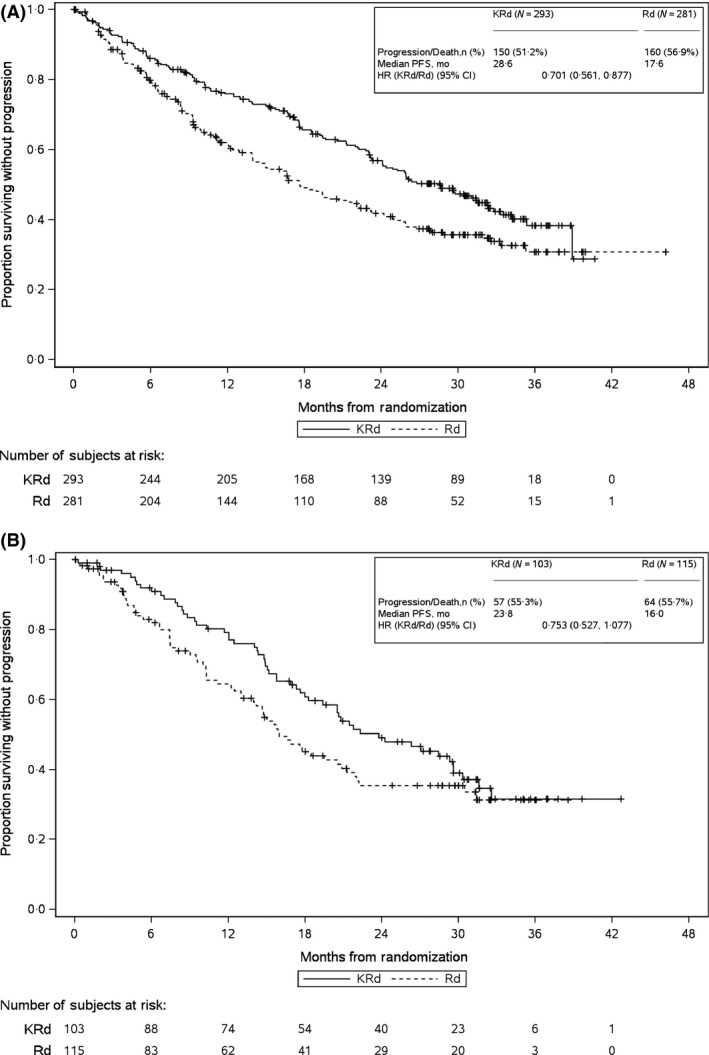
A primary analysis of the ASPIRE study found that the addition of carfilzomib to lenalidomide and dexamethasone (carfilzomib group) significantly improved progression-free survival (PFS) compared with lenalidomide and dexamethasone alone (control group) in patients with relapsed multiple myeloma (RMM). This post hoc analysis examined outcomes from ASPIRE in patients categorised by age. In the carfilzomib group, 103/396 patients were ≥70 years old, and in the control group, 115/396 patients were ≥70 years old. Median PFS for patients <70 years old was 28·6 months for the carfilzomib group versus 17·6 months for the control group [hazard ratio (HR), 0·701]. Median PFS for patients ≥70 years old was 23·8 months for the carfilzomib group versus 16·0 months for the control group (HR, 0·753). For patients <70 years the overall response rate (ORR) was 86·0% (carfilzomib group) and 66·9% (control group); for patients ≥70 years old the ORR was 90·3% (carfilzomib group) and 66·1% (control group). Within the carfilzomib group, grade ≥3 cardiovascular adverse events occurred more frequently among patients ≥70 years old compared with patients <70 years old. Carfilzomib-lenalidomide-dexamethasone has a favourable benefit-risk profile for patients with RMM, including elderly patients ≥70 years old.
clinicaltrials.gov identifier: NCT01080391.
ASPIRE研究的一项初步分析发现,在复发多发性骨髓瘤(RMM)患者中,与单独使用来那度胺和地塞米松(对照组)相比,在来那度胺和地塞米松基础上加用卡非佐米(卡非佐米组)可显著改善无进展生存期(PFS)。这项事后分析研究了按年龄分类的ASPIRE患者的结局。在卡非佐米组中,103/396例患者年龄≥70岁,在对照组中,115/396例患者年龄≥70岁。卡非佐米组<70岁患者的中位PFS为28.6个月,而对照组为17.6个月[风险比(HR),0.701]。卡非佐米组≥70岁患者的中位PFS为23.8个月,而对照组为16.0个月(HR,0.753)。对于<70岁的患者,总缓解率(ORR)为86.0%(卡非佐米组)和66.9%(对照组);对于≥70岁的患者,ORR为90.3%(卡非佐米组)和66.1%(对照组)。在卡非佐米组中;≥70岁的患者与<70岁的患者相比,≥3级心血管不良事件的发生频率更高。卡非佐米-来那度胺-地塞米松对RMM患者,包括≥70岁的老年患者,具有良好的效益风险比。
clinicaltrials.gov标识符:NCT01080391。