Harisa Gamaleldin I, Attia Sabry M, Zoheir Khairy M A, Alanazi Fars K
Kayyali Chair for Pharmaceutical Industry, Department of Pharmaceutics, College of Pharmacy, King Saud University, Riyadh, Saudi Arabia; Departments of Biochemistry, Pharmacology and Toxicology, College of Pharmacy, Al-Azhar University (Boys), Nasr City, Cairo, Egypt.
Departments of Biochemistry, Pharmacology and Toxicology, College of Pharmacy, Al-Azhar University (Boys), Nasr City, Cairo, Egypt; Department of Pharmacology and Toxicology, College of Pharmacy, King Saud University, Riyadh, Saudi Arabia.
Saudi Pharm J. 2017 Jan;25(1):120-127. doi: 10.1016/j.jsps.2016.05.007. Epub 2016 May 26.
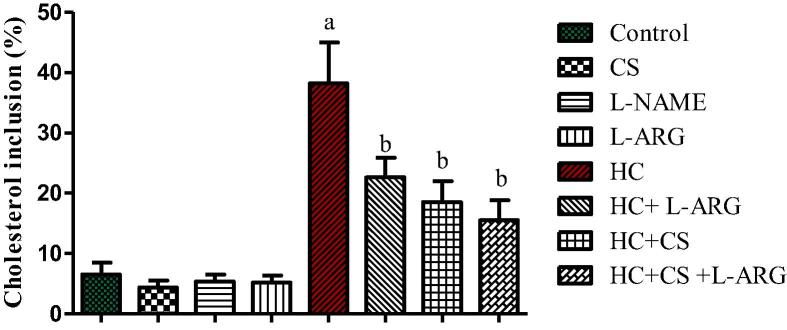
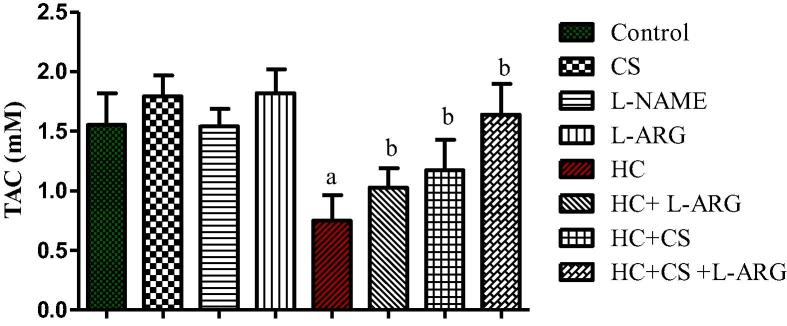
This study aimed to evaluate the protective effect of chitosan (CS) against hypercholesterolemia (HC) induced arginase activation and disruption of nitric oxide (NO) biosynthesis using erythrocytes as cellular model. Human erythrocytes were isolated and classified into eight groups. Next, cells were treated with l-arginine (l-ARG), N-nitro-l-arginine methyl ester (l-NAME), CS or CS + l-ARG in the presence of normal plasma or cholesterol enriches plasma. Then, erythrocytes were incubated at 37 °C for 24 h. The present results revealed that, HC induced significant increase of cholesterol inclusion into erythrocytes membrane compared to control. Moreover, HC caused significant decrease in nitric oxide synthase (NOS) activity similar to l-NAME; however, arginase activity and arginase/NOS ratio significantly increased compared to control. On contrast, treatment of HC with, l-arginine, CS or CS plus l-arginine prevents HC induced cholesterol loading into erythrocytes membrane, NOS inhibition and arginase activation. This study suggested that CS could be protective agent against HC induced disruption of erythrocyte's oxidative status and arginase activation.
本研究旨在以红细胞作为细胞模型,评估壳聚糖(CS)对高胆固醇血症(HC)诱导的精氨酸酶激活以及一氧化氮(NO)生物合成破坏的保护作用。分离人红细胞并分为八组。接下来,在正常血浆或富含胆固醇的血浆存在下,用L-精氨酸(L-ARG)、N-硝基-L-精氨酸甲酯(L-NAME)、CS或CS + L-ARG处理细胞。然后,将红细胞在37℃孵育24小时。目前的结果显示,与对照组相比,HC诱导红细胞膜中胆固醇含量显著增加。此外,HC导致一氧化氮合酶(NOS)活性显著降低,与L-NAME相似;然而,与对照组相比,精氨酸酶活性和精氨酸酶/NOS比值显著增加。相反,用L-精氨酸、CS或CS加L-精氨酸处理HC可防止HC诱导的胆固醇加载到红细胞膜中、NOS抑制和精氨酸酶激活。本研究表明,CS可能是一种针对HC诱导的红细胞氧化状态破坏和精氨酸酶激活的保护剂。