Alonso-Del-Real Javier, Lairón-Peris María, Barrio Eladio, Querol Amparo
Departamento de Biotecnología de los Alimentos, Grupo de Biología de Sistemas en Levaduras de Interés Biotecnológico, Instituto de Agroquímica y Tecnología de los Alimentos (IATA)-CSIC Valencia, Spain.
Departamento de Biotecnología de los Alimentos, Grupo de Biología de Sistemas en Levaduras de Interés Biotecnológico, Instituto de Agroquímica y Tecnología de los Alimentos (IATA)-CSICValencia, Spain; Departament de Genètica, Universitat de ValènciaValència, Spain.
Front Microbiol. 2017 Feb 7;8:150. doi: 10.3389/fmicb.2017.00150. eCollection 2017.
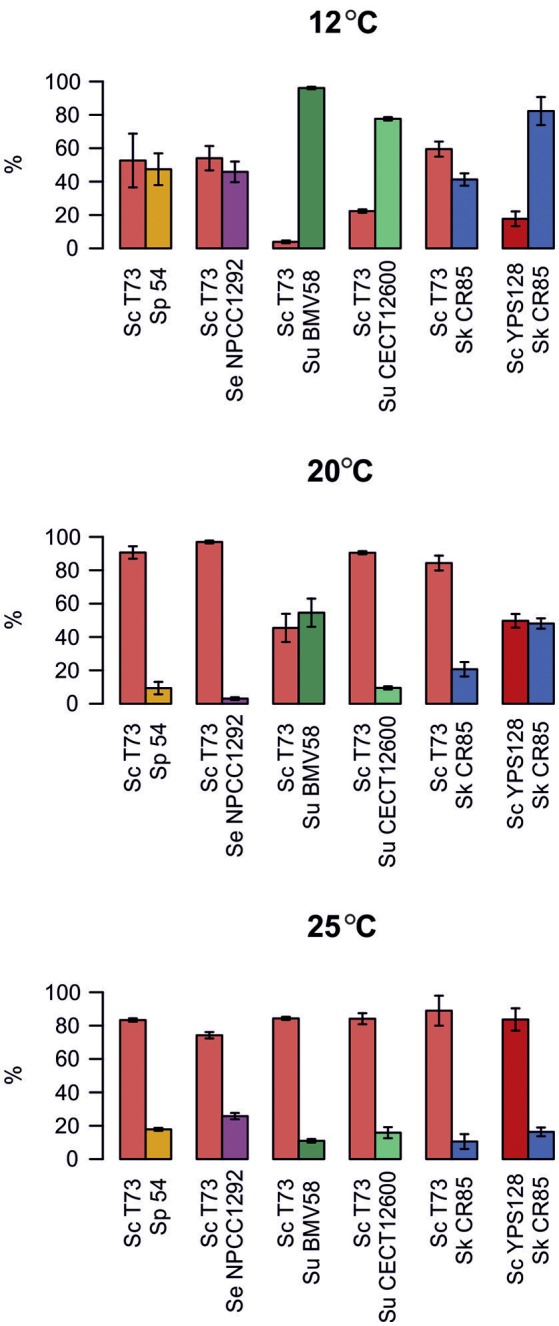
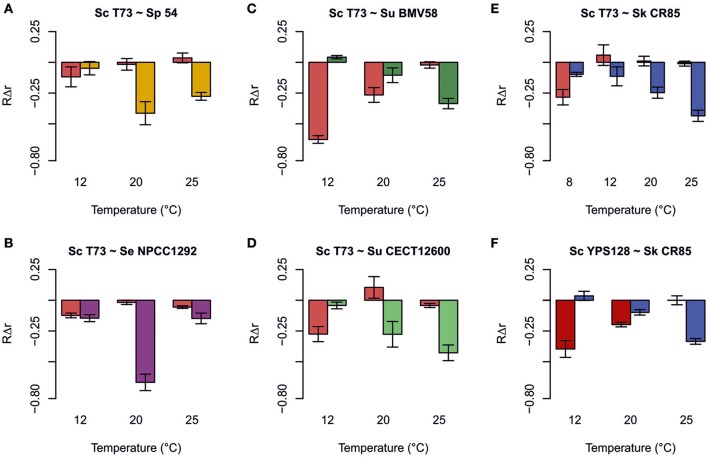
is the main microorganism responsible for the fermentation of wine. Nevertheless, in the last years wineries are facing new challenges due to current market demands and climate change effects on the wine quality. New yeast starters formed by non-conventional species (such as or ) or their hybrids ( x and x ) can contribute to solve some of these challenges. They exhibit good fermentative capabilities at low temperatures, producing wines with lower alcohol and higher glycerol amounts. However, . can competitively displace other yeast species from wine fermentations, therefore the use of these new starters requires an analysis of their behavior during competition with during wine fermentation. In the present study we analyzed the survival capacity of non- strains in competition with during fermentation of synthetic wine must at different temperatures. First, we developed a new method, based on QPCR, to quantify the proportion of different yeasts in mixed cultures. This method was used to assess the effect of competition on the growth fitness. In addition, fermentation kinetics parameters and final wine compositions were also analyzed. We observed that some cryotolerant yeasts, particularly , seriously compromised fitness during competences at lower temperatures, which explains why can replace during wine fermentations in European regions with oceanic and continental climates. From an enological point of view, mixed co-cultures between and or , deteriorated fermentation parameters and the final product composition compared to single inoculation. However, in co-inoculated synthetic must in which or coexisted with , there were fermentation performance improvements and the final wines contained less ethanol and higher amounts of glycerol. Finally, it is interesting to note that in co-inoculated fermentations, wine strains of and performed better than non-wine strains of the same species.
是负责葡萄酒发酵的主要微生物。然而,近年来,由于当前的市场需求以及气候变化对葡萄酒品质的影响,酿酒厂面临着新的挑战。由非常规物种(如或)或其杂交种(x和x)形成的新型酵母发酵剂有助于解决其中一些挑战。它们在低温下表现出良好的发酵能力,能生产出酒精含量较低、甘油含量较高的葡萄酒。然而,。能在葡萄酒发酵中竞争性地取代其他酵母物种,因此使用这些新型发酵剂需要分析它们在葡萄酒发酵过程中与竞争时的行为。在本研究中,我们分析了非菌株在不同温度下与在合成葡萄酒原汁发酵过程中的竞争生存能力。首先,我们基于定量聚合酶链反应(QPCR)开发了一种新方法,用于量化混合培养物中不同酵母的比例。该方法用于评估竞争对生长适应性的影响。此外,还分析了发酵动力学参数和最终葡萄酒成分。我们观察到,一些耐低温酵母,特别是,在较低温度下的竞争能力严重损害了的适应性,这解释了为什么在欧洲海洋性和大陆性气候地区的葡萄酒发酵过程中可以取代。从酿酒学的角度来看,与单一接种相比,和或的混合共培养会使发酵参数和最终产品成分恶化。然而,在或与共存的共接种合成原汁中,发酵性能有所改善,最终葡萄酒中的乙醇含量较低,甘油含量较高。最后,值得注意的是,在共接种发酵中,和的葡萄酒菌株比同物种的非葡萄酒菌株表现更好。