Department of Applied Plasma Engineering, Chonbuk National University, 567 Baekje-daero, Jeonju, Jeollabuk-do, Republic of Korea.
Department of Dental Pharmacology, School of Dentistry and Institute of Oral Bioscience, BK 21 Plus, Chonbuk National University, 567 Baekje-daero, Jeonju, Jeollabuk-do, Republic of Korea.
Sci Rep. 2017 Feb 22;7:43081. doi: 10.1038/srep43081.
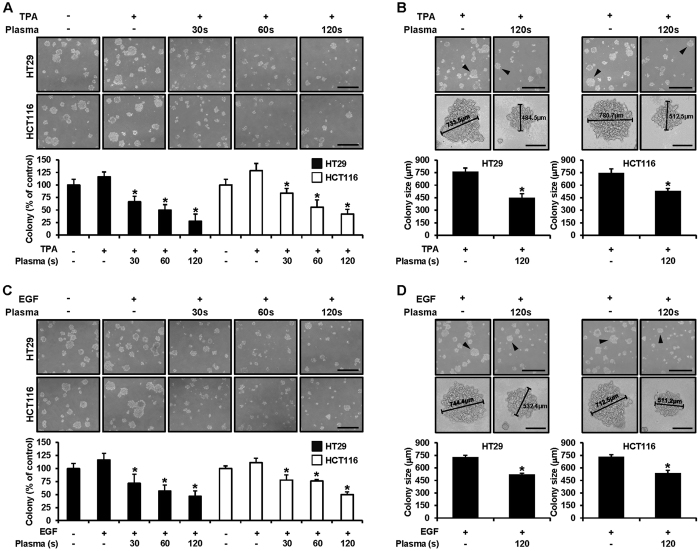
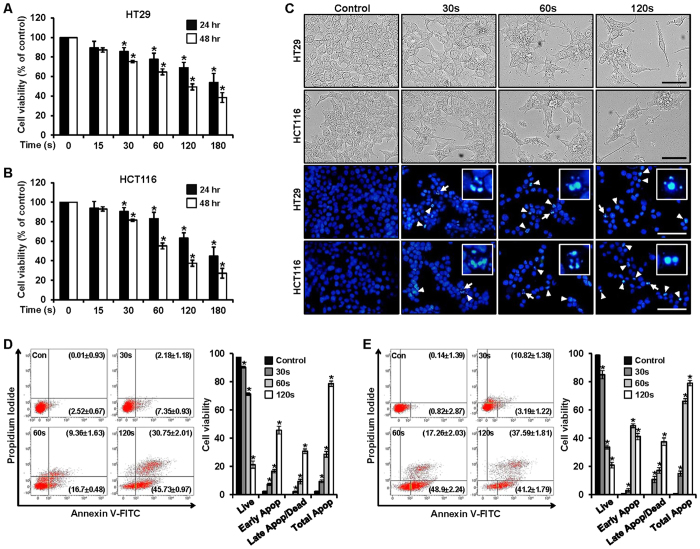
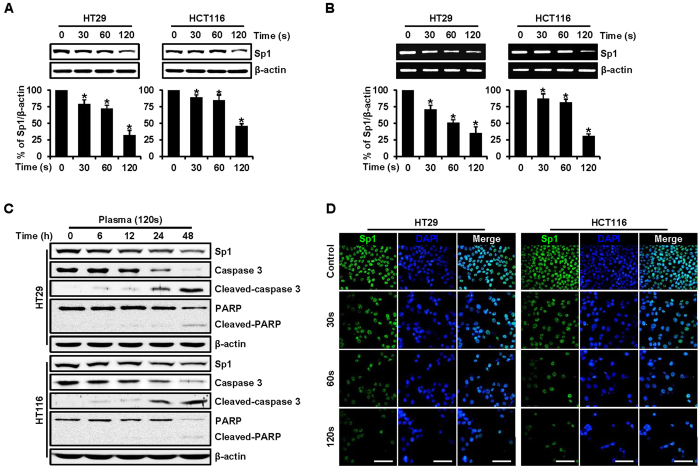
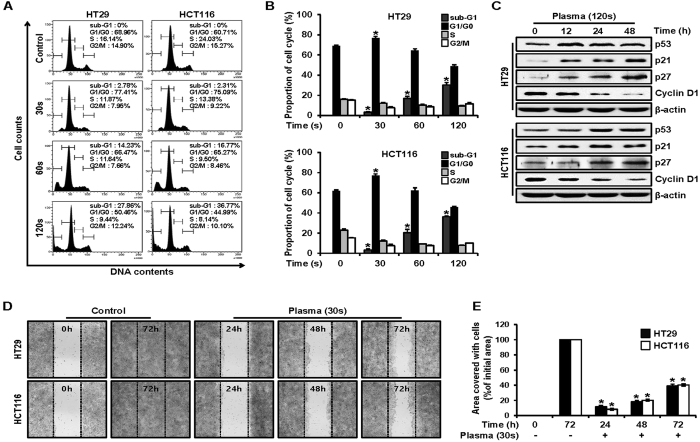
Human colorectal cancer cell lines (HT29 and HCT116) were exposed to dielectric barrier discharge (DBD) plasma at atmospheric pressure to investigate the anticancer capacity of the plasma. The dose- and time-dependent effects of DBDP on cell viability, regulation of transcription factor Sp1, cell-cycle analysis, and colony formation were investigated by means of MTS assay, DAPI staining, propidium iodide staining, annexin V-FITC staining, Western blot analysis, RT-PCR analysis, fluorescence microscopy, and anchorage-independent cell transformation assay. By increasing the duration of plasma dose times, significant reductions in the levels of both Sp1 protein and Sp1 mRNA were observed in both cell lines. Also, expression of negative regulators related to the cell cycle (such as p53, p21, and p27) was increased and of the positive regulator cyclin D1 was decreased, indicating that the plasma treatment led to apoptosis and cell-cycle arrest. In addition, the sizes and quantities of colony formation were significantly suppressed even though two cancer promoters, such as TPA and epidermal growth factor, accompanied the plasma treatment. Thus, plasma treatment inhibited cell viability and colony formation by suppressing Sp1, which induced apoptosis and cell-cycle arrest in these two human colorectal cancer cell lines.
采用常压介质阻挡放电(DBD)等离子体处理人结直肠癌细胞系(HT29 和 HCT116),以研究等离子体的抗癌能力。通过 MTS 测定法、DAPI 染色、碘化丙啶染色、膜联蛋白 V-FITC 染色、Western blot 分析、RT-PCR 分析、荧光显微镜观察和非依赖性细胞转化试验,研究了 DBDP 对细胞活力、转录因子 Sp1 调节、细胞周期分析和集落形成的剂量和时间依赖性影响。随着等离子体剂量时间的延长,两种细胞系中 Sp1 蛋白和 Sp1 mRNA 的水平均显著降低。此外,与细胞周期相关的负调节剂(如 p53、p21 和 p27)的表达增加,而正调节剂细胞周期蛋白 D1 的表达减少,表明血浆处理导致细胞凋亡和细胞周期停滞。此外,即使伴随血浆处理的有两种癌促进剂,如 TPA 和表皮生长因子,集落形成的大小和数量也显著受到抑制。因此,等离子体处理通过抑制 Sp1 抑制了细胞活力和集落形成,从而诱导这两种人结直肠癌细胞系的细胞凋亡和细胞周期停滞。