Chen Wenjuan, Shieh Christine, Swanger Sharon A, Tankovic Anel, Au Margaret, McGuire Marianne, Tagliati Michele, Graham John M, Madan-Khetarpal Suneeta, Traynelis Stephen F, Yuan Hongjie, Pierson Tyler Mark
Department of Pharmacology, Emory University School of Medicine, Atlanta, GA, USA.
Department of Neurology, Xiangya Hospital, Central South University, Changsha, China.
J Hum Genet. 2017 Jun;62(6):589-597. doi: 10.1038/jhg.2017.19. Epub 2017 Feb 23.
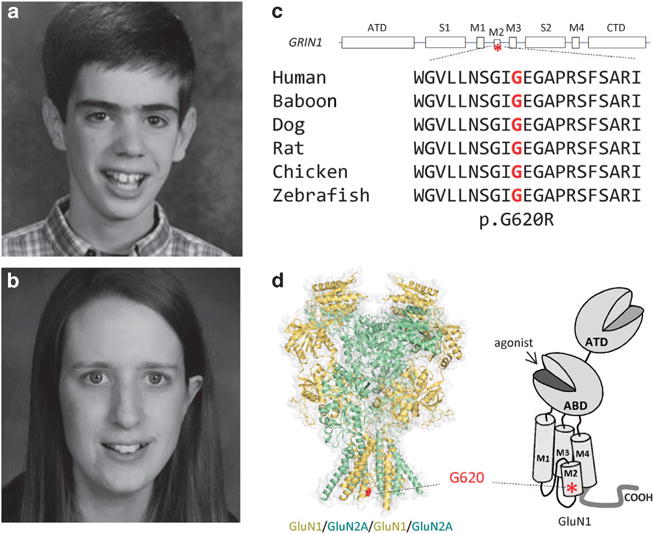
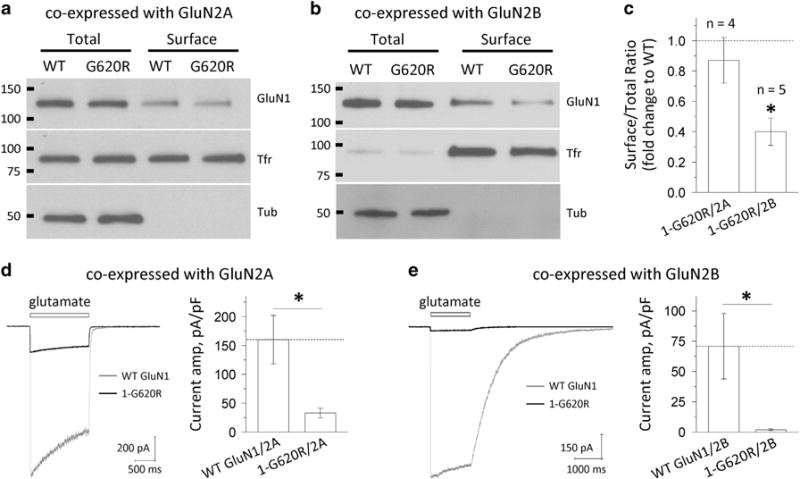
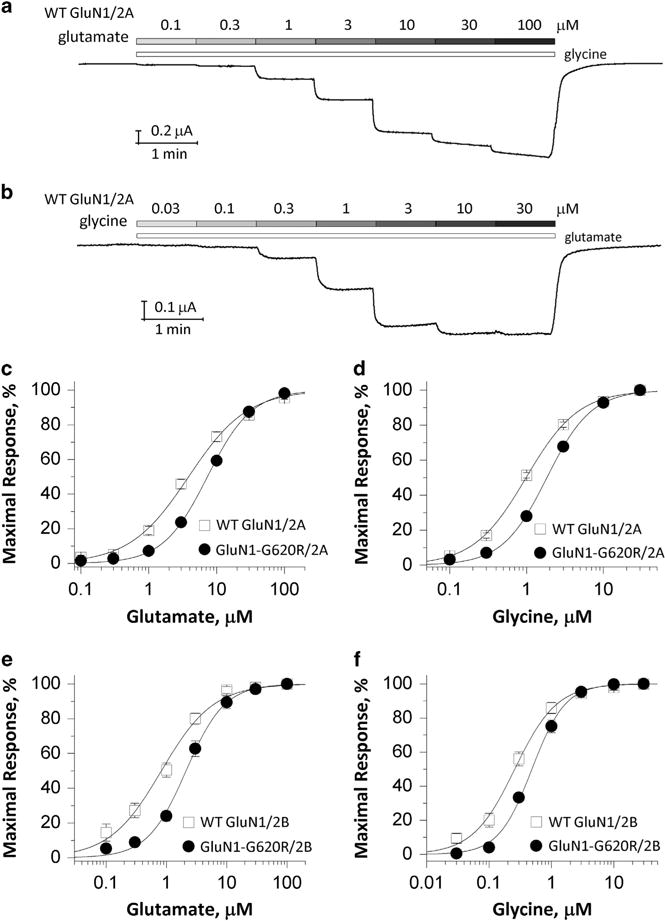
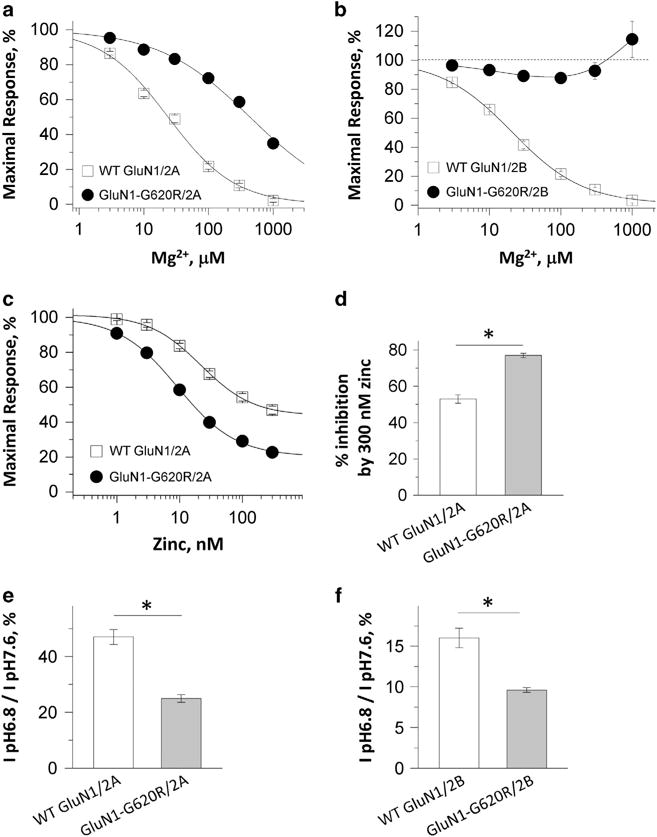
N-methyl-d-aspartate receptors (NMDARs) play important roles in brain development and neurological disease. We report two individuals with similar dominant de novo GRIN1 mutations (c.1858 G>A and c.1858 G>C; both p.G620R). Both individuals presented at birth with developmental delay and hypotonia associated with behavioral abnormalities and stereotypical movements. Recombinant NMDARs containing the mutant GluN1-G620R together with either GluN2A or GluN2B were evaluated for changes in their trafficking to the plasma membrane and their electrophysiological properties. GluN1-G620R/GluN2A complexes showed a mild reduction in trafficking, a ~2-fold decrease in glutamate and glycine potency, a strong decrease in sensitivity to Mg block, and a significant reduction of current responses to a maximal effective concentration of agonists. GluN1-G620R/GluN2B complexes showed significantly reduced delivery of protein to the cell surface associated with similarly altered electrophysiology. These results indicate these individuals may have suffered neurodevelopmental deficits as a result of the decreased presence of GluN1-G620R/GluN2B complexes on the neuronal surface during embryonic brain development and reduced current responses of GluN1-G620R-containing NMDARs after birth. These cases emphasize the importance of comprehensive functional characterization of de novo mutations and illustrates how a combination of several distinct features of NMDAR expression, trafficking and function can be present and influence phenotype.
N-甲基-D-天冬氨酸受体(NMDARs)在大脑发育和神经疾病中发挥着重要作用。我们报告了两名具有相似显性新生GRIN1突变(c.1858 G>A和c.1858 G>C;均为p.G620R)的个体。两名个体出生时均表现出发育迟缓、肌张力减退,并伴有行为异常和刻板动作。对含有突变型GluN1-G620R以及GluN2A或GluN2B的重组NMDARs进行了评估,以观察其向质膜转运的变化及其电生理特性。GluN1-G620R/GluN2A复合物在转运方面有轻度减少,谷氨酸和甘氨酸效力降低约2倍,对镁阻断的敏感性大幅降低,对最大有效浓度激动剂的电流反应显著减少。GluN1-G620R/GluN2B复合物显示蛋白质向细胞表面的递送显著减少,同时电生理也有类似改变。这些结果表明,这些个体可能因胚胎脑发育期间神经元表面GluN1-G620R/GluN2B复合物的减少以及出生后含GluN1-G620R的NMDARs电流反应降低而出现神经发育缺陷。这些病例强调了对新生突变进行全面功能表征的重要性,并说明了NMDAR表达、转运和功能的几个不同特征如何共同存在并影响表型。