Glorie Dorien, Servaes Stijn, Verhaeghe Jeroen, Wyckhuys Tine, Wyffels Leonie, Vanderveken Olivier, Stroobants Sigrid, Staelens Steven
Faculty of Medicine and Health Sciences, Molecular Imaging Center Antwerp, University of Antwerp Antwerp, Belgium.
Faculty of Medicine and Health Sciences, Molecular Imaging Center Antwerp, University of AntwerpAntwerp, Belgium; Nuclear Medicine Department, Antwerp University HospitalAntwerp, Belgium.
Front Neurosci. 2017 Feb 10;11:47. doi: 10.3389/fnins.2017.00047. eCollection 2017.
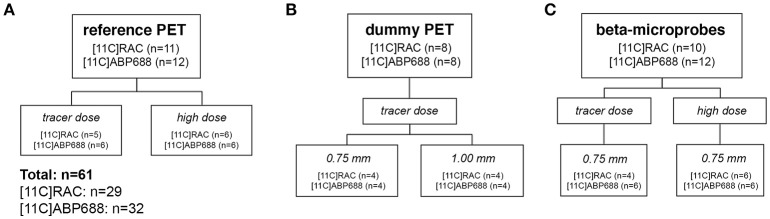
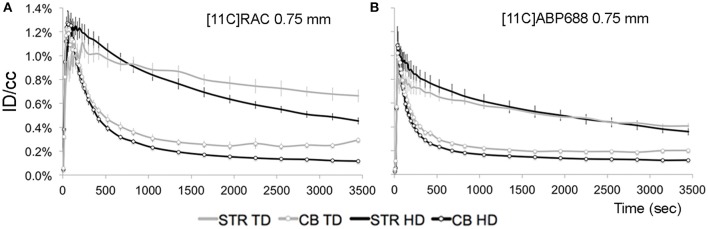
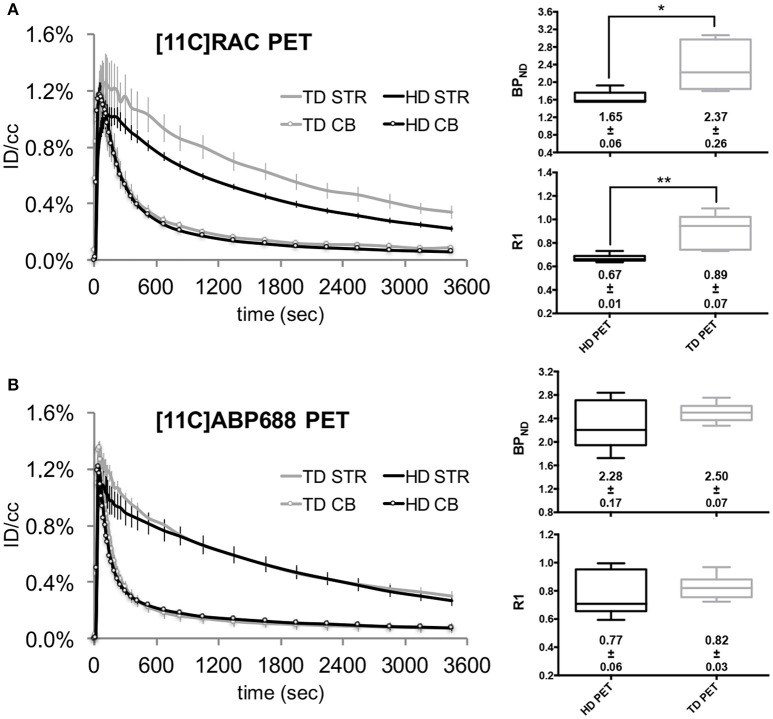
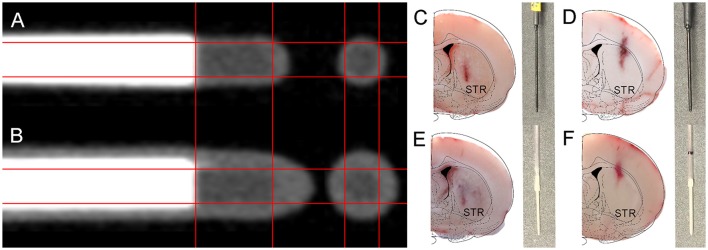
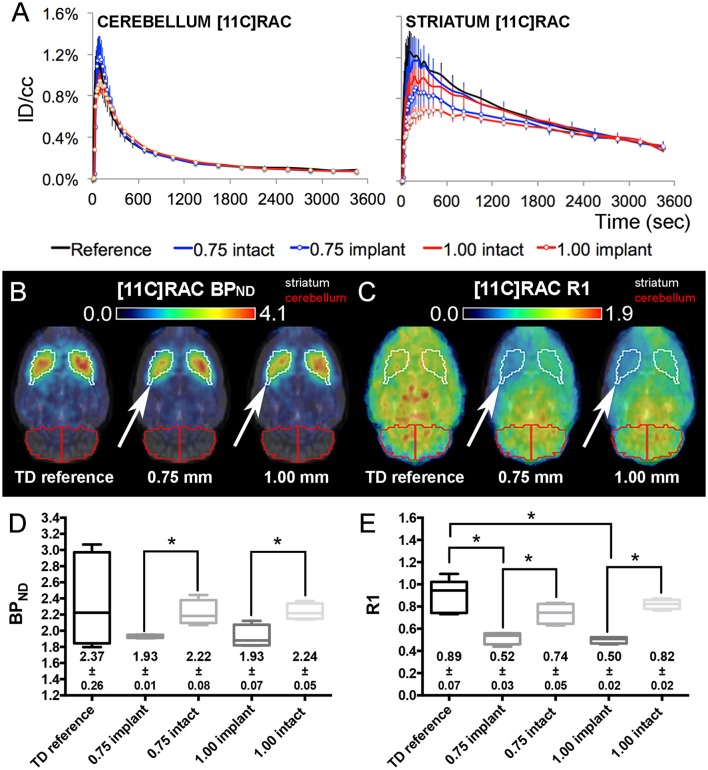
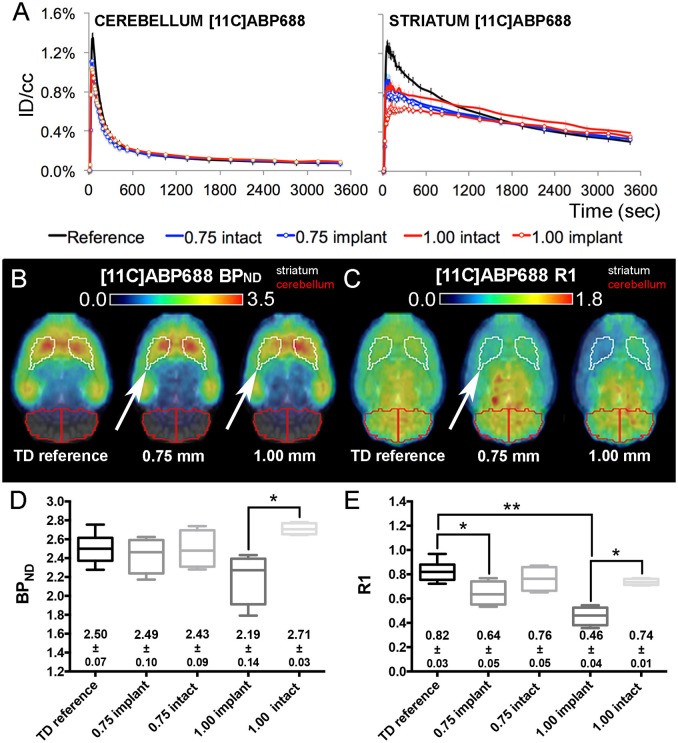
Both non-invasive micro-positron emission tomography (μPET) and beta-microprobes have the ability to determine radiotracer kinetics and neuroreceptor availability . Beta-microprobes were proposed as a cost-effective alternative to μPET, but literature revealed conflicting results most likely due to methodological differences and inflicted tissue damage. The current study has three main objectives: (i) evaluate the theoretical advantages of beta-microprobes; (ii) perform μPET imaging to assess the impact of (beta-micro)probe implantation on relative tracer delivery (R1) and receptor occupancy (non-displaceable binding potential, BP) in the rat brain; and (iii) investigate whether beta-microprobe recordings produce robust results when a pharmacological restriction for cold mass dose (tracer dose condition) is imposed. We performed acquisitions ( = 61) in naive animals, dummy probe implanted animals (outer diameter: 0.75 and 1.00 mm) and beta-microprobe implanted animals (outer diameter: 0.75 mm) using two different radiotracers with high affinity for the striatum: [C]raclopride ( = 29) and [C]ABP688 ( = 32). In addition, acquisitions were completed with or without an imposed restriction for cold mass occupancy. We estimated BP and R1 values using the simplified reference tissue method (SRTM). [C]raclopride dummy μPET BP (0.75 mm: -13.01 ± 0.94%; 1.00 mm: -13.89 ± 1.20%) and R1 values (0.75 mm: -29.67 ± 4.94%; 1.00 mm: -39.07 ± 3.17%) significantly decreased at the implant side vs. the contralateral intact side. A similar comparison for [C]ABP688 dummy μPET, demonstrated significantly ( < 0.05) decreased BP (-19.09 ± 2.45%) and R1 values (-38.12 ± 6.58%) in the striatum with a 1.00 mm implant, but not with a 0.75 mm implant. Particularly in tracer dose conditions, despite lower impact of partial volume effects, beta-microprobes proved unfit to produce representative results due to tissue destruction associated with probe insertion. We advise to use tracer dose μPET to obtain accurate results concerning receptor availability and tracer delivery, keeping in mind associated partial volume effects for which it is possible to correct.
非侵入性微型正电子发射断层扫描(μPET)和β微探针都能够测定放射性示踪剂动力学和神经受体可用性。β微探针被认为是一种经济高效的μPET替代方法,但文献显示结果相互矛盾,这很可能是由于方法学差异和造成的组织损伤。本研究有三个主要目标:(i)评估β微探针的理论优势;(ii)进行μPET成像,以评估(β微)探针植入对大鼠脑内相对示踪剂递送(R1)和受体占有率(不可置换结合潜能,BP)的影响;(iii)研究当对冷质量剂量(示踪剂剂量条件)施加药理学限制时,β微探针记录是否能产生可靠结果。我们使用两种对纹状体具有高亲和力的不同放射性示踪剂,对未处理动物、植入假探针的动物(外径:0.75和1.00毫米)和植入β微探针的动物(外径:0.75毫米)进行了采集(n = 61):[¹¹C]雷氯必利(n = 29)和[¹¹C]ABP688(n = 32)。此外,采集在有或没有对冷质量占有率施加限制的情况下完成。我们使用简化参考组织法(SRTM)估计BP和R1值。[¹¹C]雷氯必利假μPET的BP值(0.75毫米:-13.01 ± 0.94%;1.00毫米:-13.89 ± 1.20%)和R1值(0.75毫米:-29.67 ± 4.94%;1.00毫米:-39.07 ± 3.17%)在植入侧与对侧完整侧相比显著降低。[¹¹C]ABP688假μPET的类似比较表明,植入1.00毫米探针时纹状体内的BP值(-19.09 ± 2.45%)和R1值(-38.12 ± 6.58%)显著(p < 0.05)降低,但植入0.75毫米探针时未降低。特别是在示踪剂剂量条件下,尽管部分容积效应的影响较小,但由于与探针插入相关的组织破坏,β微探针被证明无法产生具有代表性的结果。我们建议使用示踪剂剂量的μPET来获得关于受体可用性和示踪剂递送的准确结果,同时要记住可能需要校正的相关部分容积效应。