Laffont Sophie, Seillet Cyril, Guéry Jean-Charles
Centre de Physiopathologie de Toulouse Purpan (CPTP), Université de Toulouse, INSERM, CNRS, UPS , Toulouse , France.
Division of Molecular Immunology, The Walter and Eliza Hall Institute of Medical Research, Melbourne, VIC, Australia; Department of Medical Biology, University of Melbourne, Melbourne, VIC, Australia.
Front Immunol. 2017 Feb 10;8:108. doi: 10.3389/fimmu.2017.00108. eCollection 2017.
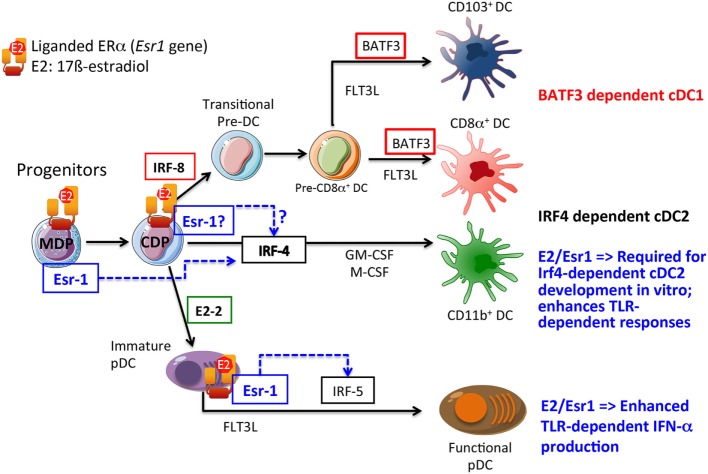
Autoimmunity, infectious diseases and cancer affect women and men differently. Because they tend to develop more vigorous adaptive immune responses than men, women are less susceptible to some infectious diseases but also at higher risk of autoimmunity. The regulation of immune responses by sex-dependent factors probably involves several non-redundant mechanisms. A privileged area of study, however, concerns the role of sex steroid hormones in the biology of innate immune cells, especially dendritic cells (DCs). In recent years, our understanding of the lineage origin of DC populations has expanded, and the lineage-committing transcription factors shaping peripheral DC subsets have been identified. Both progenitor cells and mature DC subsets express estrogen receptors (ERs), which are ligand-dependent transcription factors. This suggests that estrogens may contribute to the reported sex differences in immunity by regulating DC biology. Here, we review the recent literature and highlight evidence that estrogen-dependent activation of ERα regulates the development or the functional responses of particular DC subsets. The model of GM-CSF-induced DC differentiation shows that CD11c CD11b Ly6c cells depend on ERα activation by estrogen for their development, and for the acquisition of competence to activate naive CD4 T lymphocytes and mount a robust pro-inflammatory cytokine response to CD40 stimulation. In this model, estrogen signaling in conjunction with GM-CSF is necessary to promote early interferon regulatory factor () expression in macrophage-DC progenitors and their subsequent differentiation into IRF-4 CD11c CD11b Ly6c cells, closely related to the cDC2 subset. The Flt3L-induced model of DC differentiation in turn shows that ERα signaling promotes the development of conventional DC (cDC) and plasmacytoid DC (pDC) with higher capability of pro-inflammatory cytokine production in response to TLR stimulation. Likewise, cell-intrinsic ER signaling positively regulates the TLR-driven production of type I interferons (IFNs) in mouse pDCs . This effect of estrogens likely contributes to the greater proficiency of women's pDCs than men's as regards the production of type I IFNs elicited by TLR7 ligands. In summary, evidence is emerging in support of the notion that estrogen signaling regulates important aspects of cDC and pDC development and/or effector functions, in both mice and humans.
自身免疫性疾病、传染病和癌症对女性和男性的影响有所不同。由于女性往往比男性产生更强烈的适应性免疫反应,她们对某些传染病的易感性较低,但自身免疫的风险也更高。性别依赖性因素对免疫反应的调节可能涉及多种非冗余机制。然而,一个备受关注的研究领域是性类固醇激素在先天免疫细胞生物学中的作用,尤其是树突状细胞(DCs)。近年来,我们对DC群体谱系起源的理解有所扩展,并且已经确定了塑造外周DC亚群的谱系定向转录因子。祖细胞和成熟DC亚群均表达雌激素受体(ERs),它们是配体依赖性转录因子。这表明雌激素可能通过调节DC生物学特性来导致所报道的免疫性别差异。在这里,我们回顾了最近的文献,并强调了证据表明ERα的雌激素依赖性激活调节特定DC亚群的发育或功能反应。GM-CSF诱导的DC分化模型表明,CD11c⁺CD11b⁺Ly6c⁺细胞的发育以及获得激活初始CD4⁺T淋巴细胞的能力和对CD40刺激产生强烈促炎细胞因子反应的能力依赖于雌激素对ERα的激活。在这个模型中,雌激素信号与GM-CSF共同作用对于促进巨噬细胞-DC祖细胞中早期干扰素调节因子(IRF)的表达以及随后将其分化为IRF-4⁺CD11c⁺CD11b⁺Ly6c⁺细胞(与cDC2亚群密切相关)是必要的。Flt3L诱导的DC分化模型则表明,ERα信号促进了传统DC(cDC)和浆细胞样DC(pDC)的发育,这些细胞在对TLR刺激的反应中具有更高的促炎细胞因子产生能力。同样,细胞内源性ER信号正向调节小鼠pDC中TLR驱动的I型干扰素(IFN)产生。雌激素的这种作用可能导致女性pDC在由TLR7配体引发的I型IFN产生方面比男性更高效。总之,越来越多的证据支持雌激素信号调节小鼠和人类中cDC和pDC发育及/或效应功能的重要方面这一观点。