• 文献检索
  • 文档翻译
  • 深度研究
  • 学术资讯
  • Suppr Zotero 插件Zotero 插件
  • 邀请有礼
  • 套餐&价格
  • 历史记录
应用&插件
Suppr Zotero 插件Zotero 插件浏览器插件Mac 客户端Windows 客户端微信小程序
定价
高级版会员购买积分包购买API积分包
服务
文献检索文档翻译深度研究API 文档MCP 服务
关于我们
关于 Suppr公司介绍联系我们用户协议隐私条款
关注我们

Suppr 超能文献

核心技术专利:CN118964589B侵权必究
粤ICP备2023148730 号-1Suppr @ 2026

文献检索

告别复杂PubMed语法,用中文像聊天一样搜索,搜遍4000万医学文献。AI智能推荐,让科研检索更轻松。

立即免费搜索

文件翻译

保留排版,准确专业,支持PDF/Word/PPT等文件格式,支持 12+语言互译。

免费翻译文档

深度研究

AI帮你快速写综述,25分钟生成高质量综述,智能提取关键信息,辅助科研写作。

立即免费体验

类风湿关节炎生物制剂治疗持续时间的决定因素:来自匈牙利一家风湿病中心8年回顾性数据的证据

Determinants of biological drug survival in rheumatoid arthritis: evidence from a Hungarian rheumatology center over 8 years of retrospective data.

作者信息

Brodszky Valentin, Bíró Anikó, Szekanecz Zoltán, Soós Boglárka, Baji Petra, Rencz Fanni, Tóthfalusi László, Gulácsi László, Péntek Márta

机构信息

Department of Health Economics, Corvinus University of Budapest, Budapest, Hungary.

Department of Health Economics, Corvinus University of Budapest, Budapest, Hungary; School of Economics, The University of Edinburgh, Edinburgh, UK.

出版信息

Clinicoecon Outcomes Res. 2017 Feb 15;9:139-147. doi: 10.2147/CEOR.S124381. eCollection 2017.

DOI:10.2147/CEOR.S124381
PMID:28243133
原文链接:https://pmc.ncbi.nlm.nih.gov/articles/PMC5317255/
Abstract

OBJECTIVE

To compare drug survival of biological therapies in patients with rheumatoid arthritis (RA), and analyze the determinants of discontinuation probabilities and switches to other biological therapies.

MATERIALS AND METHODS

Consecutive RA patients initiating first biological treatment in one rheumatology center between 2006 and 2013 were included. Log-rank test was used to analyze the differences between the survival curves of different biological drugs. Cox regression was applied to analyze the discontinuation due to inefficacy, the occurrence of adverse events, or to any reasons.

RESULTS

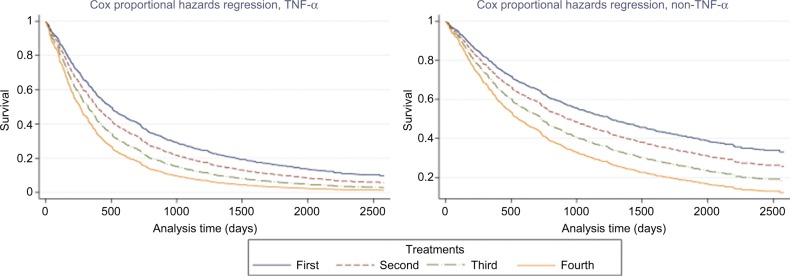
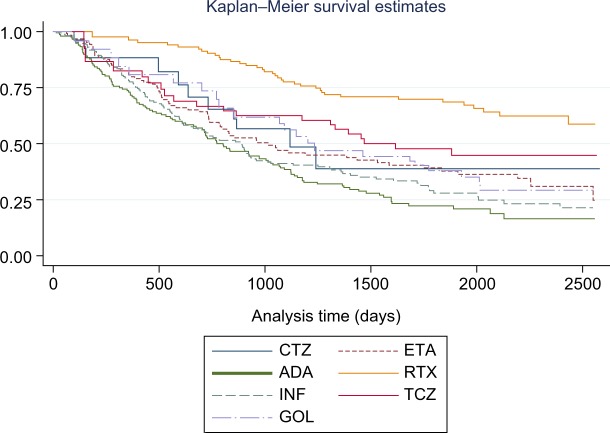
A total of 540 patients were included in the analysis. The most frequently used first-line biological treatments were infliximab (N=176, 33%), adalimumab (N=150, 28%), and etanercept (N=132, 24%). Discontinuation of first tumor necrosis factor-alpha (TNF-α) treatment was observed for 347 (64%) patients, due to inefficacy (n=209, 60%), adverse events (n=103, 30%), and other reasons (n=35, 10%). Drug survival rates for TNF-α and non-TNF-α therapies were significantly different, and were in favor of non-TNF-α therapies. Every additional number of treatment significantly increased the risk of inefficacy by 27% (<0.001) and of adverse events by 35% (=0.002). After the discontinuation of the initial TNF-α treatment, switching to rituximab and tocilizumab was associated with significantly longer treatment duration than switching to a second TNF-α. The non-TNF-α therapies resulted in significantly longer treatment duration, due to both less adverse events and longer maintenance of effectiveness.

CONCLUSION

Non-TNF-α therapies resulted in significantly longer treatment duration, and lost their effectiveness later. Increase in the number of switches significantly increased the risk of discontinuation of any biological therapy.

摘要

目的

比较类风湿关节炎(RA)患者生物治疗的药物留存率,并分析停药概率的决定因素以及转用其他生物治疗的情况。

材料与方法

纳入2006年至2013年间在一个风湿病中心开始首次生物治疗的连续RA患者。采用对数秩检验分析不同生物药物生存曲线之间的差异。应用Cox回归分析因疗效不佳、不良事件或任何原因导致的停药情况。

结果

共540例患者纳入分析。最常用的一线生物治疗药物为英夫利昔单抗(N = 176,33%)、阿达木单抗(N = 150,28%)和依那西普(N = 132,24%)。347例(64%)患者首次肿瘤坏死因子-α(TNF-α)治疗停药,原因包括疗效不佳(n = 209,60%)、不良事件(n = 103,30%)和其他原因(n = 35,10%)。TNF-α和非TNF-α治疗的药物留存率有显著差异,非TNF-α治疗更具优势。每增加一次治疗,疗效不佳的风险显著增加27%(<0.001),不良事件风险增加35%(=0.002)。初始TNF-α治疗停药后,转用利妥昔单抗和托珠单抗的治疗持续时间显著长于转用第二种TNF-α。非TNF-α治疗导致治疗持续时间显著更长,原因是不良事件较少且疗效维持时间更长。

结论

非TNF-α治疗导致治疗持续时间显著更长,且疗效丧失更晚。换药次数增加显著增加了任何生物治疗停药的风险。
https://cdn.ncbi.nlm.nih.gov/pmc/blobs/cceb/5317255/f7d4a14ad35d/ceor-9-139Fig2.jpg
https://cdn.ncbi.nlm.nih.gov/pmc/blobs/cceb/5317255/1b7fb71a83e1/ceor-9-139Fig1.jpg
https://cdn.ncbi.nlm.nih.gov/pmc/blobs/cceb/5317255/f7d4a14ad35d/ceor-9-139Fig2.jpg
https://cdn.ncbi.nlm.nih.gov/pmc/blobs/cceb/5317255/1b7fb71a83e1/ceor-9-139Fig1.jpg
https://cdn.ncbi.nlm.nih.gov/pmc/blobs/cceb/5317255/f7d4a14ad35d/ceor-9-139Fig2.jpg

相似文献

1
Determinants of biological drug survival in rheumatoid arthritis: evidence from a Hungarian rheumatology center over 8 years of retrospective data.类风湿关节炎生物制剂治疗持续时间的决定因素:来自匈牙利一家风湿病中心8年回顾性数据的证据
Clinicoecon Outcomes Res. 2017 Feb 15;9:139-147. doi: 10.2147/CEOR.S124381. eCollection 2017.
2
Outcomes after switching from one anti-tumor necrosis factor alpha agent to a second anti-tumor necrosis factor alpha agent in patients with rheumatoid arthritis: results from a large UK national cohort study.类风湿关节炎患者从一种抗肿瘤坏死因子α药物转换为另一种抗肿瘤坏死因子α药物后的结局:一项大型英国全国队列研究的结果
Arthritis Rheum. 2007 Jan;56(1):13-20. doi: 10.1002/art.22331.
3
Persistence with anti-tumor necrosis factor therapies in patients with rheumatoid arthritis: observations from the RADIUS registry.类风湿关节炎患者使用抗肿瘤坏死因子治疗的持续性:来自 RADIUS 注册研究的观察结果。
J Rheumatol. 2011 Jul;38(7):1273-81. doi: 10.3899/jrheum.101142. Epub 2011 May 15.
4
Real-world Effectiveness of Biologic Disease-modifying Antirheumatic Drugs for the Treatment of Rheumatoid Arthritis After Etanercept Discontinuation in the United Kingdom, France, and Germany.英国、法国和德国生物性改善病情抗风湿药在停用依那西普后治疗类风湿关节炎的真实世界疗效
Clin Ther. 2017 Aug;39(8):1618-1627. doi: 10.1016/j.clinthera.2017.06.009. Epub 2017 Jul 17.
5
Drug retention rates and relevant risk factors for drug discontinuation due to adverse events in rheumatoid arthritis patients receiving anticytokine therapy with different target molecules.接受不同靶向分子的细胞因子拮抗剂治疗的类风湿关节炎患者因不良反应停药的药物保留率和相关风险因素。
Ann Rheum Dis. 2012 Nov;71(11):1820-6. doi: 10.1136/annrheumdis-2011-200838. Epub 2012 Apr 13.
6
Down-titration and discontinuation strategies of tumor necrosis factor-blocking agents for rheumatoid arthritis in patients with low disease activity.低疾病活动度类风湿关节炎患者肿瘤坏死因子阻断剂的减量和停药策略
Cochrane Database Syst Rev. 2014 Sep 29(9):CD010455. doi: 10.1002/14651858.CD010455.pub2.
7
Drug survival of the first and second course of anti-tumour necrosis factor agents in juvenile idiopathic arthritis.青少年特发性关节炎中抗肿瘤坏死因子药物第一疗程和第二疗程的药物留存率
Ann Rheum Dis. 2009 Apr;68(4):552-7. doi: 10.1136/ard.2007.087130. Epub 2008 May 8.
8
Real-life 10-year retention rate of first-line anti-TNF drugs for inflammatory arthritides in adult- and juvenile-onset populations: similarities and differences.一线抗TNF药物在成人和青少年发病的炎症性关节炎患者中的真实世界10年保留率:异同点
Clin Rheumatol. 2017 Aug;36(8):1747-1755. doi: 10.1007/s10067-017-3712-8. Epub 2017 Jun 8.
9
Twelve-Year Retention Rate of First-Line Tumor Necrosis Factor Inhibitors in Rheumatoid Arthritis: Real-Life Data From a Local Registry.类风湿关节炎一线肿瘤坏死因子抑制剂的12年保留率:来自本地登记处的真实数据
Arthritis Care Res (Hoboken). 2016 Apr;68(4):432-9. doi: 10.1002/acr.22788.
10
A systematic review of the effectiveness of adalimumab, etanercept and infliximab for the treatment of rheumatoid arthritis in adults and an economic evaluation of their cost-effectiveness.阿达木单抗、依那西普和英夫利昔单抗治疗成人类风湿关节炎有效性的系统评价及其成本效益的经济学评估。
Health Technol Assess. 2006 Nov;10(42):iii-iv, xi-xiii, 1-229. doi: 10.3310/hta10420.

引用本文的文献

1
Predictors of Drug Retention and Survival Rate of bDMARDs in Rheumatoid Arthritis: A Four-Year Real-Life Tunisian Experience.类风湿关节炎中生物改善病情抗风湿药物的药物留存率和生存率的预测因素:突尼斯四年真实生活经验
Mediterr J Rheumatol. 2024 Jan 31;35(3):448-458. doi: 10.31138/mjr.090723.pof. eCollection 2024 Sep.
2
A systematic literature review informing the consensus statement on efficacy and safety of pharmacological treatment with interleukin-6 pathway inhibition with biological DMARDs in immune-mediated inflammatory diseases.一项系统文献综述,为免疫介导的炎症性疾病中生物 DMARD 类白细胞介素-6 通路抑制药物的疗效和安全性共识声明提供信息。
RMD Open. 2022 Sep;8(2). doi: 10.1136/rmdopen-2022-002359.
3

本文引用的文献

1
The Disease Activity Score (DAS) and the Disease Activity Score using 28 joint counts (DAS28) in the management of rheumatoid arthritis.疾病活动评分(DAS)和使用28个关节计数的疾病活动评分(DAS28)在类风湿关节炎管理中的应用
Clin Exp Rheumatol. 2016 Sep-Oct;34(5 Suppl 101):S40-S44. Epub 2016 Oct 18.
2
Rheumatoid arthritis.类风湿关节炎
Lancet. 2016 Oct 22;388(10055):2023-2038. doi: 10.1016/S0140-6736(16)30173-8. Epub 2016 May 3.
3
Long-term drug survival of biological agents in patients with rheumatoid arthritis in clinical practice.
Biosimilars: To switch or not to switch - that is the question.
生物类似药:换用还是不换用——这是个问题。
Reumatologia. 2020;58(1):1-3. doi: 10.5114/reum.2020.93111. Epub 2020 Feb 28.
生物制剂在类风湿关节炎患者临床实践中的长期药物留存率
Scand J Rheumatol. 2016 Nov;45(6):456-460. doi: 10.3109/03009742.2016.1141979. Epub 2016 Apr 26.
4
Patients' access to biological therapy in chronic inflammatory conditions; per capita GDP does not explain the intercountry differences.慢性炎症性疾病患者获得生物疗法的情况;人均国内生产总值无法解释国家间的差异。
Ann Rheum Dis. 2016 May;75(5):942-3. doi: 10.1136/annrheumdis-2015-208741. Epub 2016 Feb 17.
5
A structured literature review of the burden of illness and unmet needs in patients with rheumatoid arthritis: a current perspective.类风湿关节炎患者疾病负担与未满足需求的结构化文献综述:当前视角
Rheumatol Int. 2016 May;36(5):685-95. doi: 10.1007/s00296-015-3415-x. Epub 2016 Jan 8.
6
Rate of discontinuation and drug survival of biologic therapies in rheumatoid arthritis: a systematic review and meta-analysis of drug registries and health care databases.类风湿关节炎生物治疗的停药率和药物生存:药物注册和医疗保健数据库的系统评价和荟萃分析。
Rheumatology (Oxford). 2016 Mar;55(3):523-34. doi: 10.1093/rheumatology/kev374. Epub 2015 Oct 21.
7
Use of biologics for psoriasis in Central and Eastern European countries.中东欧国家使用生物制剂治疗银屑病。
J Eur Acad Dermatol Venereol. 2015 Nov;29(11):2222-30. doi: 10.1111/jdv.13222. Epub 2015 Sep 14.
8
The Budget Impact of Biosimilar Infliximab (Remsima®) for the Treatment of Autoimmune Diseases in Five European Countries.生物类似药英夫利昔单抗(Remsima®)治疗欧洲五国自身免疫性疾病的预算影响
Adv Ther. 2015 Aug;32(8):742-56. doi: 10.1007/s12325-015-0233-1. Epub 2015 Sep 5.
9
Treating rheumatoid arthritis to target: 2014 update of the recommendations of an international task force.类风湿关节炎达标治疗:国际特别工作组2014年推荐意见更新
Ann Rheum Dis. 2016 Jan;75(1):3-15. doi: 10.1136/annrheumdis-2015-207524. Epub 2015 May 12.
10
Switching from an anti-TNF monoclonal antibody to soluble TNF-receptor yields better results than vice versa: An observational retrospective study of 72 rheumatoid arthritis switchers.从抗TNF单克隆抗体转换为可溶性TNF受体比反之转换产生更好的结果:一项对72例类风湿关节炎转换者的观察性回顾性研究。
Joint Bone Spine. 2015 Oct;82(5):330-7. doi: 10.1016/j.jbspin.2015.01.021. Epub 2015 Apr 10.