Gracia-Tello Borja, Ezeonyeji Amara, Isenberg David
Department of Internal Medicine , Lozano Blesa University Hospital , Zaragoza , Spain.
Centre for Rheumatology, University College London Hospitals , London , UK.
Lupus Sci Med. 2017 Feb 2;4(1):e000182. doi: 10.1136/lupus-2016-000182. eCollection 2017.
Previous reports indicate that treating patients with lupus (SLE) at or close to the time of diagnosis successfully without using any, or minimal, corticosteroids by using B-cell depletion (BCD) is possible in the short-term. It is not however known whether using BCD is as effective or reduces corticosteroid use in the long-term. We report the long-term (up to 7 years) use of BCD with respect to its steroid-saving capacity and clinical effectiveness in newly diagnosed SLE.
Sixteen female patients with SLE were treated at, or shortly after diagnosis, with BCD therapy (BCDT) minimising the routine use of oral steroids. Post-treatment, most patients were given hydroxychloroquine (n=14) and azathioprine (n=10). The British Isles Lupus Assessment Group (BILAG) disease activity index was used for clinical assessment. Serum antidouble-stranded DNA (dsDNA) antibodies, complement (C3), erythrocyte sedimentation rate (ESR), circulating B lymphocytes (CD19) and total inmmunoglobulins were tested every 2-6 months (average of 4.5 years) (SD 2) post-treatment. Disease activity and steroid requirement were compared with three patients with SLE treated conventionally, each matched for ethnicity, sex, age, clinical features, disease duration at diagnosis and follow-up period.
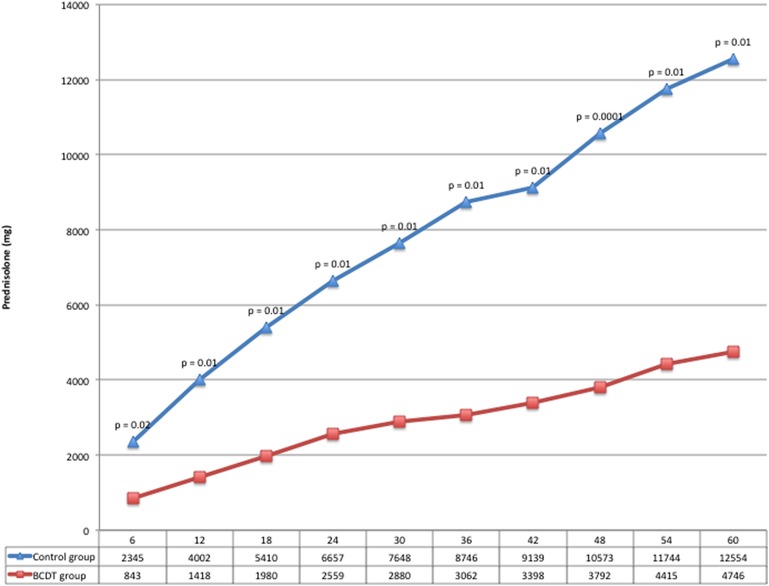
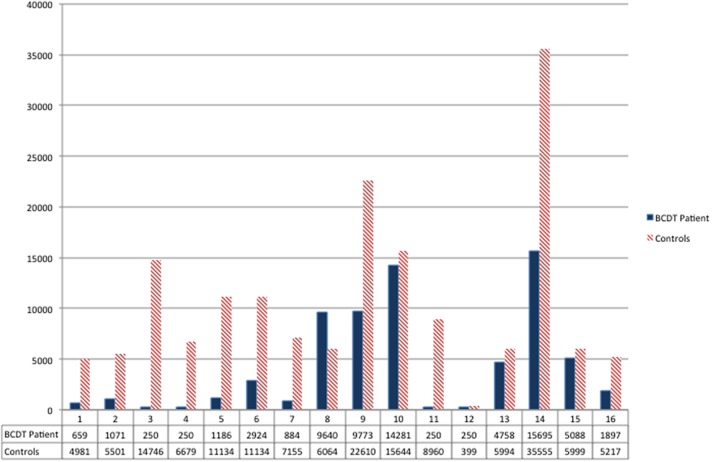
All patients given rituximab achieved BCD. The mean number of flares during follow-up (new BILAG A or B) was 2.63 (SD 3) in the BCDT group and 4 (SD 3.6) in the controls (NS, p=0.14). Post-BCDT, mean anti-dsDNA antibody level fell from 1114 U/mL (SD 1699.3) to 194 (SD 346.7) at 18 months (p=0.043), mean serum ESR fell by >70% at 6 months maintained during follow-up and serum C3 level normalised in 8 patients. The mean cumulative prednisolone dose at 60 months for the patients who underwent BCDT (n=11) was 4745.67 mg (SD 6090 mg) vs 12 553.92 mg (SD 12 672 mg) for the controls (p=0.01).
Early treatment of patients with SLE with BCDT is safe, effective and enables a reduction in steroid use.
既往报道表明,在诊断时或接近诊断时,通过使用B细胞清除(BCD)疗法,在不使用任何或仅使用极少皮质类固醇的情况下成功治疗狼疮(SLE)患者在短期内是可行的。然而,目前尚不清楚长期使用BCD是否同样有效或能否减少皮质类固醇的使用。我们报告了在新诊断的SLE患者中,长期(长达7年)使用BCD疗法在节省类固醇方面的能力及其临床疗效。
16例女性SLE患者在诊断时或诊断后不久接受BCD疗法(BCDT),尽量减少口服类固醇的常规使用。治疗后,大多数患者给予羟氯喹(n = 14)和硫唑嘌呤(n = 10)。采用不列颠群岛狼疮评估组(BILAG)疾病活动指数进行临床评估。治疗后每2 - 6个月(平均4.5年,标准差2年)检测血清抗双链DNA(dsDNA)抗体、补体(C3)、红细胞沉降率(ESR)、循环B淋巴细胞(CD19)和总免疫球蛋白。将疾病活动度和类固醇需求与3例接受传统治疗的SLE患者进行比较,这3例患者在种族、性别、年龄、临床特征、诊断时疾病持续时间和随访时间方面相匹配。
所有接受利妥昔单抗治疗的患者均实现了B细胞清除。在随访期间,BCDT组的平均发作次数(新的BILAG A或B级)为2.63(标准差3),对照组为4(标准差3.6)(无显著性差异,p = 0.14)。BCDT治疗后,18个月时平均抗dsDNA抗体水平从1114 U/mL(标准差1699.3)降至194(标准差346.7)(p = 0.043),6个月时平均血清ESR下降>70%,并在随访期间维持,8例患者的血清C3水平恢复正常。接受BCDT治疗的患者(n = 11)在60个月时的平均累积泼尼松龙剂量为4745.67 mg(标准差6090 mg),而对照组为12553.92 mg(标准差12672 mg)(p = 0.01)。
SLE患者早期采用BCDT治疗是安全、有效的,且能够减少类固醇的使用。