Rosset Emilie Moore, Trombetta-eSilva Jessica, Hepfer Glenn, Yao Hai, Bradshaw Amy Dodd
Department of Oral Health Sciences, Medical University of South Carolina, Charleston, South Carolina, United States of America.
Department of Bioengineering, Clemson University, Clemson, South Carolina, United States of America.
PLoS One. 2017 Feb 28;12(2):e0173209. doi: 10.1371/journal.pone.0173209. eCollection 2017.
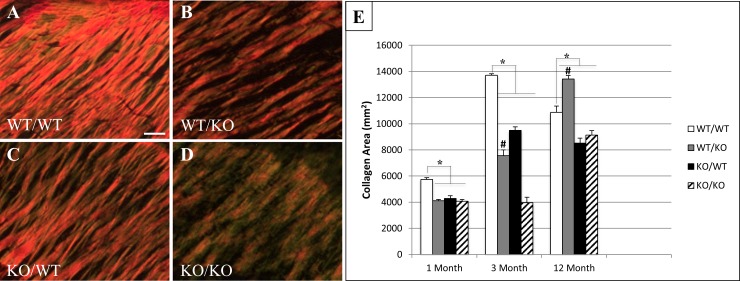
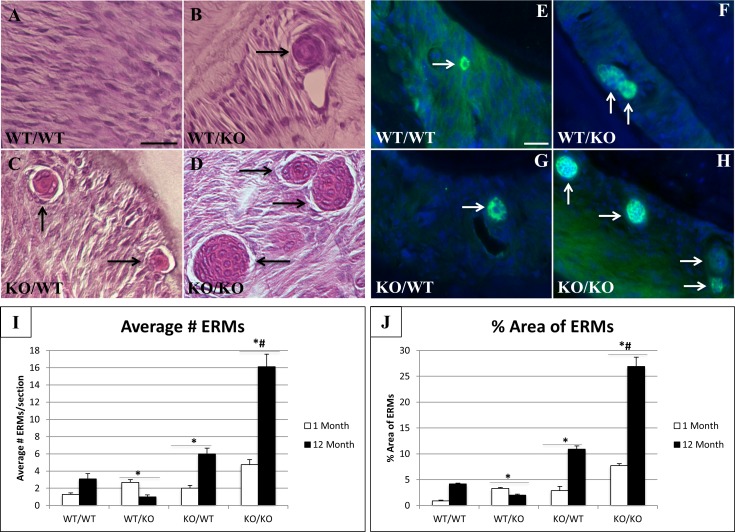
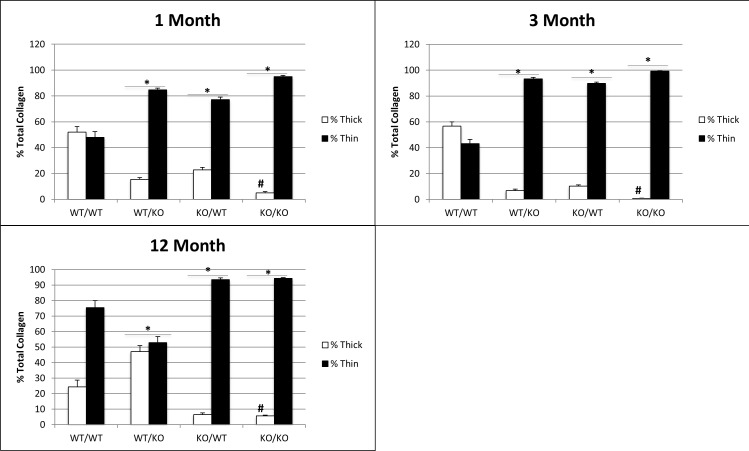
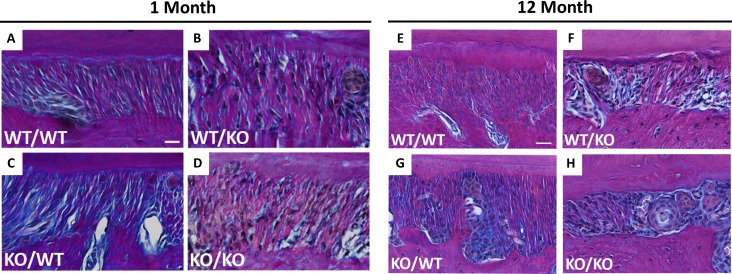
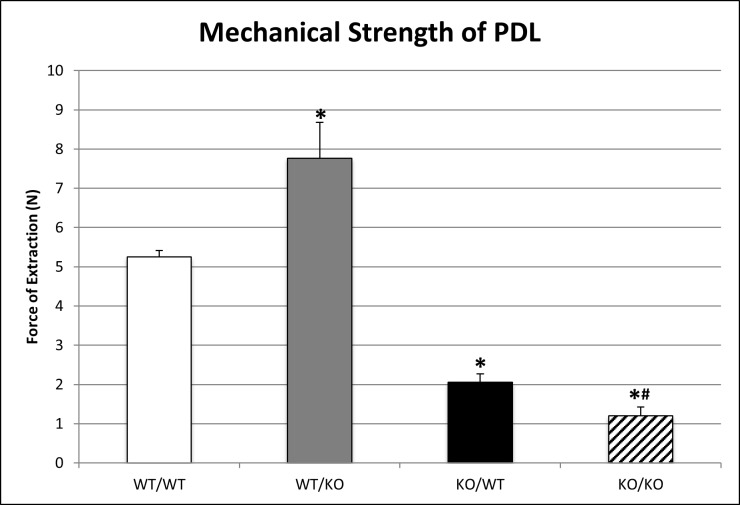
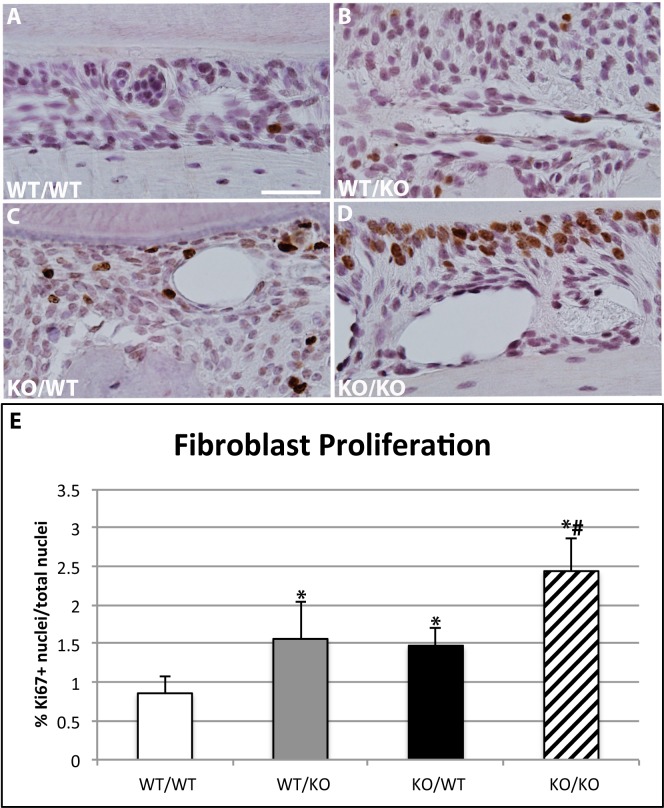
The periodontal ligament (PDL) is a fibrous connective tissue that anchors tooth cementum into alveolar bone. Secreted protein acidic and rich in cysteine (SPARC) is a collagen-binding matricellular protein known to influence collagen fiber assembly in the PDL. In contrast, functional properties of the N-propeptide of collagen I, encoded in exon 2 of the COL1A1 gene, are poorly understood. In this study, the PDL of collagen I exon 2-deleted (wt/ko), SPARC-null (ko/wt), and double transgenic (ko/ko) mice were evaluated in terms of cellularity, collagen area, fiber morphology, and extraction force and compared to WT (wt/wt) mice. Picro sirius red staining indicated a decrease in total PDL collagen content in each of the transgenic mice compared to WT at 1 and 3 month age points. At 12 months, only SPARC-null (ko/wt) and double-null PDL demonstrated less total collagen versus WT. Likewise, an increase in thin PDL collagen fibers was observed at 1 and 3 months in each transgenic, with increases only in SPARC-null and double-null mice at 12 months. The force required for tooth extraction was significantly reduced in SPARC-null versus exon 2-deleted and WT mice, whereas double-null mice demonstrated further decreases in force required for tooth extraction. The number of proliferating fibroblasts and number and size of epithelial rests of Malassez were increased in each transgenic versus WT with double-null PDL exhibiting highest levels of proliferation and rests of Malassez at 1 month of age. Consistent with increases in PDL collagen in exon-2 deleted mice, with age, numbers of rests decreased at 12 months in this genotype. These results demonstrate for the first time a functional role of the N-propeptide in regulating collagen fiber assembly and cell behavior and suggest that SPARC and the N-propeptide of collagen I have distinct activities in regulating collagen fiber assembly and fibroblast function.
牙周韧带(PDL)是一种纤维结缔组织,将牙骨质锚定到牙槽骨中。富含半胱氨酸的酸性分泌蛋白(SPARC)是一种胶原结合基质细胞蛋白,已知其会影响牙周韧带中胶原纤维的组装。相比之下,COL1A1基因外显子2编码的I型胶原N端前肽的功能特性却鲜为人知。在本研究中,对I型胶原外显子2缺失(wt/ko)、SPARC基因敲除(ko/wt)和双转基因(ko/ko)小鼠的牙周韧带进行了细胞数量、胶原面积、纤维形态和拔除力方面的评估,并与野生型(wt/wt)小鼠进行比较。天狼星红苦味酸染色表明,与1月龄和3月龄的野生型小鼠相比,每种转基因小鼠的牙周韧带总胶原含量均有所下降。在12月龄时,只有SPARC基因敲除(ko/wt)和双基因敲除的牙周韧带总胶原含量低于野生型。同样,在1月龄和3月龄时,每种转基因小鼠的牙周韧带细胶原纤维均增加,而在12月龄时,只有SPARC基因敲除和双基因敲除小鼠的细胶原纤维增加。与外显子2缺失和野生型小鼠相比,SPARC基因敲除小鼠拔牙所需的力显著降低,而双基因敲除小鼠拔牙所需的力进一步降低。与野生型小鼠相比,每种转基因小鼠中增殖的成纤维细胞数量以及马拉瑟上皮剩余的数量和大小均增加,双基因敲除的牙周韧带在1月龄时增殖水平和马拉瑟上皮剩余数量最高。与外显子2缺失小鼠牙周韧带胶原随年龄增加一致,该基因型在12月龄时上皮剩余数量减少。这些结果首次证明了N端前肽在调节胶原纤维组装和细胞行为中的功能作用,并表明SPARC和I型胶原N端前肽在调节胶原纤维组装和成纤维细胞功能方面具有不同的活性。