Asada Kazutoyo, Kamiya Hajime, Suga Shigeru, Nagao Mizuho, Ichimi Ryoji, Fujisawa Takao, Umemoto Masakazu, Tanaka Takaaki, Ito Hiroaki, Tanaka Shigeki, Ido Masaru, Taniguchi Koki, Ihara Toshiaki, Nakano Takashi
Department of Pediatrics, National Hospital Organization Mie Hospital, Tsu, Japan .
Infectious Disease Surveillance Center, National Institute of Infectious Diseases, Shinjuku, Japan .
Western Pac Surveill Response J. 2016 Nov 14;7(4):28-36. doi: 10.5365/WPSAR.2016.7.3.005. eCollection 2016 Oct-Dec.
Rotavirus vaccines were introduced in Japan in November 2011. We evaluated the subsequent reduction of the health-care burden of rotavirus gastroenteritis.
We conducted active surveillance for rotavirus gastroenteritis among children under 5 years old before and after the vaccine introduction. We surveyed hospitalization rates for rotavirus gastroenteritis in children in Tsu City, Mie Prefecture, Japan, from 2007 to 2015 and surveyed the number of outpatient visits at a Tsu City clinic from 2010 to 2015. Stool samples were obtained for rotavirus testing and genotype investigation. We assessed rotavirus vaccine coverage for infants living in Tsu City.
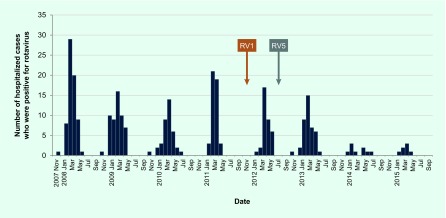
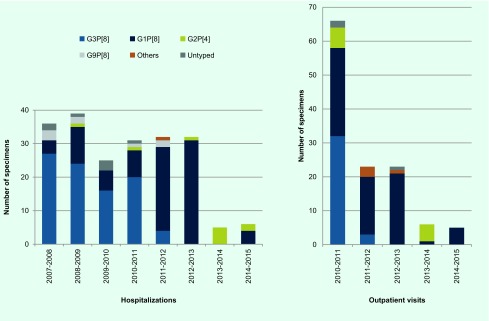
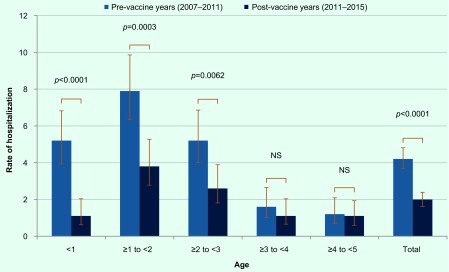
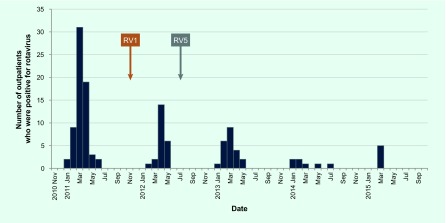
In the pre-vaccine years (2007-2011), hospitalization rates for rotavirus gastroenteritis in children under 5 years old were 5.5, 4.3, 3.1 and 3.9 cases per 1000 person-years, respectively. In the post-vaccine years (2011-2015), the rates were 3.0, 3.5, 0.8 and 0.6 cases per 1000 person-years, respectively. The hospitalization rate decreased significantly in the 2013-2014 and 2014-2015 seasons compared to the average of the seasons before vaccine introduction ( < 0.0001). In one pre-vaccine year (2010-2011), the number of outpatient visits due to the rotavirus infection was 66. In the post-vaccine years (2011-2015), the numbers for each season was 23, 23, 7 and 5, respectively. The most dominant rotavirus genotype shifted from G3P[8] to G1P[8] and to G2P[4]. The coverage of one dose of rotavirus vaccine in Tsu City was 56.5% in 2014.
After the vaccine introduction, the hospitalization rates and outpatient visits for rotavirus gastroenteritis greatly decreased.
轮状病毒疫苗于2011年11月在日本推出。我们评估了随后轮状病毒肠胃炎医疗负担的减轻情况。
在疫苗推出前后,我们对5岁以下儿童中的轮状病毒肠胃炎进行了主动监测。我们调查了日本三重县津市2007年至2015年期间儿童轮状病毒肠胃炎的住院率,并调查了2010年至2015年期间津市一家诊所的门诊就诊次数。采集粪便样本进行轮状病毒检测和基因型调查。我们评估了居住在津市的婴儿的轮状病毒疫苗接种覆盖率。
在疫苗接种前的年份(2007 - 2011年),5岁以下儿童轮状病毒肠胃炎的住院率分别为每1000人年5.5例、4.3例、3.1例和3.9例。在疫苗接种后的年份(2011 - 2015年),该比率分别为每1000人年3.0例、3.5例、0.8例和0.6例。与疫苗推出前各季节的平均水平相比,在2013 - 2014年和2014 - 2015年季节,住院率显著下降(<0.0001)。在疫苗接种前的一年(2010 - 2011年),因轮状病毒感染的门诊就诊次数为66次。在疫苗接种后的年份(2011 - 2015年),每个季节的次数分别为23次、23次、7次和5次。最主要的轮状病毒基因型从G3P[8]转变为G1P[8],再转变为G2P[4]。2014年,津市一剂轮状病毒疫苗的接种覆盖率为56.5%。
疫苗推出后,轮状病毒肠胃炎的住院率和门诊就诊次数大幅下降。