Lyndon Mataroria P, Henning Marcus A, Alyami Hussain, Krishna Sanjeev, Zeng Irene, Yu Tzu-Chieh, Hill Andrew G
Ko Awatea, Counties Manukau Health, Auckland, New Zealand.
Department of Surgery, South Auckland Clinical Campus, The University of Auckland, Auckland, New Zealand.
Perspect Med Educ. 2017 Apr;6(2):108-114. doi: 10.1007/s40037-017-0340-6.
The aim of this study was to identify burnout and quality of life profiles of medical students and determine their associations with academic motivation and achievement on progress tests using a person-oriented approach.
Medical students (n = 670) in Year 3 to Year 5 at the University of Auckland were classified into three different profiles as derived from a two-step cluster analysis using World Health Organization Quality of Life-BREF scores and Copenhagen Burnout Inventory scores. The profiles were used as independent variables to assess differences in academic motivation and achievement on progress tests using a multivariate analysis of co-variance and repeated measures analysis of co-variance methods.
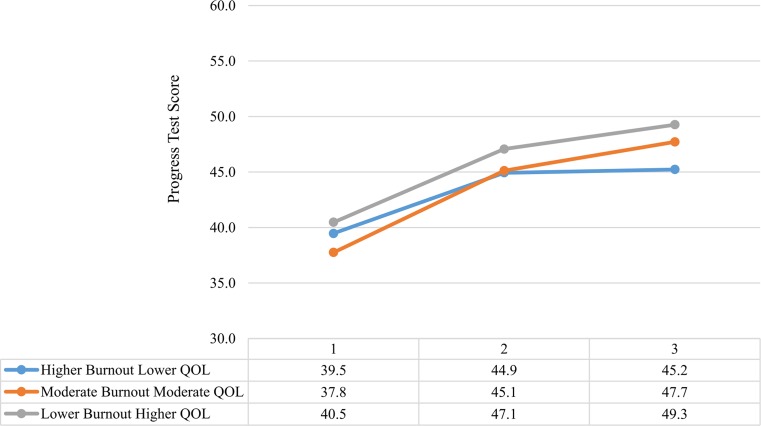
The response rate was 47%. Three clusters were obtained: Higher Burnout Lower Quality of Life (n = 62, 20%), Moderate Burnout Moderate Quality of Life (n = 131, 41%), and Lower Burnout Higher Quality of Life (n = 124, 39%). After controlling for gender and year level, Higher Burnout Lower Quality of Life students had significantly higher test anxiety (p < 0.0001) and amotivation scores (p < 0.0001); and lower intrinsic motivation (p < 0.005), self-efficacy (p < 0.001), and progress test scores (p = 0.03) compared with the other profiles.
Burnout and Quality of Life profiles of medical students are associated with differences in academic motivation and achievement over time.
本研究旨在采用以人为本的方法,确定医学生的职业倦怠和生活质量概况,并确定它们与学业动机以及阶段性测试成绩之间的关联。
奥克兰大学三至五年级的医学生(n = 670),根据世界卫生组织生活质量简表(WHO Quality of Life-BREF)分数和哥本哈根倦怠量表(Copenhagen Burnout Inventory)分数,通过两步聚类分析分为三种不同的概况。这些概况被用作自变量,采用协方差多元分析和协方差重复测量分析方法,评估学业动机和阶段性测试成绩的差异。
回复率为47%。得到三个聚类:高倦怠低生活质量(n = 62,20%)、中度倦怠中度生活质量(n = 131,41%)和低倦怠高生活质量(n = 124,39%)。在控制性别和年级水平后,与其他概况相比,高倦怠低生活质量的学生有显著更高的考试焦虑(p < 0.0001)和无动机得分(p < 0.0001);以及更低的内在动机(p < 0.005)、自我效能感(p < 0.001)和阶段性测试成绩(p = 0.03)。
医学生的职业倦怠和生活质量概况与学业动机和成绩随时间的差异有关。