De Stefano Nicola, Silva Diego G, Barnett Michael H
Department of Medicine, Surgery and Neuroscience, University of Siena, via le Bracci 2, 53100, Siena, Italy.
Novartis Pharma AG, Basel, Switzerland.
CNS Drugs. 2017 Apr;31(4):289-305. doi: 10.1007/s40263-017-0415-2.
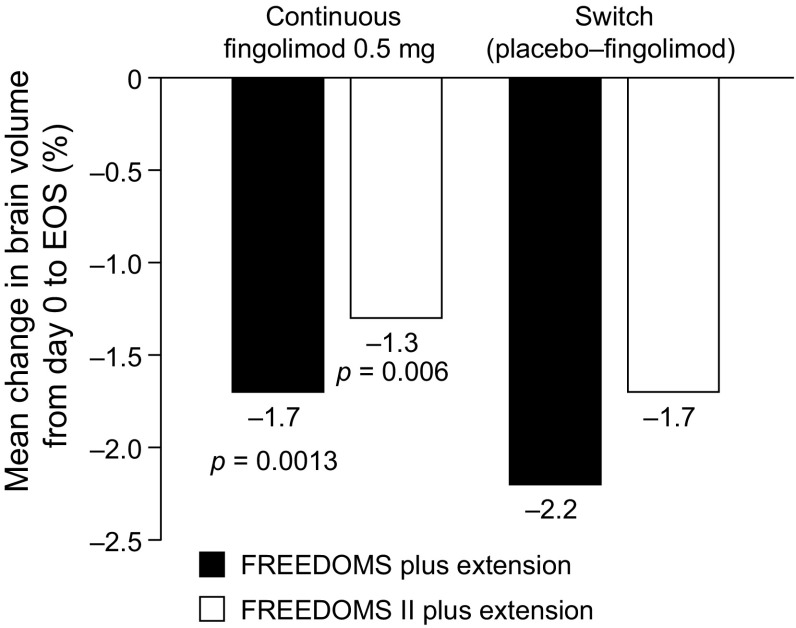
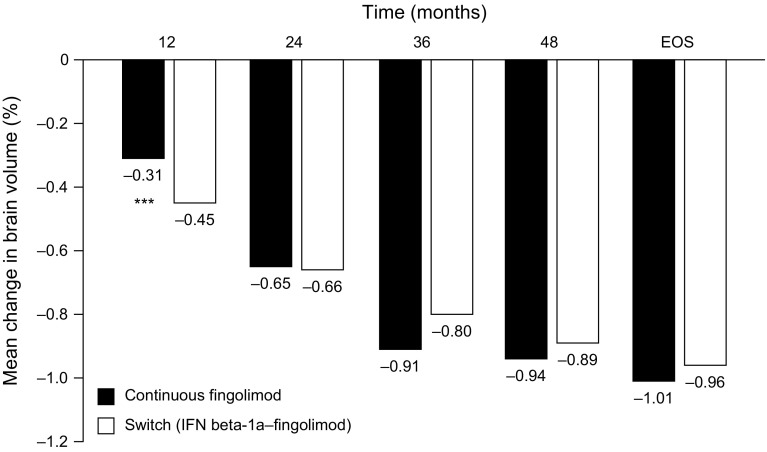
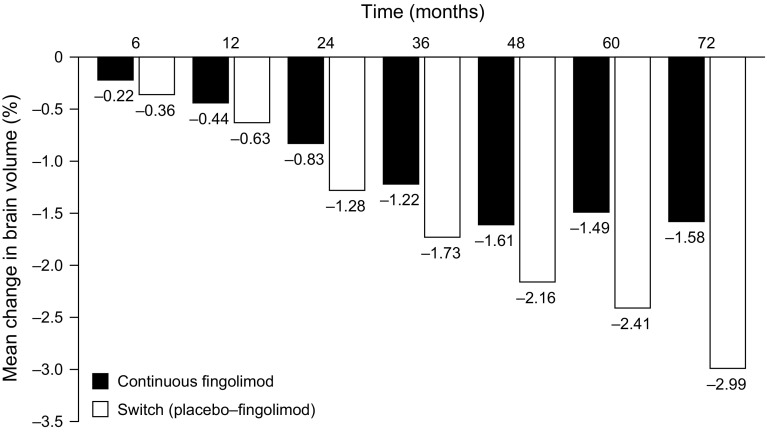
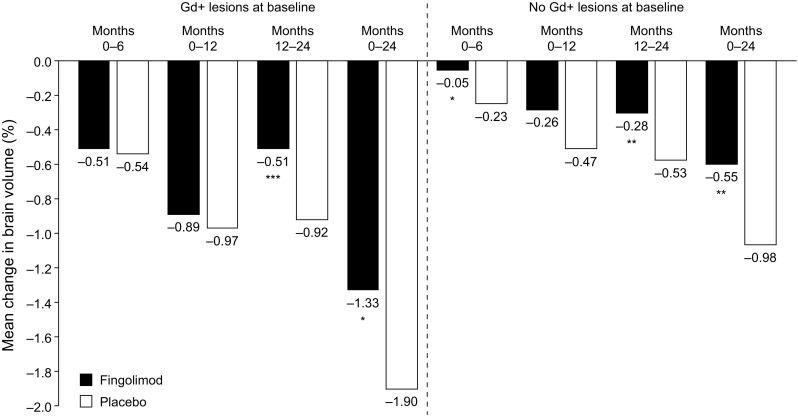
Brain atrophy occurs at a faster rate in patients with multiple sclerosis (MS) than in healthy individuals. In three randomized, controlled, phase III trials, fingolimod reduced the annual rate of brain volume loss (BVL) in patients with relapsing MS (RMS) by approximately one-third relative to that in individuals receiving placebo or intramuscular interferon beta-1a. Analysis of brain volume changes during study extensions has shown that this reduced rate of BVL is sustained in patients with RMS receiving fingolimod continuously. Subgroup analyses of the core phase III and extension studies have shown that reductions in the rate of BVL are observed irrespective of levels of inflammatory lesion activity seen by magnetic resonance imaging at baseline and on study; levels of disability at baseline; and treatment history. The rate of BVL in these studies was predicted independently by T2 lesion and gadolinium-enhancing lesion burdens at baseline, and correlations observed between BVL and increasing levels of disability strengthened over time. In another phase III trial in patients with primary progressive MS (PPMS), fingolimod did not reduce BVL overall relative to placebo; however, consistent with findings in RMS, there was a treatment effect on BVL in patients with PPMS with gadolinium-enhancing lesion activity at baseline. The association between treatment effects on BVL and future accumulation of disability argues in favor of measuring BVL on a more routine basis and with a more structured approach than is generally the case in clinical practice. Despite several practical obstacles, progress is being made in achieving this goal.
与健康个体相比,多发性硬化症(MS)患者的脑萎缩发生率更高。在三项随机、对照、III期试验中,与接受安慰剂或肌肉注射干扰素β-1a的个体相比,芬戈莫德使复发型MS(RMS)患者的年脑容量损失(BVL)率降低了约三分之一。对研究延长期内脑容量变化的分析表明,持续接受芬戈莫德治疗的RMS患者的BVL降低率得以维持。核心III期和延长期研究的亚组分析表明,无论基线和研究时磁共振成像显示的炎症性病变活动水平、基线残疾水平以及治疗史如何,BVL率均有所降低。这些研究中的BVL率由基线时的T2病变和钆增强病变负荷独立预测,并且随着时间的推移,BVL与残疾程度增加之间的相关性增强。在另一项针对原发进展型MS(PPMS)患者的III期试验中,相对于安慰剂,芬戈莫德总体上并未降低BVL;然而,与RMS的研究结果一致,对于基线时有钆增强病变活动的PPMS患者,芬戈莫德对BVL有治疗效果。治疗对BVL的影响与未来残疾累积之间的关联表明,与临床实践中通常的情况相比,应以更常规的方式和更结构化的方法来测量BVL。尽管存在一些实际障碍,但在实现这一目标方面正在取得进展。