Markovič Rene, Peltan Julien, Gosak Marko, Horvat Denis, Žalik Borut, Seguy Benjamin, Chauvel Remi, Malandain Gregoire, Couffinhal Thierry, Duplàa Cécile, Marhl Marko, Roux Etienne
Department of Physics, Faculty of Natural Sciences and Mathematics, University of Maribor, Maribor, Slovenia.
Faculty of Education, University of Maribor, Maribor, Slovenia.
PLoS One. 2017 Mar 2;12(3):e0171033. doi: 10.1371/journal.pone.0171033. eCollection 2017.
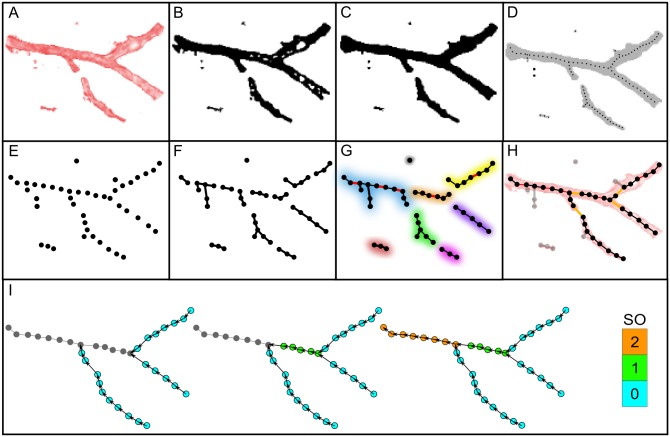
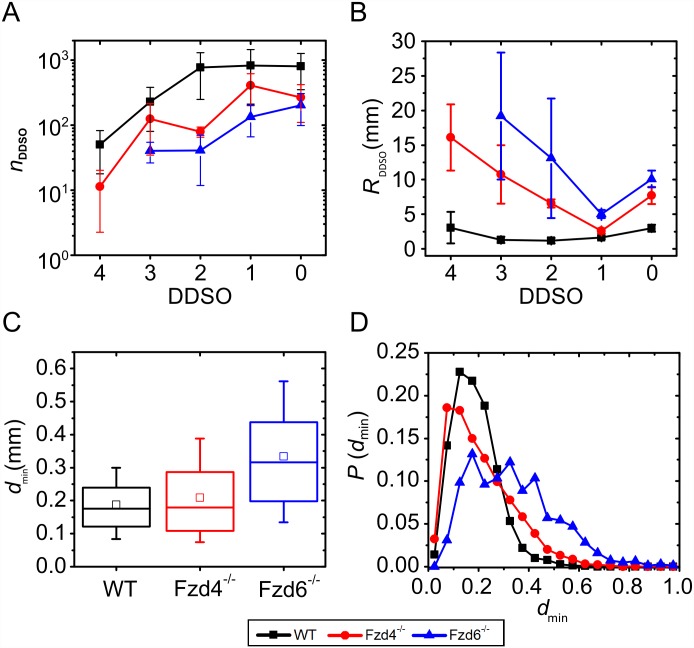
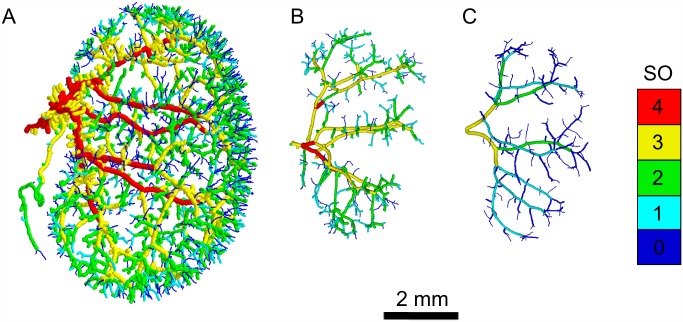
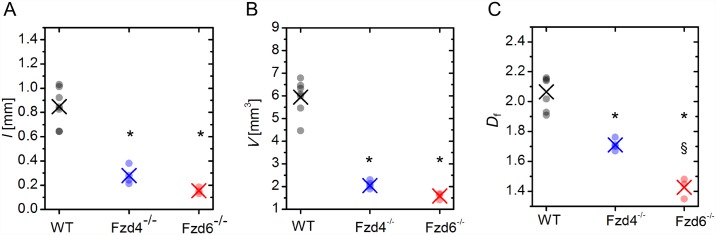
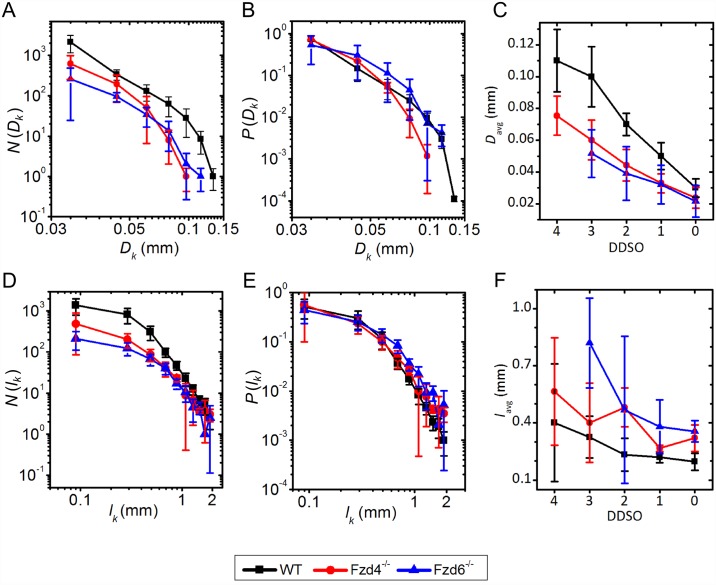
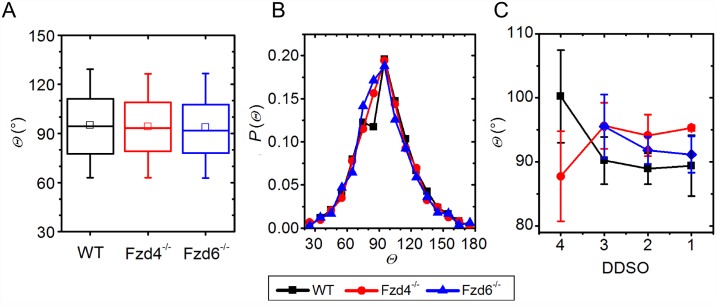
Quantitative analysis of the vascular network anatomy is critical for the understanding of the vasculature structure and function. In this study, we have combined microcomputed tomography (microCT) and computational analysis to provide quantitative three-dimensional geometrical and topological characterization of the normal kidney vasculature, and to investigate how 2 core genes of the Wnt/planar cell polarity, Frizzled4 and Frizzled6, affect vascular network morphogenesis. Experiments were performed on frizzled4 (Fzd4-/-) and frizzled6 (Fzd6-/-) deleted mice and littermate controls (WT) perfused with a contrast medium after euthanasia and exsanguination. The kidneys were scanned with a high-resolution (16 μm) microCT imaging system, followed by 3D reconstruction of the arterial vasculature. Computational treatment includes decomposition of 3D networks based on Diameter-Defined Strahler Order (DDSO). We have calculated quantitative (i) Global scale parameters, such as the volume of the vasculature and its fractal dimension (ii) Structural parameters depending on the DDSO hierarchical levels such as hierarchical ordering, diameter, length and branching angles of the vessel segments, and (iii) Functional parameters such as estimated resistance to blood flow alongside the vascular tree and average density of terminal arterioles. In normal kidneys, fractal dimension was 2.07±0.11 (n = 7), and was significantly lower in Fzd4-/- (1.71±0.04; n = 4), and Fzd6-/- (1.54±0.09; n = 3) kidneys. The DDSO number was 5 in WT and Fzd4-/-, and only 4 in Fzd6-/-. Scaling characteristics such as diameter and length of vessel segments were altered in mutants, whereas bifurcation angles were not different from WT. Fzd4 and Fzd6 deletion increased vessel resistance, calculated using the Hagen-Poiseuille equation, for each DDSO, and decreased the density and the homogeneity of the distal vessel segments. Our results show that our methodology is suitable for 3D quantitative characterization of vascular networks, and that Fzd4 and Fzd6 genes have a deep patterning effect on arterial vessel morphogenesis that may determine its functional efficiency.
血管网络解剖结构的定量分析对于理解脉管系统的结构和功能至关重要。在本研究中,我们结合了微型计算机断层扫描(microCT)和计算分析,以提供正常肾血管系统的定量三维几何和拓扑特征,并研究Wnt/平面细胞极性的两个核心基因Frizzled4和Frizzled6如何影响血管网络形态发生。对安乐死和放血后用造影剂灌注的frizzled4(Fzd4-/-)和frizzled6(Fzd6-/-)基因敲除小鼠及同窝对照(WT)进行实验。用高分辨率(16μm)的microCT成像系统对肾脏进行扫描,随后对动脉血管系统进行三维重建。计算处理包括基于直径定义的斯特拉勒阶数(DDSO)对三维网络进行分解。我们计算了定量的(i)全局尺度参数,如脉管系统的体积及其分形维数;(ii)取决于DDSO层次水平的结构参数,如血管段的层次排序、直径、长度和分支角度;以及(iii)功能参数,如沿血管树估计的血流阻力和终末小动脉的平均密度。在正常肾脏中,分形维数为2.07±0.11(n = 7),在Fzd4-/-肾脏(1.71±0.04;n = 4)和Fzd6-/-肾脏(1.54±0.09;n = 3)中显著降低。WT和Fzd4-/-的DDSO数为5,而Fzd6-/-中仅为4。突变体中血管段的直径和长度等缩放特征发生了改变,而分叉角度与WT没有差异。使用哈根-泊肃叶方程计算得出,Fzd4和Fzd6基因敲除增加了每个DDSO的血管阻力,并降低了远端血管段的密度和均匀性。我们的结果表明,我们的方法适用于血管网络的三维定量表征,并且Fzd4和Fzd6基因对动脉血管形态发生具有深刻的模式形成作用,这可能决定其功能效率。