Department of Ophthalmology, Seoul National University Bundang Hospital, Seoul National University College of Medicine, Seongnam, Korea.
Department of Internal Medicine, Seoul National University Bundang Hospital, Seoul National University College of Medicine, Seongnam, Korea.
Cancer Res Treat. 2018 Jan;50(1):30-39. doi: 10.4143/crt.2016.569. Epub 2017 Feb 27.
This prospective study was conducted to determine the incidence of lacrimal drainage obstruction (LDO) during S-1 chemotherapy and evaluate the association between the development of LDO and the concentrations of ingredients/metabolites of S-1 in tears and plasma.
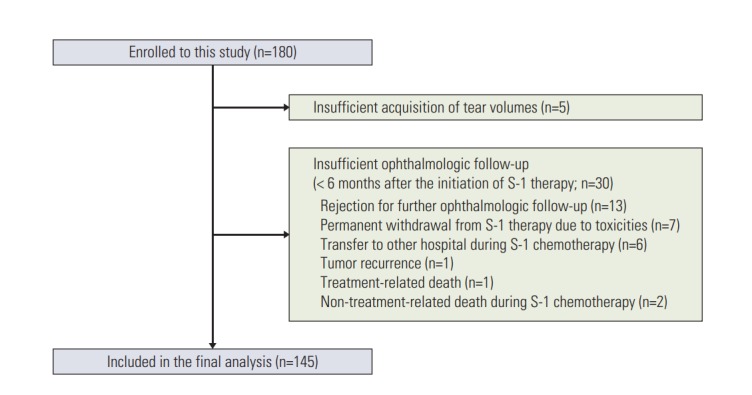
A total of 145 patients with gastric cancer who received adjuvant S-1 therapy were enrolled. Ophthalmologic examinations were performed regularly during S-1 chemotherapy. Concentrations of tegafur, 5-chloro-2,4-dihydroxypyridine (CDHP), and 5-fluorouracil at steady-state trough level were measured in both tears and plasma.
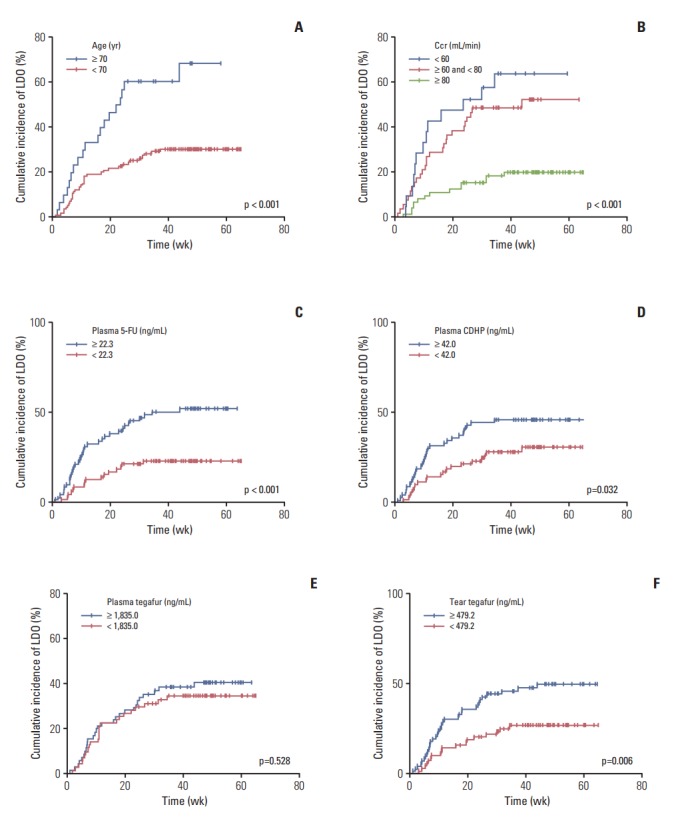
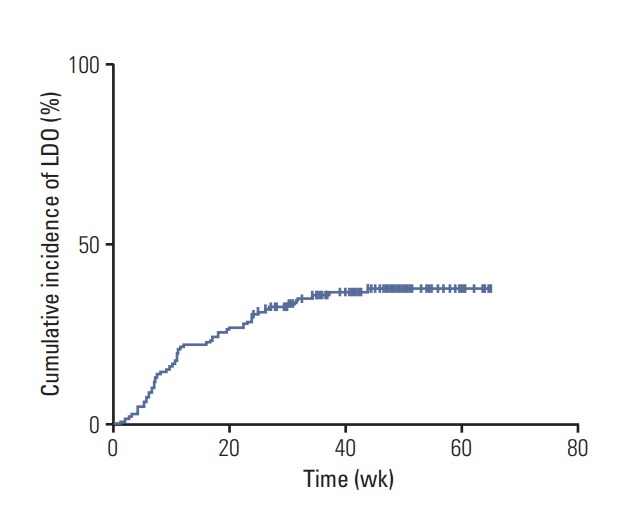
Fifty-three patients (37%) developed LDO. The median time to the onset of LDO was 10.9 weeks, and LDO developed most frequently in the nasolacrimal duct. Univariable analyses revealed that an older age (≥ 70 years), creatinine clearance rate (Ccr) < 80 mL/min, 5-fluorouracil concentration in plasma ≥ 22.3 ng/mL (median), CDHP concentration in plasma ≥ 42.0 ng/mL (median), and tegafur concentration in tears ≥ 479.2 ng/mL (median) were related to increased development of LDO. Multivariable analysis indicated that a high plasma 5-fluorouracil concentration was predictive of increased development of LDO (hazard ratio, 2.02; p=0.040), along with older age and decreased Ccr. Patients with LDO also developed S-1-related non-hematologic toxicity more frequently than those without LDO (p=0.016).
LDO is a frequent adverse event during S-1 chemotherapy. An older age, decreased Ccr, and high plasma 5-fluorouracil concentration were found to be independent risk factors for LDO. The high incidence of LDO warrants regular ophthalmologic examination and early intervention in patients receiving S-1 therapy.
本前瞻性研究旨在确定 S-1 化疗过程中泪道阻塞(LDO)的发生率,并评估 LDO 的发生与泪液和血浆中 S-1 的成分/代谢物浓度之间的关系。
共纳入 145 例接受辅助 S-1 治疗的胃癌患者。在 S-1 化疗期间定期进行眼科检查。稳态谷浓度时测量泪液和血浆中替加氟、5-氯-2,4-二羟基吡啶(CDHP)和 5-氟尿嘧啶的浓度。
53 例(37%)患者发生 LDO。LDO 的中位发病时间为 10.9 周,最常发生在鼻泪管。单变量分析显示,年龄较大(≥70 岁)、肌酐清除率(Ccr)<80 mL/min、血浆中 5-氟尿嘧啶浓度≥22.3ng/mL(中位数)、血浆中 CDHP 浓度≥42.0ng/mL(中位数)和泪液中替加氟浓度≥479.2ng/mL(中位数)与 LDO 发生率增加有关。多变量分析表明,高血浆 5-氟尿嘧啶浓度是 LDO 发生率增加的预测因素(风险比,2.02;p=0.040),此外还有年龄较大和 Ccr 降低。发生 LDO 的患者比未发生 LDO 的患者更常发生 S-1 相关非血液学毒性(p=0.016)。
LDO 是 S-1 化疗过程中的常见不良事件。年龄较大、Ccr 降低和高血浆 5-氟尿嘧啶浓度是 LDO 的独立危险因素。LDO 的高发生率需要对接受 S-1 治疗的患者进行定期眼科检查和早期干预。