Liang Donglou, Chen Qiaowan, Guo Yujin, Zhang Ting, Guo Wentao
Pharmacy Department, Jining First People's Hospital.
Department of Obstetrics, Affiliated Hospital of Jining Medical University, Jining, Shandong.
Drug Des Devel Ther. 2017 Feb 17;11:451-461. doi: 10.2147/DDDT.S129991. eCollection 2017.
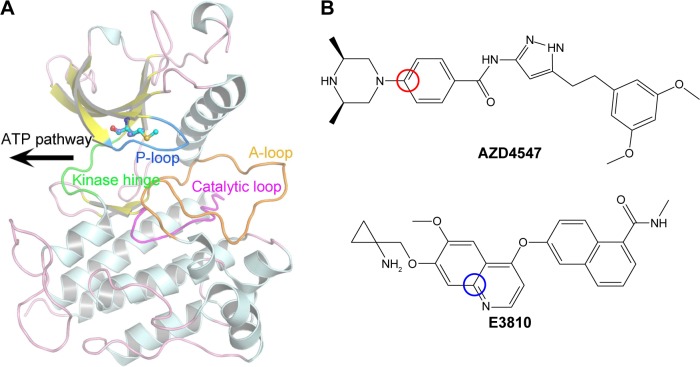
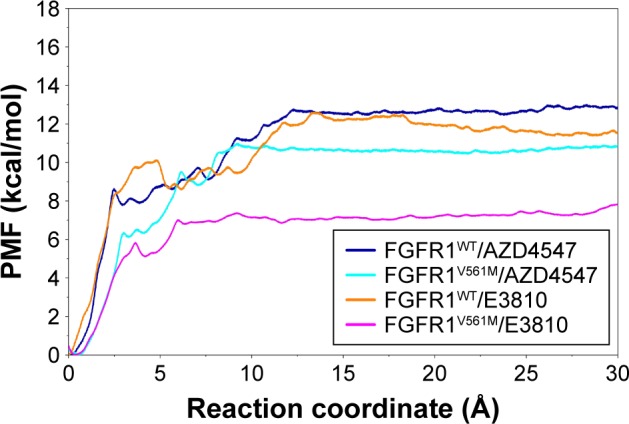
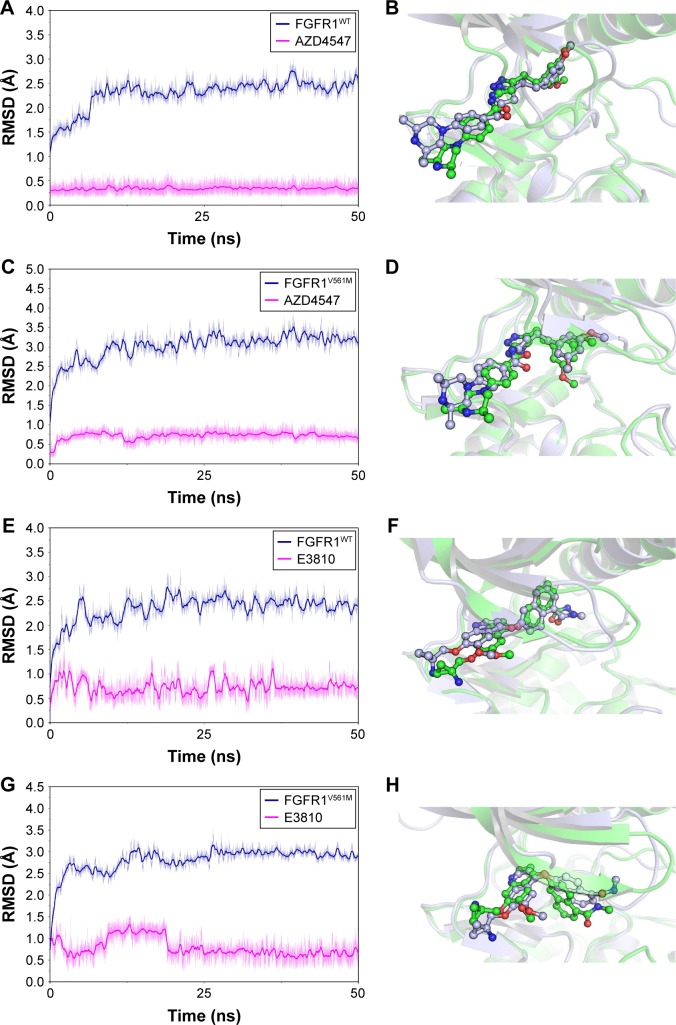
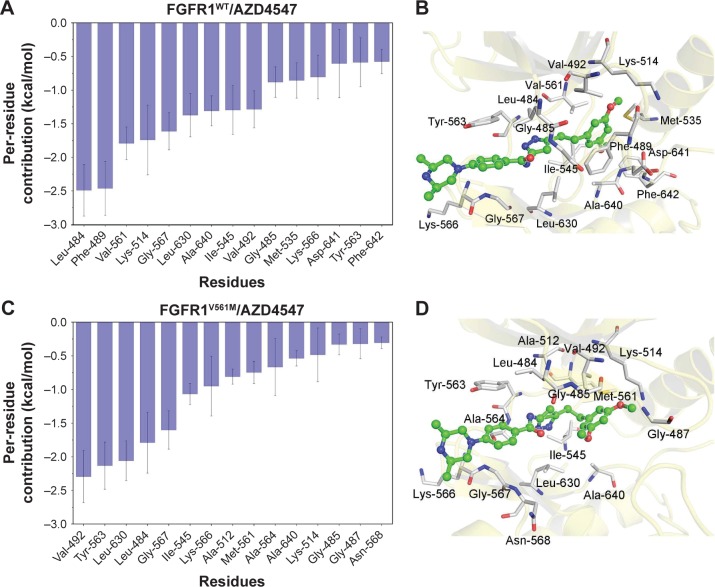
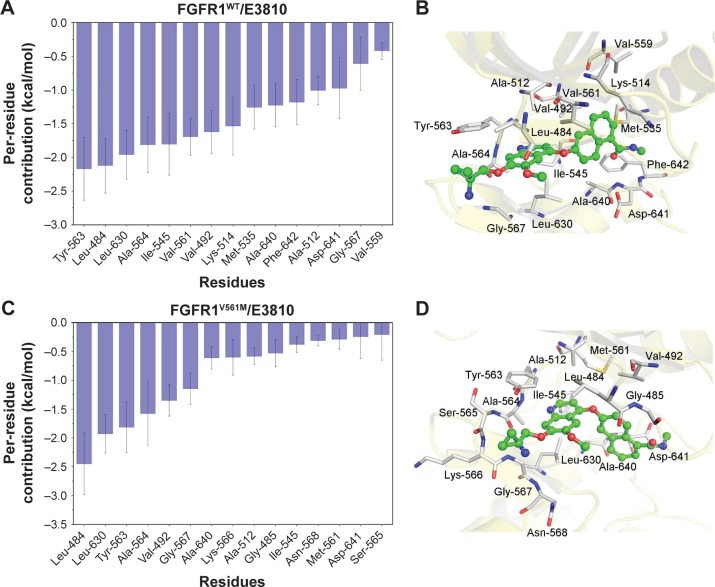
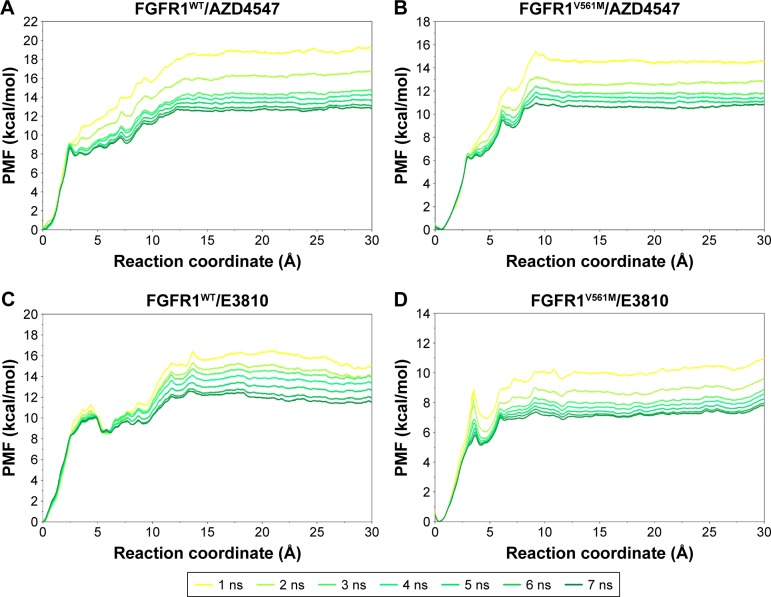
Inhibitors targeting the amplification of the fibroblast growth factor receptor 1 (FGFR1) have found success in the treatment of FGFR1-positive squamous cell lung and breast cancers. A secondary mutation of gatekeeper residue (V561M) in the binding site has been linked to the acquired resistance. Recently, two well-known small molecule inhibitors of FGFR1, AZD4547 and E3810, reported that the V561M mutation confers significant resistance to E3810, while retaining affinity for AZD4547. FGFR1 is widely investigated as potential therapeutic target, while there are few computational studies made to understand the resistance mechanisms about FGFR1 V561M gatekeeper mutation. In this study, molecular docking, classical molecular dynamics simulations, molecular mechanics/generalized born surface area (MM/GBSA) free energy calculations, and umbrella sampling (US) simulations were carried out to make clear the principle of the binding preference of AZD4547 and E3810 toward FGFR1 V561M gatekeeper mutation. The results provided by MM/GBSA reveal that AZD4547 has similar binding affinity to both FGFR1 and FGFR1, whereas E3810 has much higher binding affinity to FGFR1 than to FGFR1. Comparison of individual energy terms indicates that the major variation of E3810 between FGFR1 and FGFR1 are van der Waals interactions. In addition, US simulations prove that the potential of mean force (PMF) profile of AZD4547 toward FGFR1 and FGFR1 has similar PMF depth. However, the PMF profile of E3810 toward FGFR1 and FGFR1 has much higher PMF depth, suggesting that E3810 is more easily dissociated from FGFR1 than from FGFR1. The results not only show the drug-resistance determinants of FGFR1 gatekeeper mutation but also provide valuable implications and provide vital clues for the development of new inhibitors to combat drug resistance.
靶向成纤维细胞生长因子受体1(FGFR1)扩增的抑制剂已成功用于治疗FGFR1阳性的肺鳞状细胞癌和乳腺癌。结合位点中守门残基(V561M)的二次突变与获得性耐药有关。最近,两种著名的FGFR1小分子抑制剂AZD4547和E3810报道称,V561M突变赋予了对E3810的显著耐药性,同时保留了对AZD4547的亲和力。FGFR1作为潜在治疗靶点受到广泛研究,而关于FGFR1 V561M守门突变耐药机制的计算研究很少。在本研究中,进行了分子对接、经典分子动力学模拟、分子力学/广义玻恩表面积(MM/GBSA)自由能计算和伞形采样(US)模拟,以明确AZD4547和E3810对FGFR1 V561M守门突变的结合偏好原理。MM/GBSA提供的结果表明,AZD4547对FGFR1和FGFR1的结合亲和力相似,而E3810对FGFR1的结合亲和力比对FGFR1高得多。单个能量项的比较表明,E3810在FGFR1和FGFR1之间的主要差异是范德华相互作用。此外,US模拟证明,AZD4547对FGFR1和FGFR1的平均力势(PMF)分布具有相似的PMF深度。然而,E3810对FGFR1和FGFR1的PMF分布具有更高的PMF深度,表明E3810比FGFR1更容易从FGFR1上解离。这些结果不仅揭示了FGFR1守门突变的耐药决定因素,还为开发对抗耐药性的新抑制剂提供了有价值的启示和重要线索。