Yang Ju Dong, Dai Jianliang, Singal Amit G, Gopal Purva, Addissie Benyam D, Nguyen Mindie H, Befeler Alex S, Reddy K Rajender, Schwartz Myron, Harnois Denise M, Yamada Hiroyuki, Gores Gregory J, Feng Ziding, Marrero Jorge A, Roberts Lewis R
Division of Gastroenterology and Hepatology, Mayo Clinic College of Medicine and Science, Rochester, Minnesota.
Department of Biostatistics, MD Anderson Cancer Center, Houston, Texas.
Cancer Epidemiol Biomarkers Prev. 2017 Jul;26(7):1085-1092. doi: 10.1158/1055-9965.EPI-16-0747. Epub 2017 Mar 3.
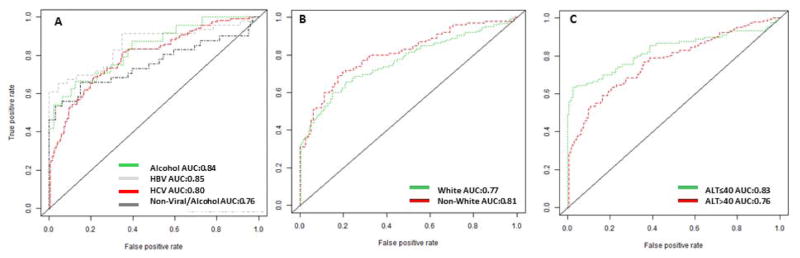
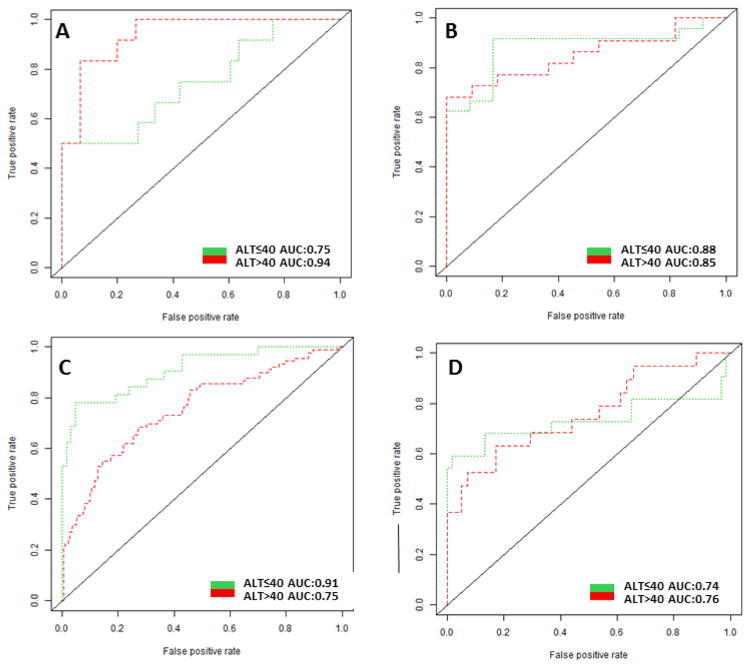
The utility of alpha-fetoprotein (AFP) for hepatocellular carcinoma (HCC) surveillance is controversial. We aimed to identify factors associated with elevated AFP and define the patients for whom AFP is effective for surveillance. Data from the NCI Early Detection Research Network phase II HCC biomarker study (233 early-stage HCC and 412 cirrhotic patients) were analyzed. We analyzed 110 early-stage HCC and 362 cirrhotic hepatitis C virus (HCV) patients for external validation. Sensitivity, specificity, and area under the ROC curve (AUC) for HCC were calculated. HCV etiology, non-White race, and serum alanine transaminase (ALT) predicted elevated AFP in cirrhotics. Non-White race and ALT predicted elevated AFP in HCC patients. Higher AUC of AFP for HCC was noted in patients with HBV (0.85) and alcohol (0.84), whereas it was lower in patients with hepatitis C virus (HCV; 0.80) and nonviral/alcohol etiology (0.76). The AUC was higher in HCV patients with serum ALT ≤40 U/L than patients with serum ALT >40 U/L (0.91 vs. 0.75, < 0.01). At 90% specificity, the sensitivity of AFP increased from 44% to 74% in Whites with HCV and from 50% to 85% in non-Whites with HCV. There was a trend toward higher AUC in HCV patients with serum ALT ≤40 U/L than those with serum ALT >40 U/L (0.79 vs. 0.69, = 0.10) in the validation cohort. The satisfactory performance of AFP in HCV patients with normal ALT should be further validated. The AFP may serve as a valuable surveillance test in HCV patients with normal ALT. .
甲胎蛋白(AFP)用于肝细胞癌(HCC)监测的效用存在争议。我们旨在确定与AFP升高相关的因素,并明确AFP对其监测有效的患者。分析了美国国立癌症研究所早期检测研究网络II期HCC生物标志物研究的数据(233例早期HCC患者和412例肝硬化患者)。我们分析了110例早期HCC患者和362例丙型肝炎病毒(HCV)肝硬化患者以进行外部验证。计算了HCC的敏感性、特异性和ROC曲线下面积(AUC)。HCV病因、非白种人种族和血清丙氨酸转氨酶(ALT)可预测肝硬化患者AFP升高。非白种人种族和ALT可预测HCC患者AFP升高。HBV患者(0.85)和酒精性患者(0.84)中AFP对HCC的AUC较高,而丙型肝炎病毒(HCV)患者(0.80)和非病毒/酒精性病因患者(0.76)中则较低。血清ALT≤40 U/L的HCV患者的AUC高于血清ALT>40 U/L的患者(0.91对0.75,<0.01)。在90%特异性时,AFP的敏感性在白种HCV患者中从44%增至74%,在非白种HCV患者中从50%增至85%。在验证队列中,血清ALT≤40 U/L的HCV患者的AUC有高于血清ALT>40 U/L患者的趋势(0.79对0.69,P = 0.10)。AFP在ALT正常的HCV患者中的良好表现应进一步验证。AFP可能是ALT正常的HCV患者中有价值的监测检测方法。