Drummond Eleanor, Nayak Shruti, Faustin Arline, Pires Geoffrey, Hickman Richard A, Askenazi Manor, Cohen Mark, Haldiman Tracy, Kim Chae, Han Xiaoxia, Shao Yongzhao, Safar Jiri G, Ueberheide Beatrix, Wisniewski Thomas
Department of Neurology, Center for Cognitive Neurology, NYU School of Medicine, New York, NY, USA.
Proteomics Laboratory, Division of Advanced Research Technologies, NYU School of Medicine, New York, NY, USA.
Acta Neuropathol. 2017 Jun;133(6):933-954. doi: 10.1007/s00401-017-1691-0. Epub 2017 Mar 4.
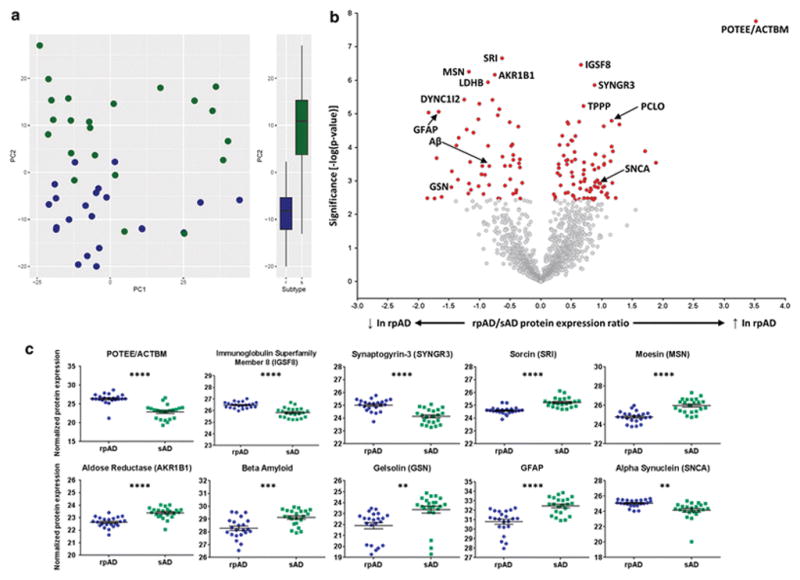
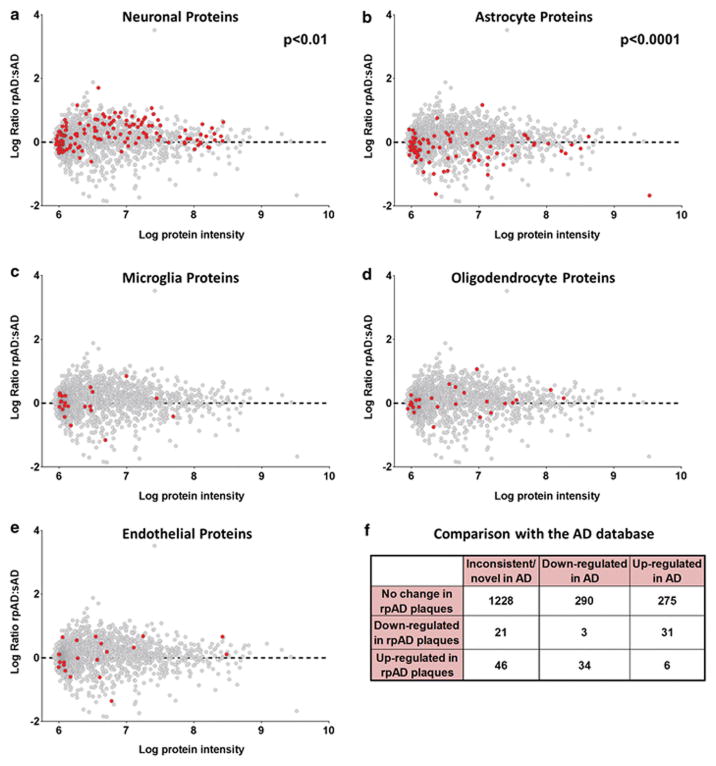
Rapidly progressive Alzheimer's disease (rpAD) is a particularly aggressive form of Alzheimer's disease, with a median survival time of 7-10 months after diagnosis. Why these patients have such a rapid progression of Alzheimer's disease is currently unknown. To further understand pathological differences between rpAD and typical sporadic Alzheimer's disease (sAD) we used localized proteomics to analyze the protein differences in amyloid plaques in rpAD and sAD. Label-free quantitative LC-MS/MS was performed on amyloid plaques microdissected from rpAD and sAD patients (n = 22 for each patient group) and protein expression differences were quantified. On average, 913 ± 30 (mean ± SEM) proteins were quantified in plaques from each patient and 279 of these proteins were consistently found in plaques from every patient. We found significant differences in protein composition between rpAD and sAD plaques. We found that rpAD plaques contained significantly higher levels of neuronal proteins (p = 0.0017) and significantly lower levels of astrocytic proteins (p = 1.08 × 10). Unexpectedly, cumulative protein differences in rpAD plaques did not suggest accelerated typical sAD. Plaques from patients with rpAD were particularly abundant in synaptic proteins, especially those involved in synaptic vesicle release, highlighting the potential importance of synaptic dysfunction in the accelerated development of plaque pathology in rpAD. Combined, our data provide new direct evidence that amyloid plaques do not all have the same protein composition and that the proteomic differences in plaques could provide important insight into the factors that contribute to plaque development. The cumulative protein differences in rpAD plaques suggest rpAD may be a novel subtype of Alzheimer's disease.
快速进展性阿尔茨海默病(rpAD)是阿尔茨海默病的一种特别侵袭性形式,诊断后的中位生存时间为7至10个月。目前尚不清楚为什么这些患者的阿尔茨海默病进展如此迅速。为了进一步了解rpAD与典型散发性阿尔茨海默病(sAD)之间的病理差异,我们使用局部蛋白质组学分析rpAD和sAD中淀粉样斑块的蛋白质差异。对从rpAD和sAD患者(每组n = 22)中显微切割的淀粉样斑块进行无标记定量液相色谱 - 串联质谱分析,并对蛋白质表达差异进行定量。平均而言,每组患者斑块中定量了913±30(平均值±标准误)种蛋白质,其中279种蛋白质在每位患者的斑块中均持续存在。我们发现rpAD和sAD斑块之间的蛋白质组成存在显著差异。我们发现rpAD斑块中神经元蛋白水平显著更高(p = 0.0017),而星形胶质细胞蛋白水平显著更低(p = 1.08×10)。出乎意料的是,rpAD斑块中的累积蛋白质差异并未表明典型sAD加速。rpAD患者的斑块中突触蛋白特别丰富,尤其是那些参与突触小泡释放的蛋白,这突出了突触功能障碍在rpAD斑块病理加速发展中的潜在重要性。综合来看,我们的数据提供了新的直接证据,即淀粉样斑块并非都具有相同的蛋白质组成,并且斑块中的蛋白质组学差异可以为促成斑块发展的因素提供重要见解。rpAD斑块中的累积蛋白质差异表明rpAD可能是阿尔茨海默病的一种新型亚型。