Kisi Shinya, Yoshida Munehito
Graduate School of Medicine, Wakayama Medical University, Japan; Department of Rehabilitation, Sumiya Orthopaedic Hospital, Japan.
Graduate School of Medicine, Wakayama Medical University, Japan; Department of Orthopedic, Wakayama Medical University, Japan.
J Phys Ther Sci. 2017 Feb;29(2):285-289. doi: 10.1589/jpts.29.285. Epub 2017 Feb 24.
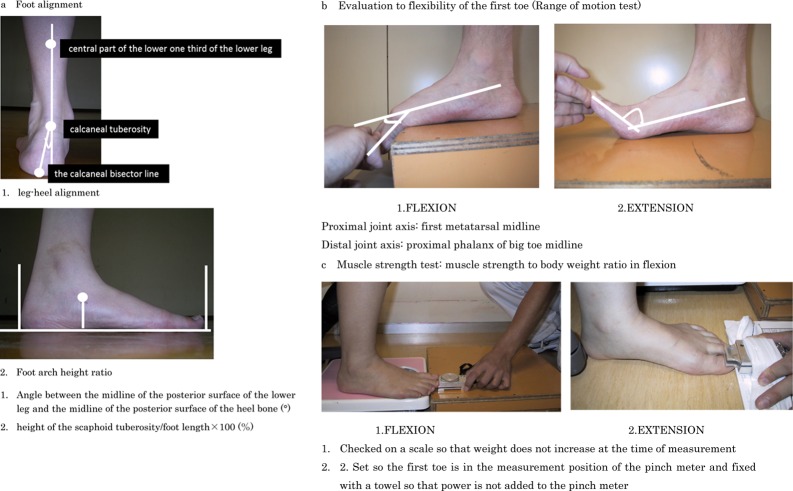
[Purpose] We investigated Achilles tendon injury in Kendo players in junior and senior high schools to obtain a possible indicator for preventing an outbreak of Achilles tendon injury and tendonitis, possible risk factors concerning foot function and morphology were extracted. [Subjects and Methods] The subjects were 60 Kendo players aged 14-18 years from Wakayama Prefecture, Japan (33 boys and 27 girls). A questionnaire survey was conducted on the past history, current status, time of occurrence about Achilles tendon pain or rupture, and site of Achilles tendon pain or rupture. Based on the responses to the questionnaire, these students were divided into two groups, i.e., those who had a history of Achilles tendon pain (n=30) or rupture (n=3) (pain group) and those who had no history of Achilles tendon pain (no-pain group), and they were examined for foot alignment, flexion and extension Range of motion test of the first toe, flexion and extension muscle strength of the first toe, and opening movement of the toes. [Results] Achilles tendon pain had occurred in 53% of the Kendo players (including 3 who had suffered Achilles tendon rupture). Poor foot alignment and deterioration of opening movement of the toes were noted in the pain group. [Conclusion] Foot alignment was poor and opening function of the toes deteriorated in the pain group, suggesting that these may be some of factors for Achilles tendon injury. Training aimed at improving foot alignment and function is important to prevent and improve Achilles tendon injury.
[目的] 我们调查了日本和歌山县初中和高中剑道运动员的跟腱损伤情况,以获取预防跟腱损伤和肌腱炎爆发的可能指标,提取了与足部功能和形态相关的可能危险因素。[对象与方法] 对象为来自日本和歌山县的60名14 - 18岁的剑道运动员(33名男生和27名女生)。就跟腱疼痛或断裂的既往史、现状、发生时间以及跟腱疼痛或断裂的部位进行了问卷调查。根据问卷回答,将这些学生分为两组,即有跟腱疼痛史(n = 30)或断裂史(n = 3)的学生(疼痛组)和无跟腱疼痛史的学生(无疼痛组),并对他们进行了足部对线、第一趾屈伸活动度测试、第一趾屈伸肌力以及足趾张开运动的检查。[结果] 53%的剑道运动员出现过跟腱疼痛(包括3名跟腱断裂者)。疼痛组存在足部对线不良和足趾张开运动变差的情况。[结论] 疼痛组足部对线不良且足趾张开功能变差,提示这些可能是跟腱损伤的部分因素。旨在改善足部对线和功能的训练对于预防和改善跟腱损伤很重要。