Yeun Young-Ran
Department of Nursing, Kangwon National University, Republic of Korea.
J Phys Ther Sci. 2017 Feb;29(2):365-369. doi: 10.1589/jpts.29.365. Epub 2017 Feb 24.
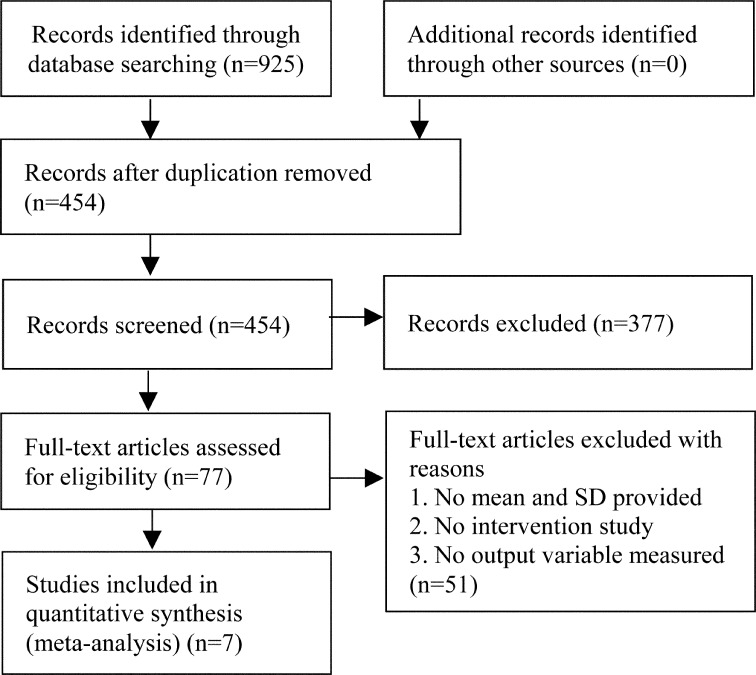
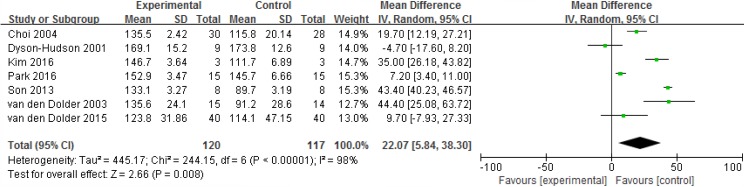
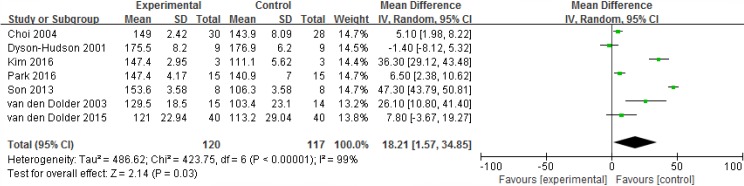
[Purpose] This study was conducted to identify and analyze the degree of effect of massage therapy on the range of motion of the shoulder. [Subjects and Methods] The database search was conducted using PubMed, CINAHL, Embase, PsycINFO, RISS, NDSL, NANET, DBpia, and KoreaMed. The meta-analysis was based on 7 studies, covered a total of 237 participants, and used a random-effects model. [Results] The effect size estimate showed that massage therapy significantly improved the shoulder range of motion, especially the flexion (SMD: 18.21, 95% CI 1.57-34.85) and abduction (SMD: 22.07, 95% CI 5.84-38.30). [Conclusion] The review findings suggest that massage therapy is effective in improving the shoulder flexion and abduction.
[目的] 本研究旨在确定并分析按摩疗法对肩部活动范围的影响程度。[对象与方法] 通过PubMed、CINAHL、Embase、PsycINFO、RISS、NDSL、NANET、DBpia和KoreaMed进行数据库检索。荟萃分析基于7项研究,共纳入237名参与者,并采用随机效应模型。[结果] 效应量估计表明,按摩疗法显著改善了肩部活动范围,尤其是前屈(标准化均数差:18.21,95%可信区间1.57 - 34.85)和外展(标准化均数差:22.07,95%可信区间5.84 - 38.30)。[结论] 综述结果表明,按摩疗法在改善肩部前屈和外展方面有效。