Yamamoto Yuki, Nagasato Masaki, Yoshida Teruhiko, Aoki Kazunori
Division of Molecular and Cellular Medicine, National Cancer Center Research Institute, Tokyo, Japan.
Division of Genetics, National Cancer Center Research Institute, Tokyo, Japan.
Cancer Sci. 2017 May;108(5):831-837. doi: 10.1111/cas.13228. Epub 2017 May 7.
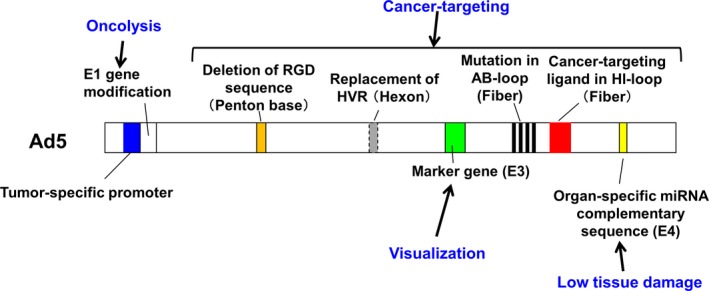
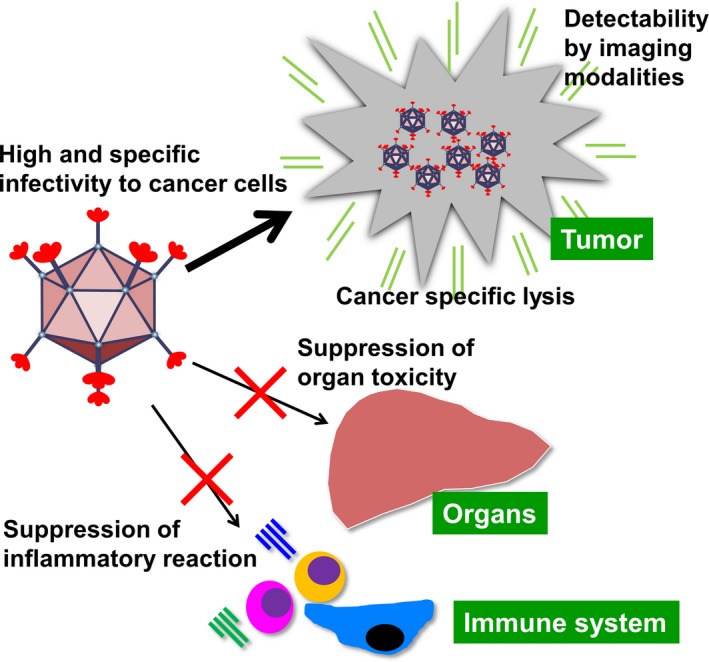
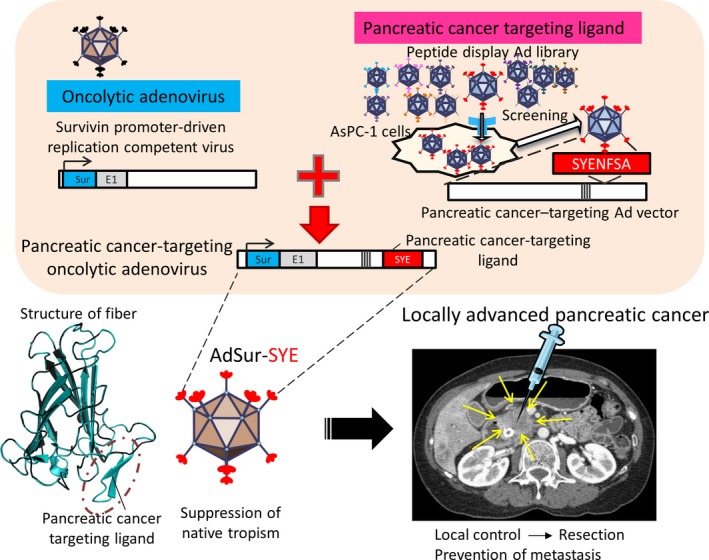
Adenoviruses are widely used to deliver genes to a variety of cell types and have been used in a number of clinical trials for gene therapy and oncolytic virotherapy. However, several concerns must be addressed for the clinical use of adenovirus vectors. Selective delivery of a therapeutic gene by adenovirus vectors to target cancer is precluded by the widespread distribution of the primary cellular receptors. The systemic administration of adenoviruses results in hepatic tropism independent of the primary receptors. Adenoviruses induce strong innate and acquired immunity in vivo. Furthermore, several modifications to these vectors are necessary to enhance their oncolytic activity and ensure patient safety. As such, the adenovirus genome has been engineered to overcome these problems. The first part of the present review outlines recent progress in the genetic modification of adenovirus vectors for cancer treatment. In addition, several groups have recently developed cancer-targeting adenovirus vectors by using libraries that display random peptides on a fiber knob. Pancreatic cancer-targeting sequences have been isolated, and these oncolytic vectors have been shown by our group to be associated with a higher gene transduction efficiency and more potent oncolytic activity in cell lines, murine models, and surgical specimens of pancreatic cancer. In the second part of this review, we explain that combining cancer-targeting strategies can be a promising approach to increase the clinical usefulness of oncolytic adenovirus vectors.
腺病毒被广泛用于将基因传递到多种细胞类型,并已用于许多基因治疗和溶瘤病毒治疗的临床试验。然而,腺病毒载体的临床应用必须解决几个问题。腺病毒载体通过原发性细胞受体的广泛分布,无法将治疗性基因选择性地传递到靶癌细胞。腺病毒的全身给药导致与原发性受体无关的肝脏嗜性。腺病毒在体内诱导强烈的先天性和获得性免疫。此外,对这些载体进行一些修饰对于增强其溶瘤活性和确保患者安全是必要的。因此,腺病毒基因组已被改造以克服这些问题。本综述的第一部分概述了用于癌症治疗的腺病毒载体基因改造的最新进展。此外,最近有几个研究小组通过使用在纤维瘤上展示随机肽的文库,开发了靶向癌症的腺病毒载体。已经分离出靶向胰腺癌的序列,并且我们小组已经证明这些溶瘤载体在胰腺癌的细胞系、小鼠模型和手术标本中具有更高的基因转导效率和更强的溶瘤活性。在本综述的第二部分,我们解释了结合癌症靶向策略可能是提高溶瘤腺病毒载体临床实用性的一种有前景的方法。