
食物资源对淡水贻贝脂肪酸组成、生长和存活的影响。
Effects of food resources on the fatty acid composition, growth and survival of freshwater mussels.
作者信息
Bartsch Michelle R, Bartsch Lynn A, Richardson William B, Vallazza Jon M, Moraska Lafrancois Brenda
机构信息
United States Geological Survey, Upper Midwest Environmental Sciences Center, La Crosse, Wisconsin, United States of America.
National Park Service, Ashland, Wisconsin, United States of America.
出版信息
PLoS One. 2017 Mar 7;12(3):e0173419. doi: 10.1371/journal.pone.0173419. eCollection 2017.
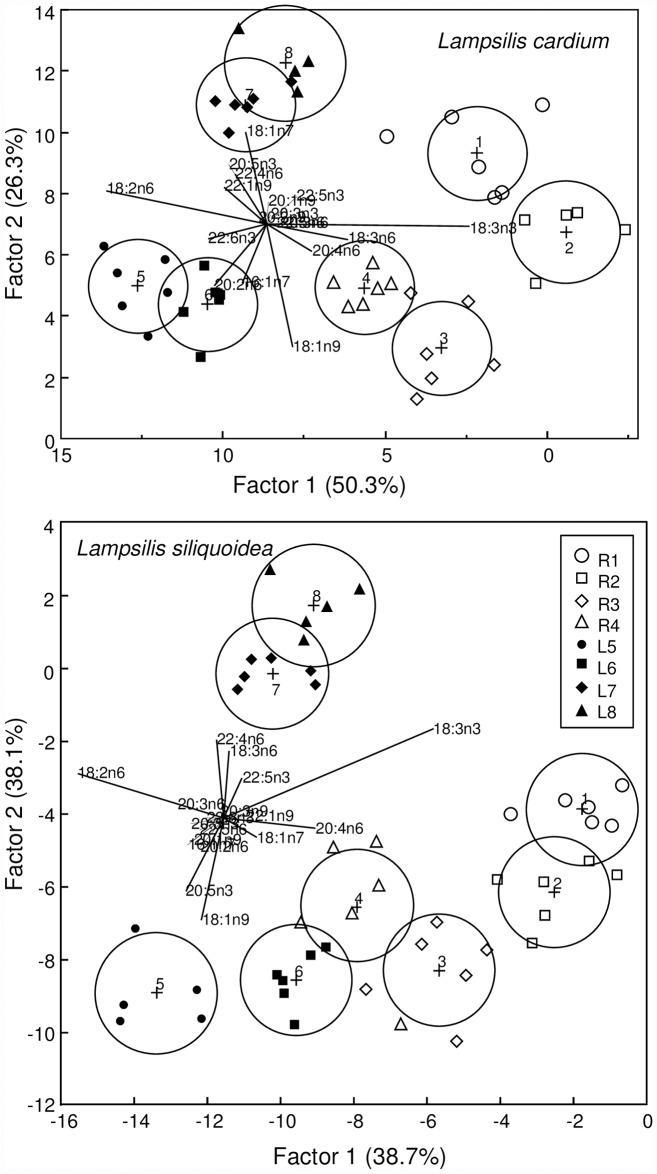
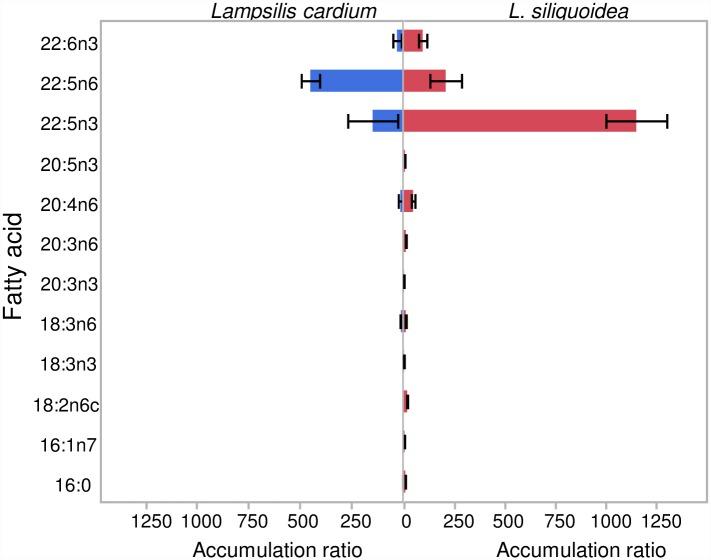
Increased nutrient and sediment loading in rivers have caused observable changes in algal community composition, and thereby, altered the quality and quantity of food resources available to native freshwater mussels. Our objective was to characterize the relationship between nutrient conditions and mussel food quality and examine the effects on fatty acid composition, growth and survival of juvenile mussels. Juvenile Lampsilis cardium and L. siliquoidea were deployed in cages for 28 d at four riverine and four lacustrine sites in the lower St. Croix River, Minnesota/Wisconsin, USA. Mussel foot tissue and food resources (four seston fractions and surficial sediment) were analyzed for quantitative fatty acid (FA) composition. Green algae were abundant in riverine sites, whereas cyanobacteria were most abundant in the lacustrine sites. Mussel survival was high (95%) for both species. Lampsilis cardium exhibited lower growth relative to L. siliquoidea (p <0.0001), but growth of L. cardium was not significantly different across sites (p = 0.13). In contrast, growth of L. siliquoidea was significantly greater at the most upstream riverine site compared to the lower three lacustrine sites (p = 0.002). In situ growth of Lampsilis siliquoidea was positively related to volatile solids (10 - 32 μm fraction), total phosphorus (<10 and 10 - 32 μm fractions), and select FA in the seston (docosapentaeonic acid, DPA, 22:5n3; 4,7,10,13,16-docosapentaenoic, 22:5n6; arachidonic acid, ARA, 20:4n6; and 24:0 in the <10 and 10 - 32 μm fractions). Our laboratory feeding experiment also indicated high accumulation ratios for 22:5n3, 22:5n6, and 20:4n6 in mussel tissue relative to supplied algal diet. In contrast, growth of L. siliquiodea was negatively related to nearly all FAs in the largest size fraction (i.e., >63 μm) of seston, including the bacterial FAs, and several of the FAs associated with sediments. Reduced mussel growth was observed in L. siliquoidea when the abundance of cyanobacteria exceeded 9% of the total phytoplankton biovolume. Areas dominated by cyanobacteria may not provide sufficient food quality to promote or sustain mussel growth.
河流中营养物质和沉积物负荷的增加已导致藻类群落组成发生明显变化,进而改变了本地淡水贻贝可利用的食物资源的质量和数量。我们的目标是描述营养条件与贻贝食物质量之间的关系,并研究其对幼体贻贝脂肪酸组成、生长和存活的影响。在美国明尼苏达州/威斯康星州圣克罗伊河下游的4个河流站点和4个湖泊站点,将幼体心形丽蚌和鳞形丽蚌置于网箱中28天。分析了贻贝足部组织和食物资源(四个悬浮颗粒级分和表层沉积物)的定量脂肪酸(FA)组成。河流站点绿藻丰富,而湖泊站点蓝藻最为丰富。两种贻贝的存活率都很高(95%)。相对于鳞形丽蚌,心形丽蚌的生长较慢(p<0.0001),但心形丽蚌在各站点间的生长差异不显著(p = 0.13)。相比之下,与下游三个湖泊站点相比,最上游河流站点的鳞形丽蚌生长显著更快(p = 0.002)。鳞形丽蚌的原位生长与挥发性固体(10 - 32μm级分)、总磷(<10和10 - 32μm级分)以及悬浮颗粒中的特定脂肪酸(二十二碳五烯酸,DPA,22:5n3;4,7,10,13,16 - 二十二碳五烯酸,22:5n6;花生四烯酸,ARA,20:4n6;以及<10和10 - 32μm级分中的24:0)呈正相关。我们的实验室投喂实验还表明,相对于提供的藻类食物,贻贝组织中22:5n3、22:5n6和20:4n6的积累率较高。相比之下,鳞形丽蚌的生长与悬浮颗粒最大级分(即>63μm)中的几乎所有脂肪酸呈负相关,包括细菌脂肪酸以及与沉积物相关的几种脂肪酸。当蓝藻丰度超过浮游植物总体积的9%时,观察到鳞形丽蚌的生长减缓。以蓝藻为主的区域可能无法提供足够的食物质量来促进或维持贻贝的生长。





 Zotero 插件