Gentil Coline A, Gammill Hilary S, Luu Christine T, Mayes Maureen D, Furst Dan E, Nelson J Lee
Division of Clinical Research, Fred Hutchinson Cancer Research Center, 1100 Fairview Ave N, Seattle, WA, 98109, USA.
Department of Obstetrics and Gynecology, University of Washington, Seattle, WA, USA.
Arthritis Res Ther. 2017 Mar 7;19(1):46. doi: 10.1186/s13075-017-1253-9.
Specific HLA class II alleles are associated with systemic sclerosis (SSc) risk, clinical characteristics, and autoantibodies. HLA nomenclature initially developed with antibodies as typing reagents defining DRB1 allele groups. However, alleles from different DRB1 allele groups encode the same third hypervariable region (3rd HVR) sequence, the primary T-cell recognition site, and 3rd HVR charge differences can affect interactions with T cells. We considered 3rd HVR sequences (amino acids 67-74) irrespective of the allele group and analyzed parental inheritance considered according to the 3rd HVR charge, comparing SSc patients with controls.
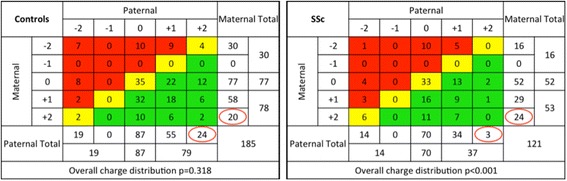
In total, 306 families (121 SSc and 185 controls) were HLA genotyped and parental HLA-haplotype origin was determined. Analysis was conducted according to DRβ1 3rd HVR sequence, charge, and parental inheritance.
The distribution of 3rd HVR sequences differed in SSc patients versus controls (p = 0.007), primarily due to an increase of specific DRB1*11 alleles, in accord with previous observations. The 3rd HVR sequences were next analyzed according to charge and parental inheritance. Paternal transmission of DRB1 alleles encoding a +2 charge 3rd HVR was significantly reduced in SSc patients compared with maternal transmission (p = 0.0003, corrected for analysis of four charge categories p = 0.001). To a lesser extent, paternal transmission was increased when charge was 0 (p = 0.021, corrected for multiple comparisons p = 0.084). In contrast, paternal versus maternal inheritance was similar in controls.
SSc patients differed from controls when DRB1 alleles were categorized according to 3rd HVR sequences. Skewed parental inheritance was observed in SSc patients but not in controls when the DRβ1 3rd HVR was considered according to charge. These observations suggest that epigenetic modulation of HLA merits investigation in SSc.
特定的人类白细胞抗原(HLA)II类等位基因与系统性硬化症(SSc)的风险、临床特征及自身抗体相关。HLA命名法最初是用抗体作为分型试剂来定义DRB1等位基因组的。然而,来自不同DRB1等位基因组的等位基因编码相同的第三高变区(3rd HVR)序列,即主要的T细胞识别位点,且3rd HVR电荷差异会影响与T细胞的相互作用。我们考虑了3rd HVR序列(氨基酸67 - 74),而不考虑等位基因组,并根据3rd HVR电荷分析亲代遗传情况,将SSc患者与对照组进行比较。
总共对306个家庭(121例SSc患者和185例对照)进行了HLA基因分型,并确定了亲代HLA单倍型来源。根据DRβ1 3rd HVR序列、电荷和亲代遗传情况进行分析。
SSc患者与对照组的3rd HVR序列分布不同(p = 0.007),主要是由于特定DRB1*11等位基因增加,这与先前的观察结果一致。接下来根据电荷和亲代遗传情况分析3rd HVR序列。与母系传递相比,编码带 +2电荷3rd HVR的DRB1等位基因的父系传递在SSc患者中显著减少(p = 0.0003,经四个电荷类别分析校正后p = 0.001)。在较小程度上,当电荷为0时父系传递增加(p = 0.021,经多重比较校正后p = 0.084)。相比之下,对照组中父系与母系遗传情况相似。
当根据3rd HVR序列对等位基因进行分类时,SSc患者与对照组不同。当根据电荷考虑DRβ1 3rd HVR时,在SSc患者中观察到亲代遗传偏倚,而在对照组中未观察到。这些观察结果表明,HLA的表观遗传调控值得在SSc中进行研究。