Archey William B, Arrick Bradley A
Norris Cotton Cancer Center, 1 Medical Center Drive, Lebanon, NH 03755 USA.
Department of Medicine, Dartmouth Medical School, Hanover, NH 03755 USA.
Cancer Cell Int. 2017 Mar 2;17:33. doi: 10.1186/s12935-017-0401-2. eCollection 2017.
Absence of the estrogen receptor-α (ER) is perhaps the most distinctive pathological feature of breast cancers arising in women who inherit a mutation in BRCA1. Two hypotheses, not necessarily mutually exclusive, exist in the literature that describe mechanisms of ER transcriptional repression in breast cancer. One hypothesis suggests that methylation of cytosine-guanine dinucleotides (CpGs) primarily mediates repression, while the other maintains that transcriptional control is mediated by certain positive and negative promoter elements.
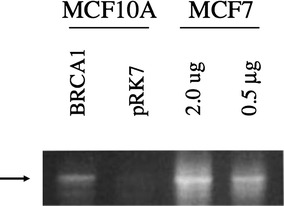
To determine if wild type BRCA1 could induce activity of the ER promoter, we performed a series of transient transfections with ER promoter segments linked to a luciferase reporter. The effect of BRCA1 on endogenous ER expression was evaluated by RNA analysis.
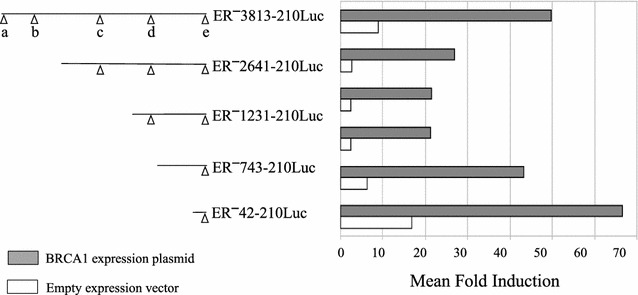
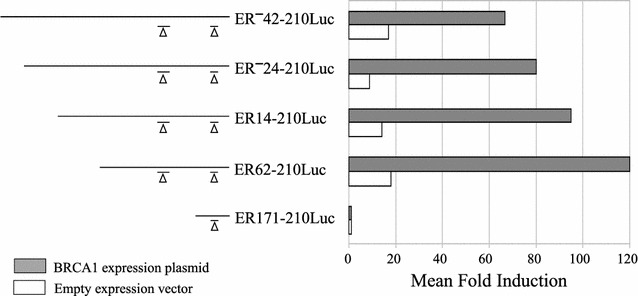
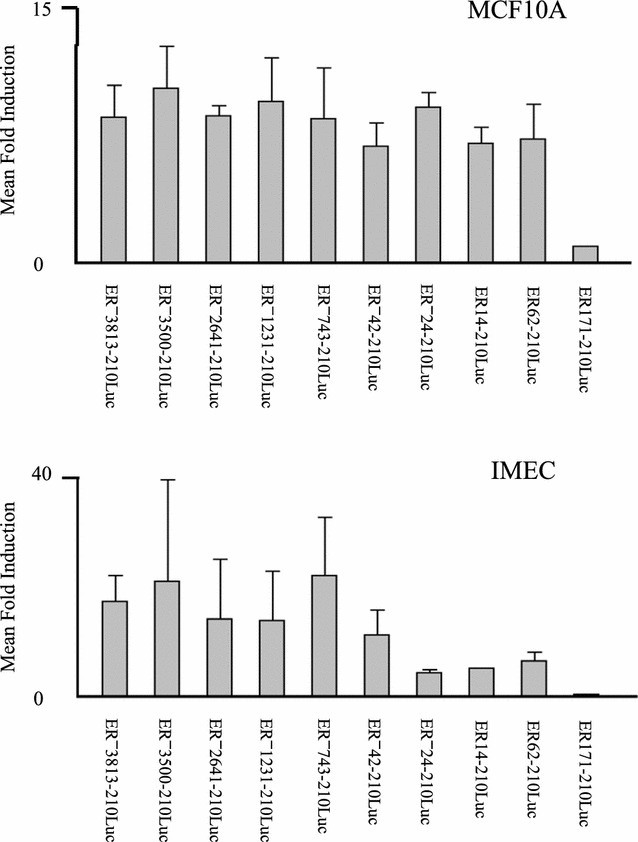
Following cotransfection with a BRCA1 expression plasmid, we observed that ER promoter-driven luciferase activity was significantly increased in both MCF10A and IMEC cells ( < 0.005 and 0.0005 respectively, two-tailed test). Specifically, the full length ER promoter construct showed approximately 5.6-fold (MCF10A) and tenfold (IMEC) increases in luciferase activity following BRCA1 transfection, compared with transfection with an empty expression plasmid (i.e. lacking BRCA1 sequence). We localized the ER promoter segment responsible for transactivation by BRCA1 to a 109 bp region containing an AP2γ homologous site.
The work described here, along with previously published work, indicates that activity of certain transcriptional regulatory elements and CpG methylation both represent important mechanisms by which the ER gene is typically inactive in breast cancers associated with BRCA1 mutations. The absence of ER in these breast cancers has significant implications for pathogenesis, prevention, and treatment.
雌激素受体α(ER)缺失可能是遗传性BRCA1基因突变女性所患乳腺癌最显著的病理特征。文献中存在两种描述乳腺癌中ER转录抑制机制的假说,这两种假说不一定相互排斥。一种假说认为胞嘧啶-鸟嘌呤二核苷酸(CpG)甲基化主要介导抑制作用,而另一种假说则认为转录调控由某些正负启动子元件介导。
为了确定野生型BRCA1是否能诱导ER启动子的活性,我们用与荧光素酶报告基因相连的ER启动子片段进行了一系列瞬时转染。通过RNA分析评估BRCA1对内源性ER表达的影响。
与BRCA1表达质粒共转染后,我们观察到在MCF10A和IMEC细胞中,ER启动子驱动的荧光素酶活性均显著增加(分别为<0.005和0.0005,双侧检验)。具体而言,与用空表达质粒(即不含BRCA1序列)转染相比,全长ER启动子构建体在转染BRCA1后荧光素酶活性分别增加了约5.6倍(MCF10A)和10倍(IMEC)。我们将负责BRCA1反式激活的ER启动子片段定位到一个包含AP2γ同源位点的109 bp区域。
本文所述工作以及先前发表的工作表明,某些转录调控元件的活性和CpG甲基化均代表了ER基因在与BRCA1突变相关的乳腺癌中通常无活性的重要机制。这些乳腺癌中ER的缺失对发病机制、预防和治疗具有重要意义。