Oka Takakazu, Wakita Hisako, Kimura Keishin
Department of Psychosomatic Medicine, Graduate School of Medical Sciences, Kyushu University, Maidashi 3-1-1, Higashi-ku, Fukuoka, 812-8582 Japan.
Japan Yoga Therapy Society, Sanbonmatsu 1-2-24, Yonago, Tottori 683-0842 Japan.
Biopsychosoc Med. 2017 Mar 3;11:5. doi: 10.1186/s13030-017-0090-z. eCollection 2017.
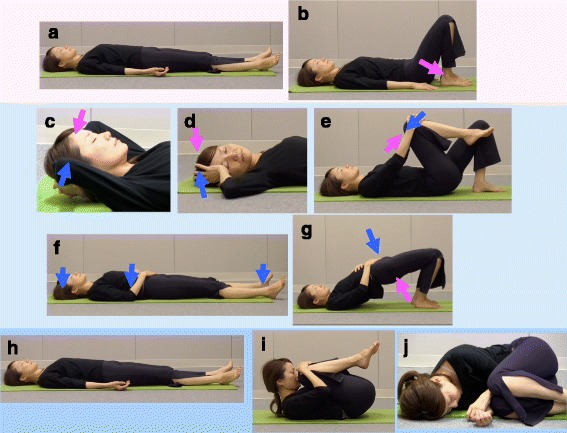
Our previous randomized controlled trial demonstrated that isometric yoga in a sitting position reduces fatigue in patients with chronic fatigue syndrome/myalgic encephalomyelitis (CFS/ME). However, some patients experience difficulties sitting or practicing isometric yoga in a sitting position for long periods. To date, therapeutic interventions for patients with severe symptoms have not been established. Therefore, we developed a recumbent isometric yoga program, which takes approximately 20 min to complete, designed to reduce fatigue in patients with severe CFS/ME. The aim of this pilot study was to assess the feasibility, safety, and usefulness of this program.
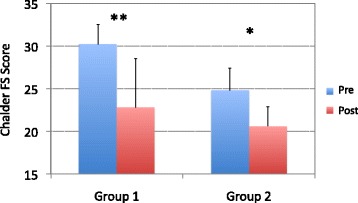
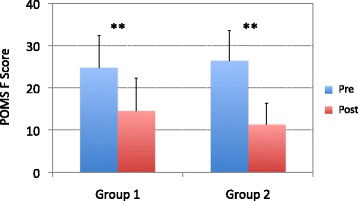
This pilot study included 12 adult patients with CFS/ME. Six patients were reluctant to practice isometric yoga in a sitting position because of the severity of their fatigue (group 1). The remaining six patients had previously practiced isometric yoga in a sitting position (group 2). For 3 months, the patients of both groups practiced recumbent isometric yoga every 2 to 4 weeks with a yoga instructor and at home on other days if they could. The short-term effects of isometric yoga on fatigue were assessed using the Profile of Mood Status (POMS) questionnaire immediately before and after their final session with the yoga instructor. The long-term effects of isometric yoga on fatigue were assessed using the Chalder Fatigue Scale (FS) questionnaire before and after the intervention period. Adverse events, satisfaction with the program, and preference of yoga position (sitting or recumbent) were also recorded.
All subjects completed the intervention. In both groups, the POMS fatigue score was significantly decreased after practicing the 20-min yoga program and the Chalder FS score was decreased significantly after the 3-month intervention period. There were no serious adverse events. All subjects in group 2 preferred the recumbent isometric yoga program over a sitting yoga program.
This study suggests that recumbent isometric yoga is a feasible and acceptable treatment for patients with CFS/ME, even for patients who experience difficulty practicing isometric yoga in the sitting position.
我们之前的随机对照试验表明,坐姿等长瑜伽可减轻慢性疲劳综合征/肌痛性脑脊髓炎(CFS/ME)患者的疲劳。然而,一些患者在长时间坐着或进行坐姿等长瑜伽练习时会遇到困难。迄今为止,尚未确立针对症状严重患者的治疗干预措施。因此,我们制定了一项约需20分钟完成的卧式等长瑜伽计划,旨在减轻重度CFS/ME患者的疲劳。这项初步研究的目的是评估该计划的可行性、安全性和有效性。
这项初步研究纳入了12名成年CFS/ME患者。6名患者因疲劳严重而不愿进行坐姿等长瑜伽练习(第1组)。其余6名患者之前曾进行过坐姿等长瑜伽练习(第2组)。在3个月的时间里,两组患者每2至4周在瑜伽教练的指导下进行卧式等长瑜伽练习,如果可以的话,在其他日子在家中自行练习。在与瑜伽教练的最后一次课程前后,使用情绪状态剖面图(POMS)问卷评估等长瑜伽对疲劳的短期影响。在干预期前后,使用查尔德疲劳量表(FS)问卷评估等长瑜伽对疲劳的长期影响。还记录了不良事件、对该计划的满意度以及对瑜伽姿势(坐姿或卧式)的偏好。
所有受试者均完成了干预。在两组中,进行20分钟的瑜伽计划后,POMS疲劳评分显著降低,3个月干预期后,查尔德FS评分显著降低。没有严重的不良事件。第2组的所有受试者都更喜欢卧式等长瑜伽计划,而不是坐姿瑜伽计划。
这项研究表明,卧式等长瑜伽对于CFS/ME患者是一种可行且可接受的治疗方法,即使对于那些在进行坐姿等长瑜伽练习时有困难的患者也是如此。