El-Yazbi Ahmed F, Abd-Elrahman Khaled S
Department of Pharmacology and Toxicology, Faculty of Medicine, American University of BeirutBeirut, Lebanon; Department of Pharmacology and Toxicology, Faculty of Pharmacy, Alexandria UniversityAlexandria, Egypt.
Department of Pharmacology and Toxicology, Faculty of Pharmacy, Alexandria UniversityAlexandria, Egypt; Department of Cellular and Molecular Medicine, Faculty of Medicine, University of OttawaOttawa, ON, Canada.
Front Pharmacol. 2017 Feb 23;8:87. doi: 10.3389/fphar.2017.00087. eCollection 2017.
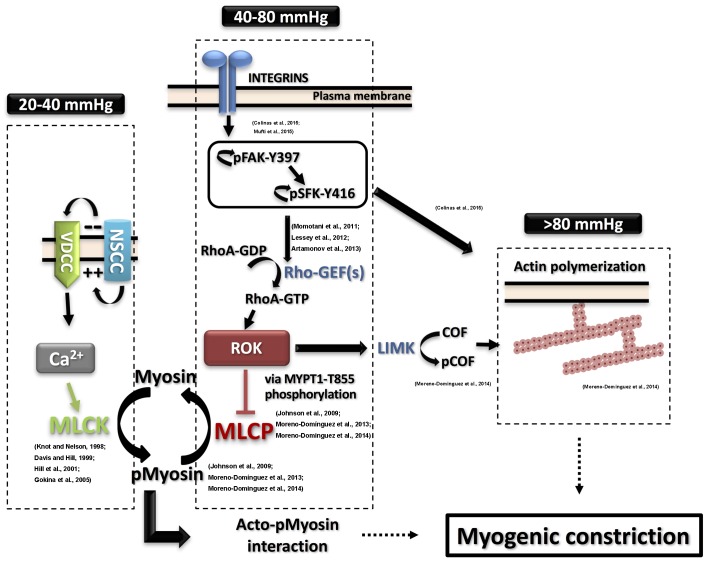
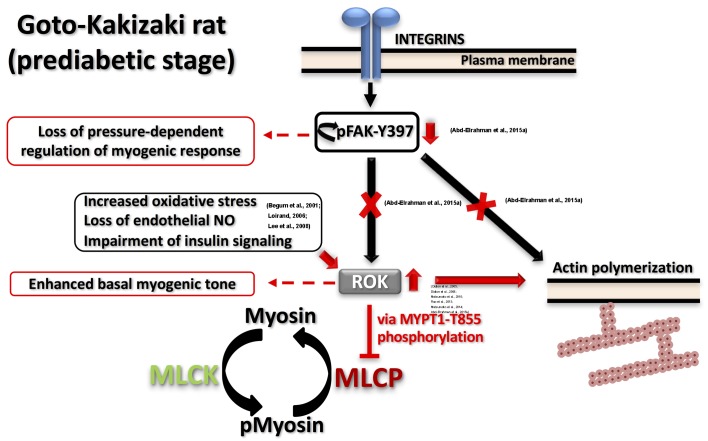
The myogenic response is an inherent property of resistance arteries that warrants a relatively constant blood flow in response to changes in perfusion pressure and protect delicate organs from vascular insufficiencies and excessive blood flow. This fundamental phenomenon has been extensively studied aiming to elucidate the underlying mechanisms triggering smooth muscle contraction in response to intraluminal pressure elevation, particularly, Rho-associated kinase (ROK)-mediated Ca-independent mechanisms. The size of the resistance arteries limits the capacity to examine changes in protein phosphorylation/expression levels associated with ROK signaling. A highly sensitive biochemical detection approach was beneficial in examining the role of ROK in different force generation mechanisms along the course of myogenic constriction. In this mini review, we summarize recent results showing direct evidence for the contribution of ROK in development of myogenic response at the level of mechanotransduction, myosin light chain phosphatase inhibition and dynamic actin cytoskeleton reorganization. We will also present evidence that alterations in ROK signaling could underlie the progressive loss in myogenic response in a rat model of type 2 diabetes.
肌源性反应是阻力动脉的一种固有特性,可确保在灌注压力变化时血流相对恒定,并保护脆弱器官免受血管供血不足和血流过多的影响。这一基本现象已得到广泛研究,旨在阐明腔内压力升高时触发平滑肌收缩的潜在机制,特别是 Rho 相关激酶(ROK)介导的钙非依赖性机制。阻力动脉的大小限制了检测与 ROK 信号相关的蛋白质磷酸化/表达水平变化的能力。一种高度灵敏的生化检测方法有助于研究 ROK 在肌源性收缩过程中不同力产生机制中的作用。在本综述中,我们总结了近期的研究结果,这些结果显示了 ROK 在机械转导、肌球蛋白轻链磷酸酶抑制和动态肌动蛋白细胞骨架重组水平上对肌源性反应发展的贡献的直接证据。我们还将提供证据表明,ROK 信号的改变可能是 2 型糖尿病大鼠模型中肌源性反应逐渐丧失的基础。