Kwako Laura E, Momenan Reza, Grodin Erica N, Litten Raye Z, Koob George F, Goldman David
Office of the Clinical Director, National Institute on Alcohol Abuse and Alcoholism, National Institutes of Health, Bethesda, MD, 20892, USA.
Clinical Neuroimaging Research Core, National Institute on Alcohol Abuse and Alcoholism, National Institutes of Health, Bethesda, MD, 20892, USA.
Neuropharmacology. 2017 Aug 1;122:254-264. doi: 10.1016/j.neuropharm.2017.03.006. Epub 2017 Mar 7.
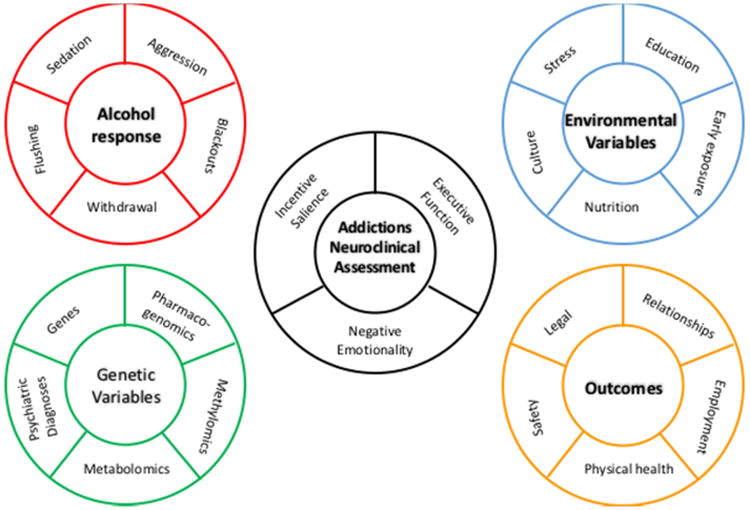
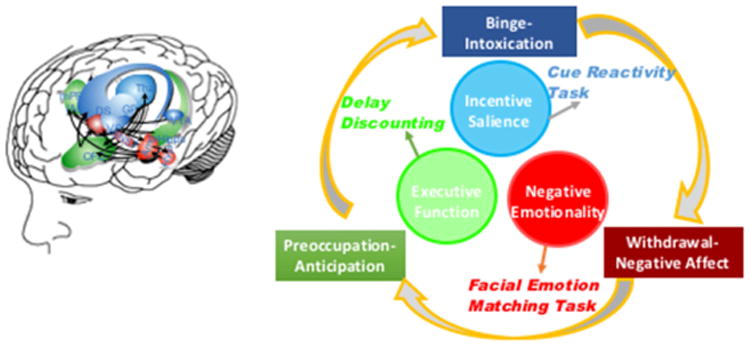
Incentive salience, negative emotionality, and executive function are functional domains that are etiologic in the initiation and progression of addictive disorders, having been implicated in humans with addictive disorders and in animal models of addictions. Measures of these three neuroscience-based functional domains can capture much of the effects of inheritance and early exposures that lead to trait vulnerability shared across different addictive disorders. For specific addictive disorders, these measures can be supplemented by agent specific measures such as those that access pharmacodynamic and pharmacokinetic variation attributable to agent-specific gatekeeper molecules including receptors and drug-metabolizing enzymes. Herein, we focus on the translation and reverse translation of knowledge derived from animal models of addiction to the human condition via measures of neurobiological processes that are orthologous in animals and humans, and that are shared in addictions to different agents. Based on preclinical data and human studies, measures of these domains in a general framework of an Addictions Neuroclinical Assessment (ANA) can transform the assessment and nosology of addictive disorders, and can be informative for staging disease progression. We consider next steps and challenges for implementation of ANA in clinical care and research. This article is part of the Special Issue entitled "Alcoholism".
动机显著性、负性情绪和执行功能是成瘾性障碍发生和发展过程中的病因性功能领域,在成瘾性障碍患者和成瘾动物模型中均有涉及。基于这三个神经科学功能领域的测量方法可以捕捉到许多遗传因素和早期接触因素的影响,这些因素会导致不同成瘾性障碍共有的特质易感性。对于特定的成瘾性障碍,这些测量方法可以通过特定药物的测量方法进行补充,例如那些能够获取归因于特定药物守门分子(包括受体和药物代谢酶)的药效学和药代动力学变化的方法。在此,我们重点关注如何通过在动物和人类中同源且在不同药物成瘾中均存在的神经生物学过程测量方法,将成瘾动物模型中的知识转化并反向转化为人类情况。基于临床前数据和人体研究,在成瘾神经临床评估(ANA)的总体框架内对这些领域进行测量,可以改变成瘾性障碍的评估和分类,并为疾病进展分期提供信息。我们考虑了在临床护理和研究中实施ANA的后续步骤和挑战。本文是名为“酒精中毒”的特刊的一部分。