Yamazaki Naoya, Takenouchi Tatsuya, Fujimoto Manabu, Ihn Hironobu, Uchi Hiroshi, Inozume Takashi, Kiyohara Yoshio, Uhara Hisashi, Nakagawa Kazuhiko, Furukawa Hiroshi, Wada Hidefumi, Noguchi Kazuo, Shimamoto Takashi, Yokota Kenji
Department of Dermatologic Oncology, National Cancer Center Hospital, 5-1-1 Tsukiji, Chuo-ku, Tokyo, 104-0045, Japan.
Department of Dermatology, Niigata Cancer Center Hospital, Niigata, Japan.
Cancer Chemother Pharmacol. 2017 Apr;79(4):651-660. doi: 10.1007/s00280-016-3237-x. Epub 2017 Mar 11.
This phase I b study evaluated the safety and anti-tumor activity of pembrolizumab in Japanese patients with advanced melanoma.
Pembrolizumab (2 mg/kg) was given every 3 weeks (Q3W) for up to 2 years or until confirmed progression or unacceptable toxicity. The tumor response was assessed as per the Response Evaluation Criteria in Solid Tumors version 1.1 (RECIST v1.1) by both investigator review and central review.
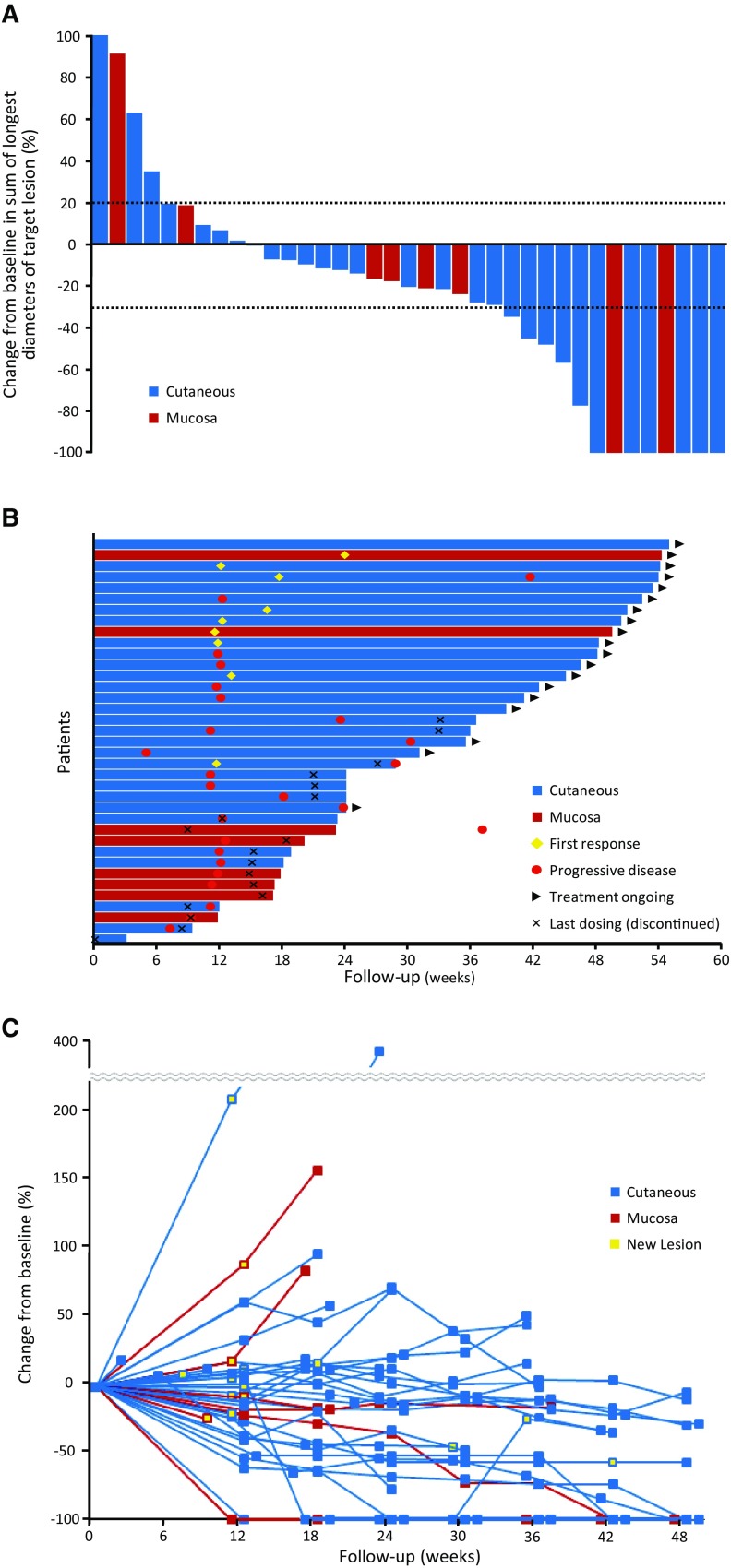
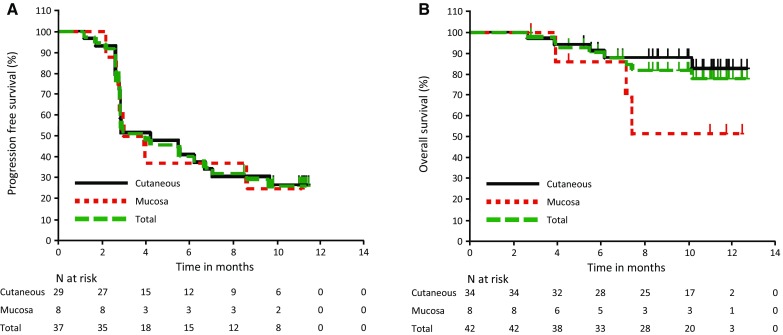
Forty-two patients with advanced melanoma received pembrolizumab. A primary cutaneous histology was observed in 34 patients (81.0%), while a primary mucosal histology was observed in 8 patients (19.0%). Thirty-four patients (81.0%) experienced treatment-related adverse events (AEs). The most common treatment-related AEs were pruritus, maculopapular rash, malaise, and hypothyroidism. Grade 3-5 treatment-related AEs occurred in 8 patients (19.0%). The only grade 3-5 treatment-related AE reported in at least two patients was anemia. There were two treatment-related deaths (unknown cause and cerebral hemorrhage). Among the 37 evaluable patients, the confirmed overall response rates (ORRs) determined by central review were 24.1% (95% CI 10.3-43.5) for cutaneous melanoma and 25.0% (95% CI 3.2-65.1) for mucosal melanoma. The responses were durable, and the median duration of response was not reached in either population. The median overall survival (OS) was not reached, with a 12-month OS of 82.7% for cutaneous melanoma and 51.4% for mucosal melanoma.
The safety profile of pembrolizumab in Japanese patients was similar to that reported in the previous clinical studies. Pembrolizumab provided promising anti-tumor activity in Japanese patients with advanced melanoma.
本I b期研究评估了帕博利珠单抗在日本晚期黑色素瘤患者中的安全性和抗肿瘤活性。
每3周(Q3W)给予帕博利珠单抗(2 mg/kg),持续2年或直至确认疾病进展或出现不可接受的毒性。由研究者评估和中心评估按照实体瘤疗效评价标准第1.1版(RECIST v1.1)评估肿瘤反应。
42例晚期黑色素瘤患者接受了帕博利珠单抗治疗。34例患者(81.0%)为原发性皮肤组织学类型,8例患者(19.0%)为原发性黏膜组织学类型。34例患者(81.0%)发生了与治疗相关的不良事件(AE)。最常见的与治疗相关的AE为瘙痒、斑丘疹、不适和甲状腺功能减退。8例患者(19.0%)发生3 - 5级与治疗相关的AE。至少2例患者报告的唯一3 - 5级与治疗相关的AE为贫血。有2例与治疗相关的死亡(原因不明和脑出血)。在37例可评估患者中,中心评估确定的皮肤黑色素瘤确诊总缓解率(ORR)为24.1%(95%CI 10.3 - 43.5),黏膜黑色素瘤为25.0%(95%CI 3.2 - 65.1)。缓解持续存在,两个群体的中位缓解持续时间均未达到。中位总生存期(OS)未达到,皮肤黑色素瘤12个月总生存率为82.7%,黏膜黑色素瘤为51.4%。
帕博利珠单抗在日本患者中的安全性与先前临床研究报告的相似。帕博利珠单抗在日本晚期黑色素瘤患者中显示出有前景的抗肿瘤活性。