Peters Abby E, Comerford Eithne J, Macaulay Sophie, Bates Karl T, Akhtar Riaz
Department of Musculoskeletal Biology, Institute of Ageing and Chronic Disease, University of Liverpool, The William Henry Duncan Building, 6 West Derby Street, Liverpool L7 8TX, UK; Department of Mechanical, Materials and Aerospace Engineering, School of Engineering, University of Liverpool, The Quadrangle, Brownlow Hill, Liverpool L69 3GH, UK.
Department of Musculoskeletal Biology, Institute of Ageing and Chronic Disease, University of Liverpool, The William Henry Duncan Building, 6 West Derby Street, Liverpool L7 8TX, UK; Department of Mechanical, Materials and Aerospace Engineering, School of Engineering, University of Liverpool, The Quadrangle, Brownlow Hill, Liverpool L69 3GH, UK; Institute of Veterinary Science, Leahurst Campus, University of Liverpool, Chester High Road, Neston, Wirral CH64 7TE, UK.
J Mech Behav Biomed Mater. 2017 Jul;71:114-121. doi: 10.1016/j.jmbbm.2017.03.006. Epub 2017 Mar 7.
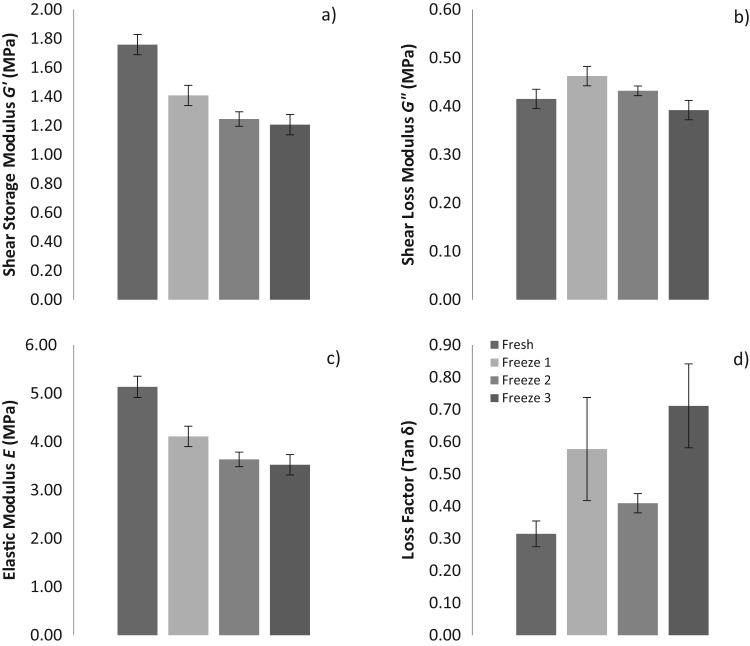
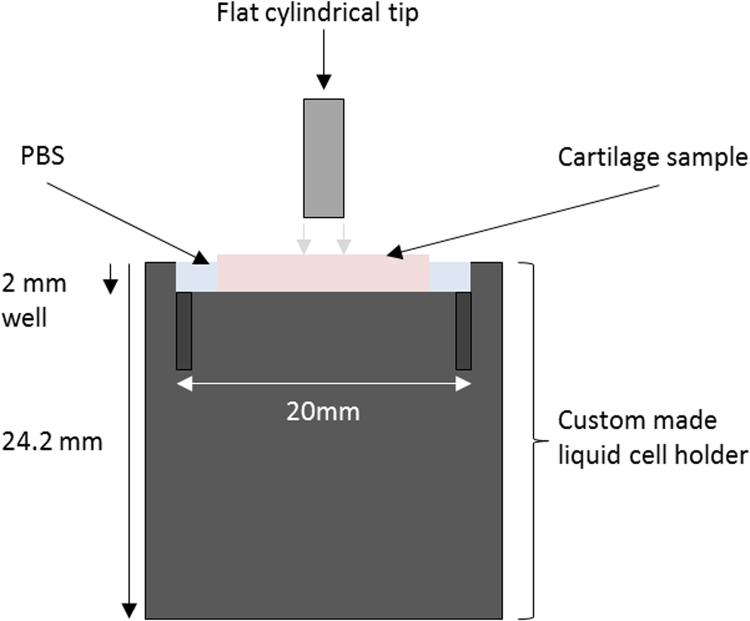
Tissue material properties are crucial to understanding their mechanical function, both in healthy and diseased states. However, in certain circumstances logistical limitations can prevent testing on fresh samples necessitating one or more freeze-thaw cycles. To date, the nature and extent to which the material properties of articular cartilage are altered by repetitive freezing have not been explored. Therefore, the aim of this study is to quantify how articular cartilage mechanical properties, measured by nanoindentation, are affected by multiple freeze-thaw cycles. Canine cartilage plugs (n = 11) from medial and lateral femoral condyles were submerged in phosphate buffered saline, stored at 3-5°C and tested using nanoindentation within 12h. Samples were then frozen at -20°C and later thawed at 3-5°C for 3h before material properties were re-tested and samples re-frozen under the same conditions. This process was repeated for all 11 samples over three freeze-thaw cycles. Overall mean and standard deviation of shear storage modulus decreased from 1.76 ± 0.78 to 1.21 ± 0.77MPa (p = 0.91), shear loss modulus from 0.42 ± 0.19 to 0.39 ± 0.17MPa (p=0.70) and elastic modulus from 5.13 ± 2.28 to 3.52 ± 2.24MPa (p = 0.20) between fresh and three freeze-thaw cycles respectively. The loss factor increased from 0.31 ± 0.38 to 0.71 ± 1.40 (p = 0.18) between fresh and three freeze-thaw cycles. Inter-sample variability spanned as much as 10.47MPa across freezing cycles and this high-level of biological variability across samples likely explains why overall mean "whole-joint" trends do not reach statistical significance across the storage conditions tested. As a result multiple freeze-thaw cycles cannot be explicitly or statistically linked to mechanical changes within the cartilage. However, the changes in material properties observed herein may be sufficient in magnitude to impact on a variety of clinical and scientific studies of cartilage, and should be considered when planning experimental protocols.
组织材料特性对于理解其在健康和患病状态下的机械功能至关重要。然而,在某些情况下,后勤限制可能会妨碍对新鲜样本进行测试,从而需要进行一个或多个冻融循环。迄今为止,反复冷冻对关节软骨材料特性的改变性质和程度尚未得到研究。因此,本研究的目的是量化通过纳米压痕测量的关节软骨机械性能如何受到多个冻融循环的影响。将来自犬股骨内侧和外侧髁的软骨栓(n = 11)浸入磷酸盐缓冲盐水中,储存在3 - 5°C,并在12小时内使用纳米压痕进行测试。然后将样本在-20°C冷冻,之后在3 - 5°C解冻3小时,然后重新测试材料性能并在相同条件下重新冷冻。对所有11个样本重复此过程,进行三个冻融循环。新鲜样本和经过三个冻融循环后,剪切储能模量的总体平均值和标准差分别从1.76±0.78降至1.21±0.77MPa(p = 0.91),剪切损耗模量从0.42±0.19降至0.39±0.17MPa(p = 0.70),弹性模量从5.13±2.28降至3.52±2.24MPa(p = 0.20)。新鲜样本和经过三个冻融循环后,损耗因子从0.31±0.38增加到0.71±1.40(p = 0.18)。在冷冻循环中,样本间变异性高达10.47MPa,并且样本间这种高水平的生物学变异性可能解释了为什么在测试的储存条件下总体平均“全关节”趋势未达到统计学显著性。因此,多个冻融循环与软骨内的机械变化之间无法建立明确的或统计学上的联系。然而,本文观察到的材料性能变化在幅度上可能足以影响各种软骨临床和科学研究,并且在规划实验方案时应予以考虑。