Qiu ZhiHuang, Chen LiangWan, Cao Hua, Chen Qiang, Peng Hua
Department of Cardiac Surgery, Union Hospital, Fujian Medical University, Fuzhou, Fujian, China (mainland).
Med Sci Monit. 2017 Mar 13;23:1268-1276. doi: 10.12659/msm.899547.
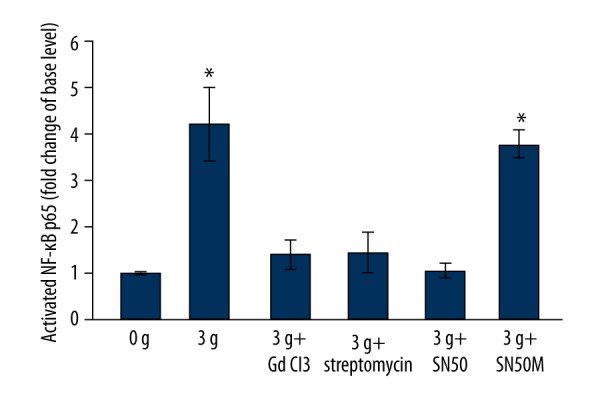
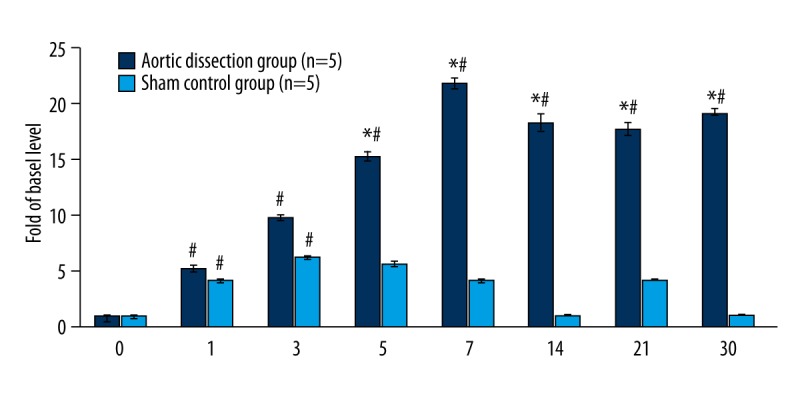
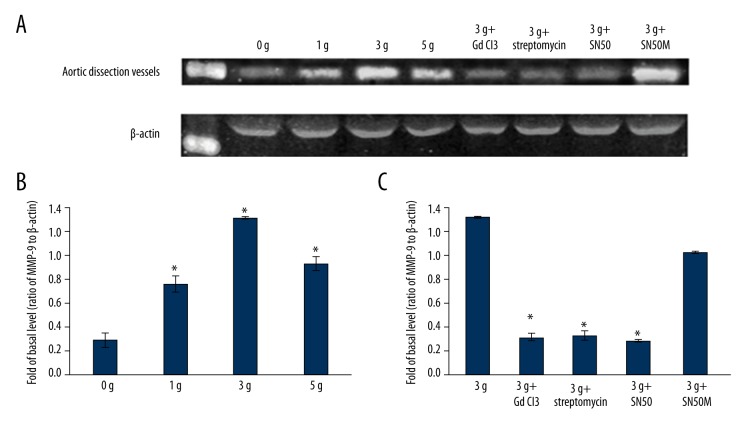
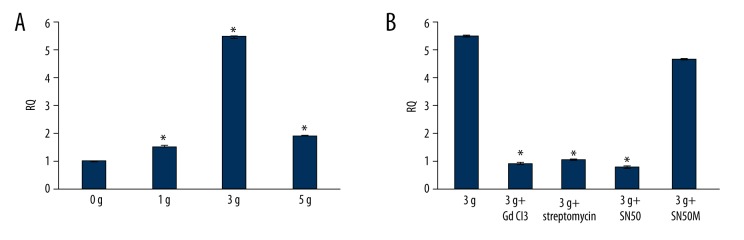
BACKGROUND The aim of the study was to investigate the expression of matrix metalloproteinase-9 (MMP-9) in rat abdominal aortic dissection (AD) induced by mechanical strain, so as to offer a better understanding of the possible mechanisms of AD. MATERIAL AND METHODS Experimental AD in rats was achieved by the injection of porcine pancreatic elastase. At days 0, 1, 3, 5, 7, 14, 21, and 30 after the establishment of AD model, serum MMP-9 levels were measured by enzyme-linked immunosorbent assay (ELISA). Four groups of vascular rings were stretched in vitro with a mechanical strength of 0 g, 1 g, 3 g, or 5 g for 30 min. Another four groups were pretreated with GdCl3, streptomycin, SN50, and SN50M, followed by stretching with 3 g for 30 min. The messenger RNA and the protein of MMP-9 were analyzed by real-time RT-PCR and Western blotting, and NF-κB p65 was detected by ELISA. RESULTS After the establishment of rat abdominal AD model, the serum MMP-9 levels of AD groups increased significantly. The results showed increased expression of MMP-9 in rat AD vessels stretched with mechanical strength of 1 g, 3 g, and 5 g, but this effect was mostly blocked by Gd Cl3 and streptomycin. The NF-κB activity in aortic rings was activated by stretching with a mechanical strength of 3 g and was blocked by SN50, but not by SN50M. CONCLUSIONS The expression of MMP-9 in serum was increased significantly after rat abdominal AD formation. Mechanical strain induced MMP-9 expression in AD vessels, which was mediated through the activation of the stretch-activated channel-induced NF-κB pathway.
背景 本研究旨在探讨基质金属蛋白酶-9(MMP-9)在机械应变诱导的大鼠腹主动脉夹层(AD)中的表达,以便更好地理解AD的可能机制。
材料与方法 通过注射猪胰弹性蛋白酶建立大鼠实验性AD模型。在AD模型建立后的第0、1、3、5、7、14、21和30天,采用酶联免疫吸附测定(ELISA)法检测血清MMP-9水平。将四组血管环分别以0 g、1 g、3 g或5 g的机械强度在体外拉伸30分钟。另外四组先用GdCl3、链霉素、SN50和SN50M预处理,然后以3 g的强度拉伸30分钟。采用实时逆转录-聚合酶链反应(RT-PCR)和蛋白质印迹法分析MMP-9的信使核糖核酸(mRNA)和蛋白质,并通过ELISA检测核因子-κB p65。
结果 大鼠腹主动脉AD模型建立后,AD组血清MMP-9水平显著升高。结果显示,在以1 g、3 g和5 g机械强度拉伸的大鼠AD血管中,MMP-9表达增加,但这种作用大多被GdCl3和链霉素阻断。主动脉环中的核因子-κB活性在以3 g机械强度拉伸时被激活,并被SN50阻断,但未被SN50M阻断。
结论 大鼠腹主动脉AD形成后,血清中MMP-9的表达显著增加。机械应变诱导AD血管中MMP-9的表达,这是通过拉伸激活通道诱导的核因子-κB途径的激活介导的。