Bowers E Keith, Thompson Charles F, Sakaluk Scott K
Behavior, Ecology, Evolution, and Systematics Section, School of Biological Sciences, Illinois State University, Normal, IL 61790-4120 USA.
Evol Biol. 2017 Mar;44(1):11-20. doi: 10.1007/s11692-016-9380-9. Epub 2016 Mar 25.
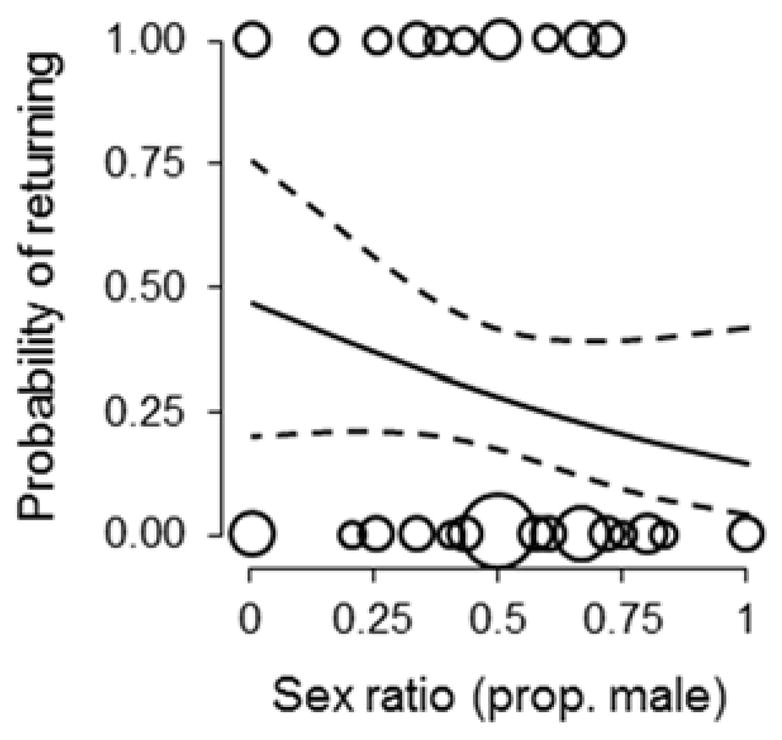
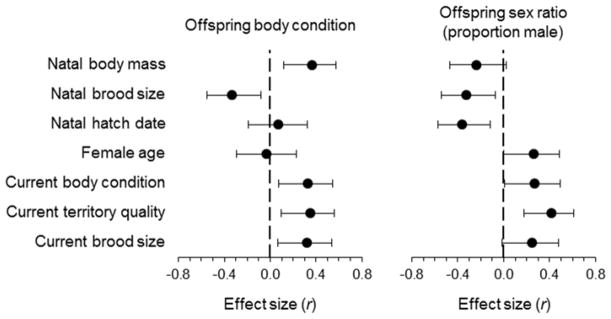
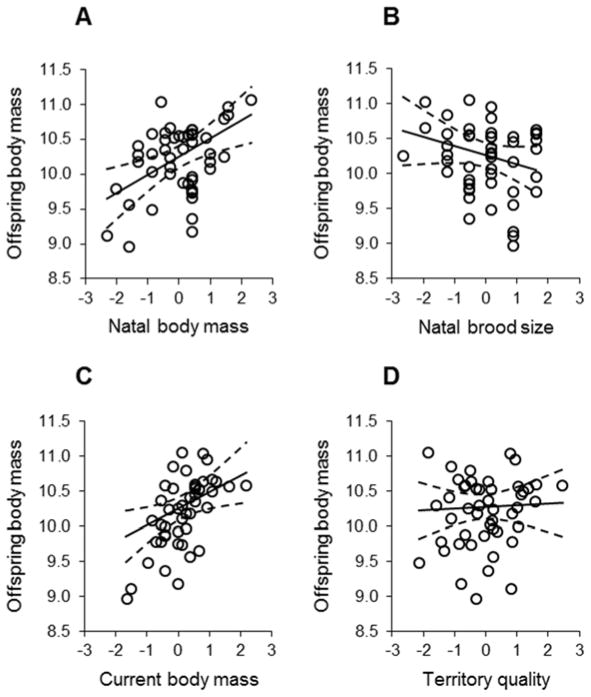
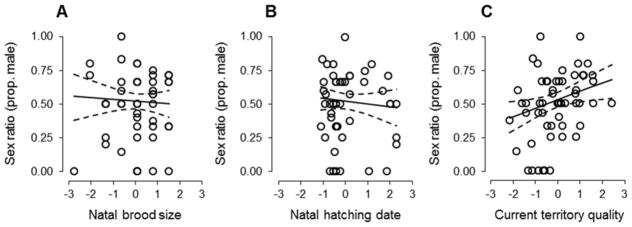
Females in a variety of taxa adjust offspring sex ratios to prevailing ecological conditions. However, little is known about whether conditions experienced during a female's early ontogeny influence the sex ratio of her offspring. We tested for past and present ecological predictors of offspring sex ratios among known-age females that were produced as offspring and bred as adults in a population of house wrens. The body condition of offspring that a female produced and the proportion of her offspring that were male were negatively correlated with the size of the brood in which she herself was reared. The proportion of sons within broods was negatively correlated with maternal hatching date, and varied positively with the quality of a female's current breeding territory as predicted. However, females producing relatively more sons than daughters were less likely to return to breed in the population the following year. Although correlative, our results suggest that the rearing environment can have enduring effects on later maternal investment and sex allocation. Moreover, the overproduction of sons relative to daughters may increase costs to a female's residual reproductive value, constraining the extent to which sons might be produced in high-quality breeding conditions. Sex allocation in birds remains a contentious subject, largely because effects on offspring sex ratios are small. Our results suggest that offspring sex ratios are shaped by various processes and trade-offs that act throughout the female life history and ultimately reduce the extent of sex-ratio adjustment relative to classic theoretical predictions.
多种分类群中的雌性会根据当前的生态条件调整后代的性别比例。然而,对于雌性个体早期发育过程中所经历的条件是否会影响其后代的性别比例,我们却知之甚少。我们在一群家鹪鹩中,对已知年龄的雌性个体进行了测试,这些雌性个体在幼年时作为后代出生,成年后进行繁殖,以此来寻找后代性别比例的过去和当前的生态预测因素。雌性所产后代的身体状况以及其雄性后代的比例与它自己成长过程中的育雏规模呈负相关。一窝中儿子的比例与母亲的孵化日期呈负相关,并且正如所预测的那样,与雌性当前繁殖领地的质量呈正相关。然而,产下相对较多儿子的雌性次年回到该种群中繁殖的可能性较小。尽管这些结果只是相关性的,但它们表明成长环境可能会对后期的母体投资和性别分配产生持久影响。此外,相对于女儿而言儿子的过量生产可能会增加雌性剩余繁殖价值的成本,从而限制了在高质量繁殖条件下可能生产儿子的程度。鸟类的性别分配仍然是一个有争议的话题,很大程度上是因为对后代性别比例的影响较小。我们的结果表明,后代性别比例是由贯穿雌性生命历程的各种过程和权衡所塑造的,最终相对于经典理论预测而言,降低了性别比例调整的程度。