Wan Quanyuan, Yang Chunrong, Rao Youliang, Liao Zhiwei, Su Jianguo
College of Fisheries, Huazhong Agricultural University , Wuhan , China.
College of Veterinary Medicine, Huazhong Agricultural University , Wuhan , China.
Front Immunol. 2017 Feb 24;8:189. doi: 10.3389/fimmu.2017.00189. eCollection 2017.
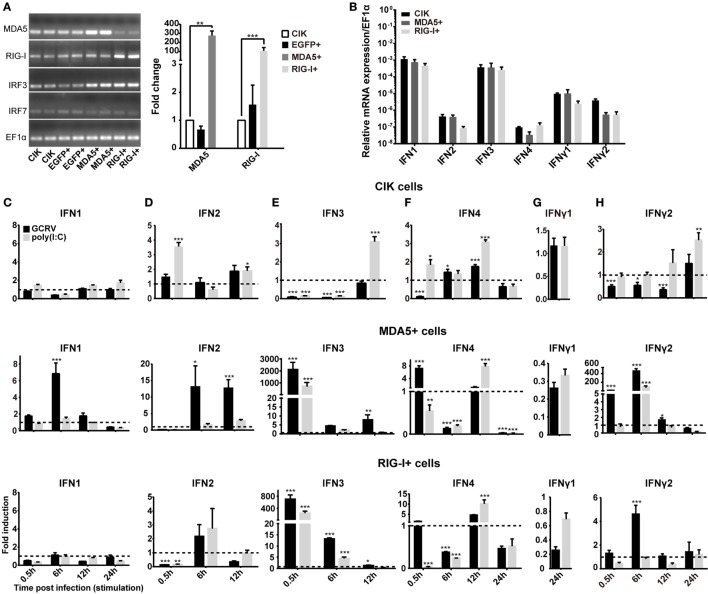
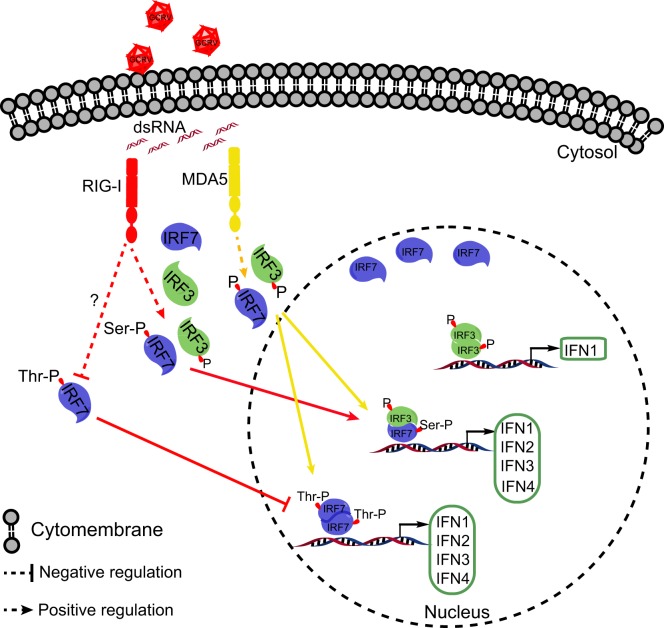
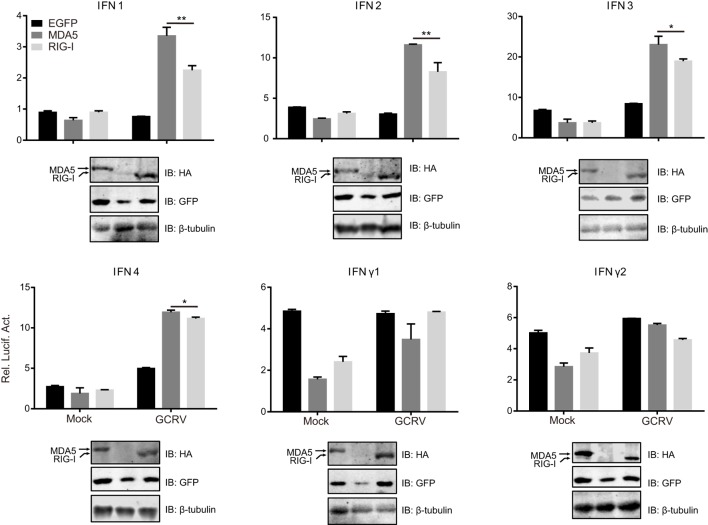
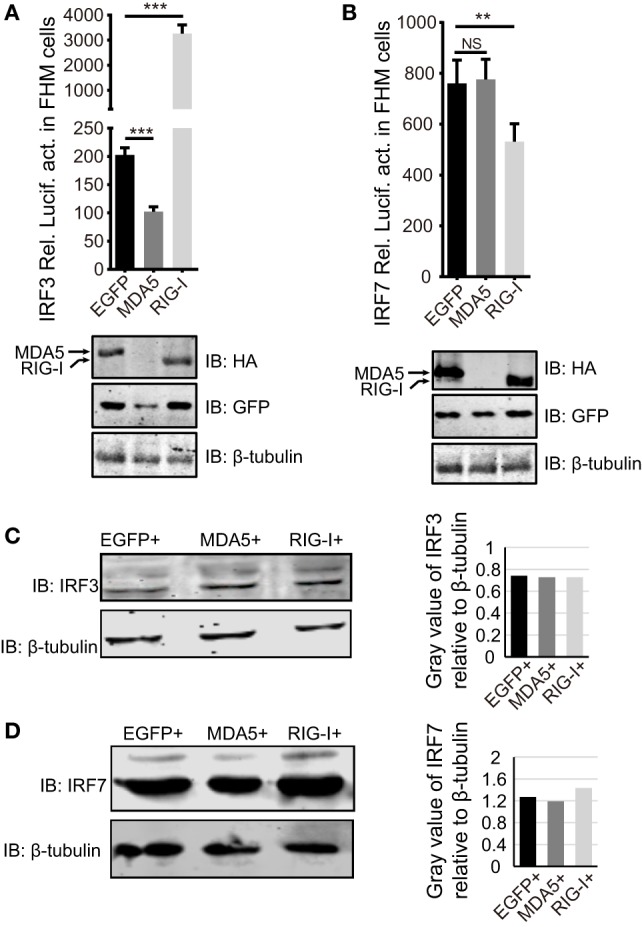
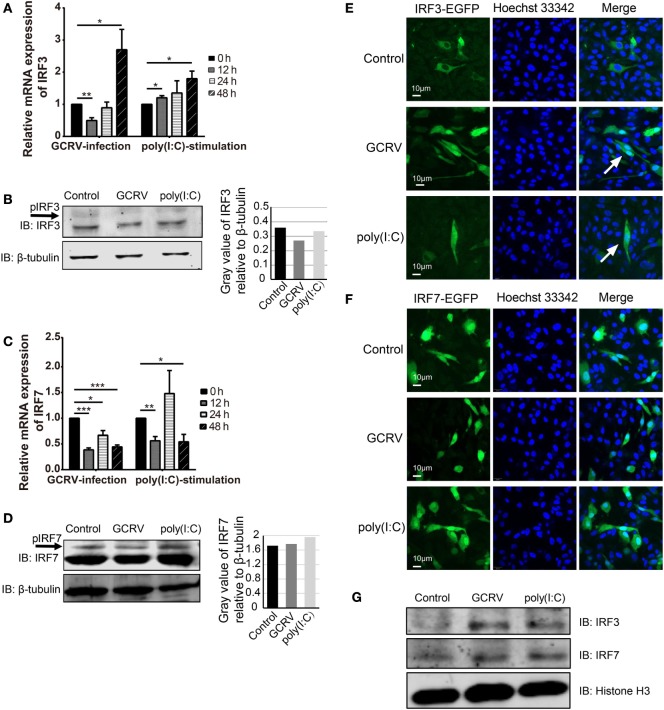
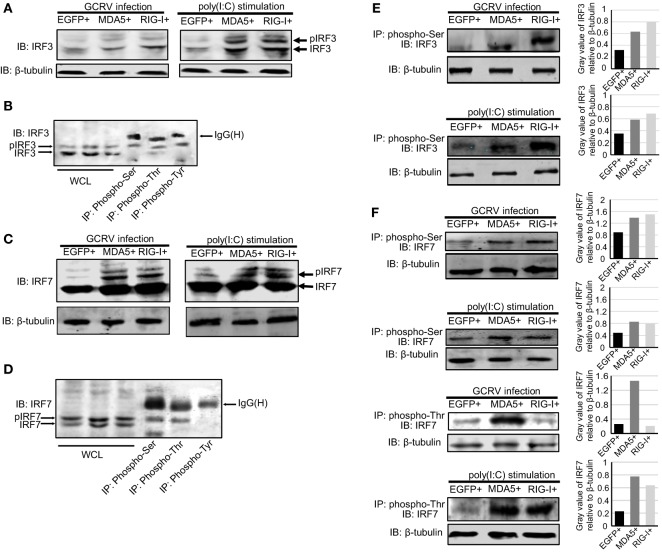
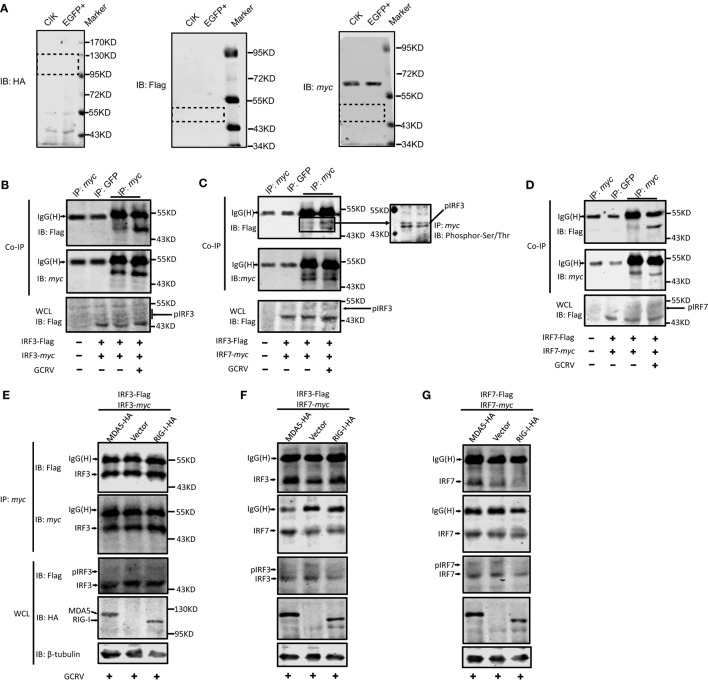
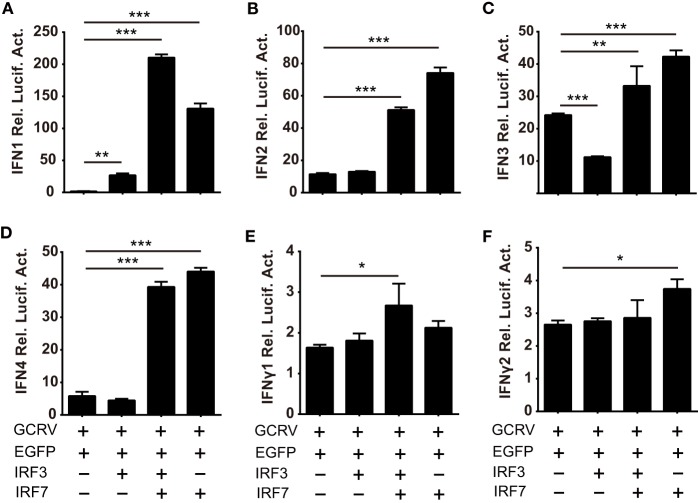
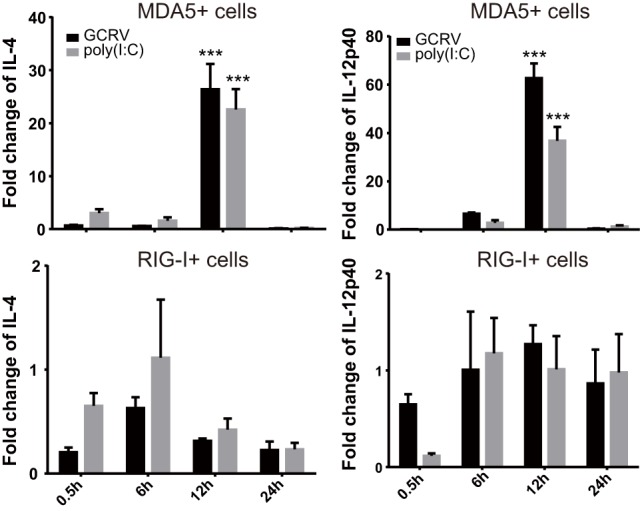
Retinoic acid-inducible gene I (RIG-I) and melanoma differentiation-associated gene 5 (MDA5) are critical cytosolic sensors that trigger the production of interferons (IFNs). Though their recognition functions are well identified, their unique roles in the downstream signal transduction remain to be elucidated. Herein, we report the differential effect between grass carp () MDA5 (CiMDA5) and CiRIG-I on the production of various IFNs upon grass carp reovirus (GCRV) infection in kidney (CIK) cell line. In CIK cells, grass carp IFN1 (CiIFN1) and CiIFN3 are relatively highly expressed while CiIFN2 and CiIFN4 are relatively slightly expressed. Following GCRV infection, CiMDA5 induces a more extensive type I IFN response than CiRIG-I. Further investigation reveals that both CiMDA5 and CiRIG-I facilitate the expression and total phosphorylation levels of grass carp IFN regulatory factor (IRF) 3 (CiIRF3) and CiIRF7 upon GCRV infection or poly(I:C) stimulation. However, the difference is that CiRIG-I decreases the threonine phosphorylation level of CiIRF7. As a consequence, CiMDA5 enhances the heterodimerization of CiIRF3 and CiIRF7 and homodimerization of CiIRF7, whereas CiRIG-I facilitates the heterodimerization but attenuates homodimerization of CiIRF7. Moreover, the present study suggests that CiIRF3 and CiIRF7 heterodimers and CiIRF7 homodimers are able to induce more extensive IFN-I responses than CiIRF3 homodimers under GCRV infection. Additionally, CiMDA5 induces a stronger type II IFN (IFN-II) response against GCRV infection than CiRIG-I. Collectively, these results demonstrate that CiMDA5 plays a more potent role than CiRIG-I in IFN response to GCRV infection through differentially regulating the phosphorylation and dimerization of CiIRF3 and CiIRF7.
视黄酸诱导基因I(RIG-I)和黑色素瘤分化相关基因5(MDA5)是触发干扰素(IFN)产生的关键胞质传感器。尽管它们的识别功能已得到充分确认,但其在下游信号转导中的独特作用仍有待阐明。在此,我们报告了草鱼()MDA5(CiMDA5)和CiRIG-I在草鱼呼肠孤病毒(GCRV)感染肾(CIK)细胞系后对各种IFN产生的不同影响。在CIK细胞中,草鱼IFN1(CiIFN1)和CiIFN3表达相对较高,而CiIFN2和CiIFN4表达相对较低。GCRV感染后,CiMDA5诱导的I型IFN反应比CiRIG-I更广泛。进一步研究发现,在GCRV感染或聚肌苷酸:聚胞苷酸(poly(I:C))刺激后,CiMDA5和CiRIG-I均促进草鱼IFN调节因子(IRF)3(CiIRF3)和CiIRF7的表达及总磷酸化水平。然而,不同的是CiRIG-I降低了CiIRF7的苏氨酸磷酸化水平。因此,CiMDA5增强了CiIRF3和CiIRF7的异源二聚化以及CiIRF7的同源二聚化,而CiRIG-I促进了CiIRF3和CiIRF7的异源二聚化,但减弱了CiIRF7的同源二聚化。此外,本研究表明,在GCRV感染下,CiIRF3和CiIRF7异源二聚体以及CiIRF7同源二聚体比CiIRF3同源二聚体能够诱导更广泛的I型IFN反应。另外,CiMDA5对GCRV感染诱导的II型IFN(IFN-II)反应比CiRIG-I更强。总体而言,这些结果表明,CiMDA5通过差异调节CiIRF3和CiIRF7的磷酸化和二聚化,在对GCRV感染的IFN反应中比CiRIG-I发挥更有效的作用。