Holton James, Yousri Tahir, Arealis George, Levy Ofer
Royal Orthopaedic Hospital , Birmingham, UK.
Royal Berkshire Hospital , Reading, UK.
Orthop Rev (Pavia). 2017 Feb 24;9(1):6977. doi: 10.4081/or.2017.6977. eCollection 2017 Feb 20.
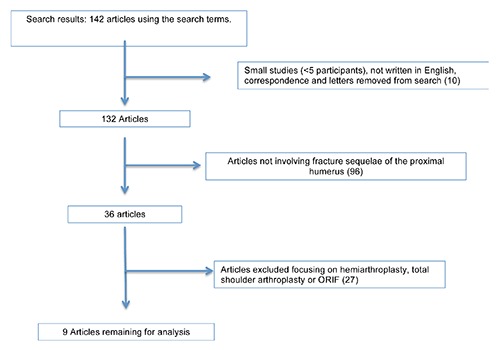
Fracture sequelae of the proximal humerus poses a complex management decision due to the frequent deformity and its consequences on the peri-articular soft tissues. These patients are frequently elderly with significant medical comorbidities. Due to the age of the patient there is frequently rotator cuff deficiency and therefore the reverse shoulder arthroplasty (RSA) becomes the arthroplasty of choice. We have performed a systematic review of the literature and report nine studies presenting RSA for the treatment of fracture sequelae of the proximal humerus. It is clear that RSA can improve the range of movement and function following proximal humerus fracture sequelae. However, there is a risk of significant complications including dislocation (16.7%), infection (6.7%), intra-operative fracture (3%) and neurological injury (2.6%). There is a need to invest in future prospective comparative studies and randomised trials to further test RSA in fracture sequelae patients. This will provide us with information regarding the longevity of different prosthesis, outcomes and cost-effectiveness of treatment.
肱骨近端骨折后遗症由于其常见的畸形以及对关节周围软组织的影响,给治疗决策带来了复杂性。这些患者多为老年人,常伴有严重的内科合并症。鉴于患者年龄,经常存在肩袖缺损,因此反肩关节置换术(RSA)成为首选的关节置换术。我们对文献进行了系统回顾,并报告了9项关于RSA治疗肱骨近端骨折后遗症的研究。显然,RSA可改善肱骨近端骨折后遗症后的活动范围和功能。然而,存在显著并发症的风险,包括脱位(16.7%)、感染(6.7%)、术中骨折(3%)和神经损伤(2.6%)。有必要开展未来的前瞻性对照研究和随机试验,以进一步在骨折后遗症患者中测试RSA。这将为我们提供有关不同假体的使用寿命、治疗效果和成本效益的信息。