Abdelaziz Ahmed, Vaishampayan Ulka
Department of Oncology, Wayne State University/Barbara Ann Karmanos Cancer Center, 4100 John R St, Detroit, MI, 48201, USA.
Curr Treat Options Oncol. 2017 Mar;18(3):18. doi: 10.1007/s11864-017-0444-6.
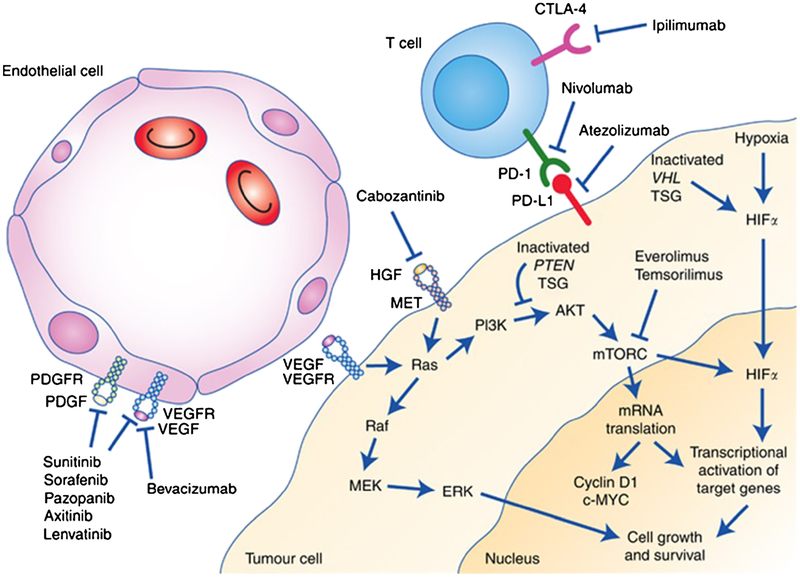
Cabozantinib was approved by the FDA in April 2016 for the treatment of advanced renal cancer, pretreated with at least one prior antiangiogenic therapy. This is the first agent in the therapy of kidney cancer to show a statistically significant improvement in all three endpoints of clinical efficacy, response rate, progression free survival, and overall survival (OS), in a phase III randomized trial. The reporting of METEOR coincided with that of the Checkmate 025 study which randomized similarly eligible patients to receive nivolumab or everolimus 10 mg daily. As the drug development has occurred in parallel for cabozantinib and nivolumab, no evidence exists for decision making regarding optimal sequencing of these agents. A third option of lenvatinib and everolimus was also rapidly approved based on a phase II randomized trial demonstrating promising magnitude of improvement in response, progression-free survival (PFS), and OS. The differences in toxicity profiles, duration and toxicities of prior therapy, presence of brain metastases, concomitant immunosuppressive therapies, or autoimmune conditions are the factors that are taken into account when choosing therapy. The patients who have demonstrated response, prolonged clinical benefit and tolerability, and with anti-VEGF therapy are likely to benefit from continued antiangiogenic activity combined with MET and HGF inhibition with cabozantinib at progression. The patients who have intolerance or poor response to anti-VEGF TKI should be switched to nivolumab as the preferential therapy of choice. Clearly, better predictors are required to aid in guiding therapeutic decisions. The CABOSUN trial will likely shift the entire paradigm. The CABOSUN trial demonstrated superior PFS and response rates favoring cabozantinib as compared to sunitinib in untreated, intermediate, or poor-risk RCC and can be predicted to become the front-line therapy of choice. Immune-based regimens such as the combinations of nivolumab + ipilimumab and bevacizumab + atezolizumab have completed phase III trials, comparing to sunitinib, and results are awaited. In the future, a similar clinical dilemma will be shifted to the front-line therapy and the nuances of trial eligibility, and patient comorbidities will remain important factors. Optimal sequencing and predictive biomarkers are the questions that need to be incorporated in future clinical trials within RCC.
卡博替尼于2016年4月获美国食品药品监督管理局(FDA)批准,用于治疗晚期肾癌,此前至少接受过一种抗血管生成疗法。在一项III期随机试验中,这是治疗肾癌的首个药物,在临床疗效、缓解率、无进展生存期和总生存期(OS)这三个终点上均显示出具有统计学意义的改善。METEOR试验结果的公布与Checkmate 025研究同期,后者将符合条件的患者随机分组,分别接受纳武单抗或每日10毫克依维莫司治疗。由于卡博替尼和纳武单抗的药物研发是并行开展的,因此尚无证据可用于指导这两种药物的最佳序贯治疗决策。基于一项II期随机试验显示出在缓解、无进展生存期(PFS)和OS方面有显著改善,乐伐替尼和依维莫司的联合用药方案也很快获批。在选择治疗方案时,会考虑毒性特征差异、既往治疗的持续时间和毒性、脑转移的存在、伴随的免疫抑制治疗或自身免疫性疾病等因素。对接受抗VEGF治疗后已显示出缓解、临床获益延长和耐受性良好的患者,在疾病进展时,继续采用抗血管生成活性联合卡博替尼对MET和HGF的抑制作用,可能会使其获益。对抗VEGF TKI不耐受或反应不佳的患者,应改用纳武单抗作为首选治疗方案。显然,需要更好的预测指标来辅助指导治疗决策。CABOSUN试验可能会改变整个治疗模式。CABOSUN试验表明,在未经治疗的中危或低危肾细胞癌(RCC)患者中,与舒尼替尼相比,卡博替尼的PFS和缓解率更优,预计将成为一线治疗的首选方案。基于免疫的方案,如纳武单抗 + 伊匹单抗和贝伐单抗 + 阿特珠单抗的联合用药方案,已完成与舒尼替尼对比的III期试验,结果有待公布。未来,类似的临床困境将转移至一线治疗,试验入组标准的细微差别以及患者的合并症仍将是重要因素。最佳序贯治疗和预测性生物标志物是未来RCC临床试验中需要纳入考量的问题。