Ledin Håkan, Good Lars, Johansson Torsten, Aspenberg Per
a Orthopedics, Department of Clinical and Experimental Medicine, Faculty of Medicine , Linköping University , Linköping.
b Department of Orthopedics , Aleris Specialist Care Motala AB , Motala.
Acta Orthop. 2017 Jun;88(3):259-262. doi: 10.1080/17453674.2017.1300745. Epub 2017 Mar 13.
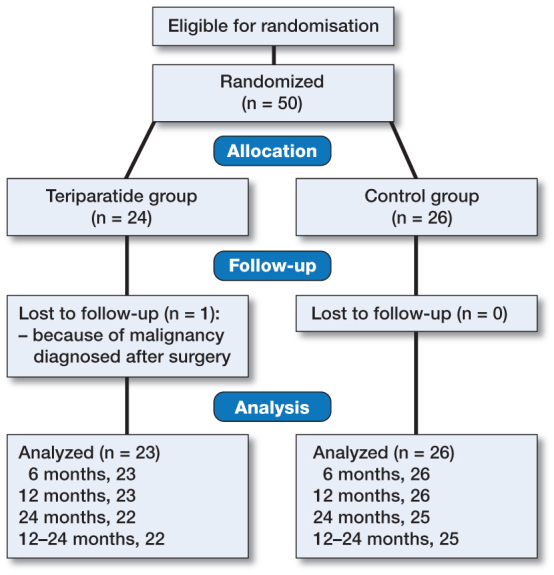
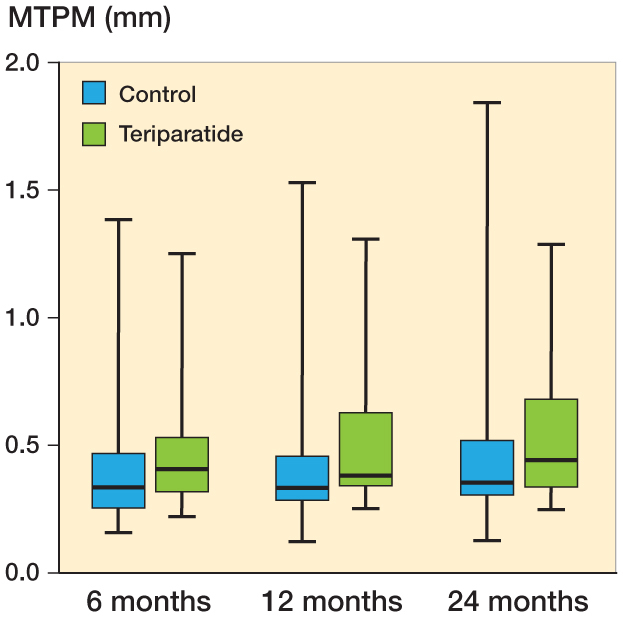
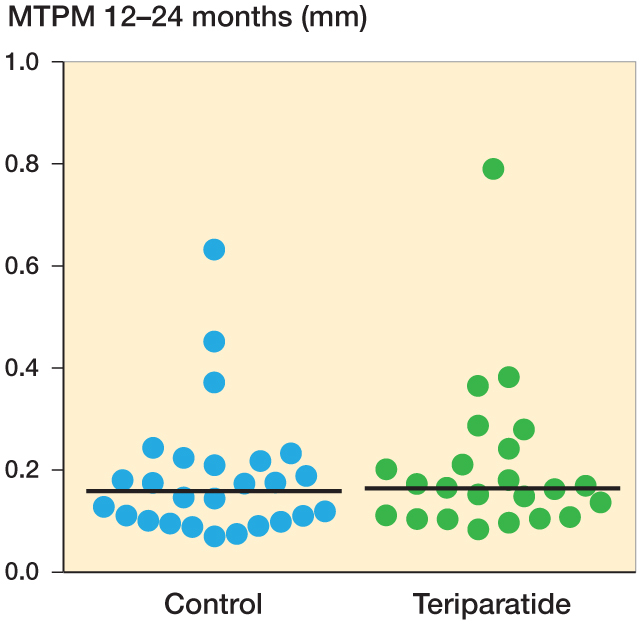
Background and purpose - Aseptic loosening is a main cause of late revision in total knee replacement (TKR). Teriparatide, a recombinant parathyroid hormone (PTH), stimulates osteoblasts and has been suggested to improve cancellous bone healing in humans. This might also be relevant for prosthesis fixation. We used radiostereometric analysis (RSA) to investigate whether teriparatide influences prosthesis fixation. Early migration as measured by RSA can predict future loosening. Patients and methods - In a randomized controlled trial with blind evaluation, 50 patients with osteoarthritis of the knee were allocated to a teriparatide treatment group (Forsteo, 20 μg daily for 2 months postoperatively) or to an untreated control group. RSA was performed postoperatively and at 6 months, 12 months, and 24 months. The primary effect variable was maximal total point motion (MTPM) from 12 to 24 months. Results - Median maximal total point motion from 12 to 24 months was similar in the 2 groups (teriparatide: 0.14 mm, 10% and 90% percentiles: 0.08 and 0.24; control: 0.13 mm, 10% and 90% percentiles: 0.09 and 0.21). [Authors: this is perhaps better than using "10th" and "90th", which looks ugly in print./language editor] The 95% confidence interval for the difference between group means was -0.03 to 0.04 mm, indicating that no difference occurred. Interpretation - We found no effect of teriparatide on migration in total knee replacement. Other trials using the same dosing have suggested a positive effect of teriparatide on human cancellous fracture healing. Thus, the lack of effect on migration may have been due to something other than the dose. In a similar study in this issue of Acta Orthopaedica, we found that migration could be reduced with denosumab (Ledin et al. 2017 ). The difference in response between the anabolic substance teriparatide and the antiresorptive denosumab suggests that resorption has a more important role during the postoperative course than any deficit in bone formation.
背景与目的——无菌性松动是全膝关节置换术(TKR)后期翻修的主要原因。特立帕肽是一种重组甲状旁腺激素(PTH),可刺激成骨细胞,有人认为它能促进人体松质骨愈合。这可能也与假体固定有关。我们采用放射立体测量分析(RSA)来研究特立帕肽是否会影响假体固定。通过RSA测量的早期移位可预测未来的松动情况。
患者与方法——在一项采用盲法评估的随机对照试验中,50例膝关节骨关节炎患者被分为特立帕肽治疗组(福斯高林,术后2个月每日20μg)或未治疗的对照组。术后以及6个月、12个月和24个月时进行RSA。主要效应变量是12至24个月时的最大总点运动(MTPM)。
结果——两组在12至24个月时的最大总点运动中位数相似(特立帕肽组:0.14mm,第10和第90百分位数:0.08和0.24;对照组:0.13mm,第10和第90百分位数:0.09和0.21)。组间均值差异的95%置信区间为-0.03至0.04mm,表明无差异。
解读——我们发现特立帕肽对全膝关节置换术中的移位无影响。其他使用相同剂量的试验表明特立帕肽对人体松质骨骨折愈合有积极作用。因此,对移位缺乏影响可能是由于剂量以外的其他因素。在本期《骨与关节杂志》的一项类似研究中,我们发现地诺单抗可减少移位(莱丁等人,2017年)。合成代谢物质特立帕肽和抗吸收药物地诺单抗之间反应的差异表明,在术后过程中,吸收比任何骨形成不足发挥着更重要的作用。