Mabikwa Onkabetse V, Greenwood Darren C, Baxter Paul D, Fleming Sarah J
Division of Epidemiology and Biostatistics, LICAMM, School of Medicine, University of Leeds, Leeds, UK.
Section of Epidemiology and Biostatistics, LICAP, School of Medicine, University of Leeds, Leeds, UK.
BMC Health Serv Res. 2017 Mar 14;17(1):201. doi: 10.1186/s12913-017-2137-z.
One aspect to consider when reporting results of observational studies in epidemiology is how quantitative risk factors are analysed. The STROBE (Strengthening the Reporting of Observational Studies in Epidemiology) guidelines recommend that researchers describe how they handle quantitative variables when analysing data. For categorised quantitative variables, the authors are required to provide reasons and justifications informing their practice. We investigated and assessed the practices and reporting of categorised quantitative variables in epidemiology.
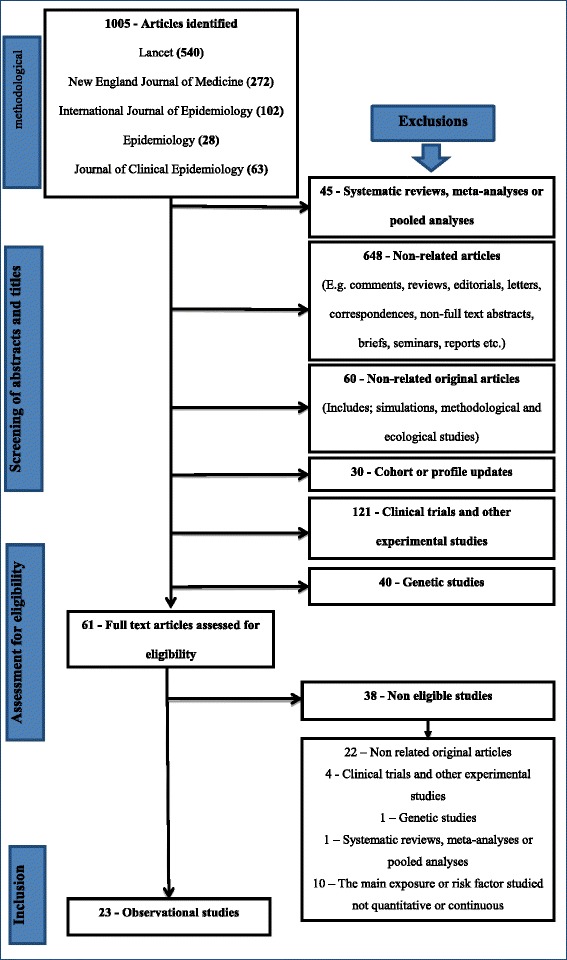
The assessment was based on five medical journals that publish epidemiological research. Observational studies published between April and June 2015 and investigating the relationships between quantitative exposures (or risk factors) and the outcomes were considered for assessment. A standard form was used to collect the data, and the reporting patterns amongst eligible studies were quantified and described.
Out of 61 articles assessed for eligibility, 23 observational studies were included in the assessment. Categorisation of quantitative exposures occurred in 61% of these studies and reasons informing the practice were rarely provided. Only one article explained the choice of categorisation in the analysis. Transformation of quantitative exposures into four or five groups was common and dominant amongst studies using equally spaced categories. Dichotomisation was not popular; the practice featured in one article. Overall, the majority (86%) of the studies preferred ordered or arbitrary group categories. Other criterions used to decide categorical boundaries were based on established guidelines such as consensus statements and WHO standards.
Categorisation of continuous variables remains a dominant practice in epidemiological studies. The reasons informing the practice of categorisation within published work are limited and remain unknown in most articles. The existing STROBE guidelines could provide stronger recommendations on reporting quantitative risk factors in epidemiology.
在报告流行病学观察性研究结果时,需要考虑的一个方面是如何分析定量风险因素。STROBE(加强流行病学观察性研究报告)指南建议研究人员描述在分析数据时如何处理定量变量。对于分类的定量变量,作者需要提供其做法的理由和依据。我们调查并评估了流行病学中分类定量变量的做法及报告情况。
评估基于五本发表流行病学研究的医学期刊。纳入评估的是2015年4月至6月间发表的、调查定量暴露(或风险因素)与结局之间关系的观察性研究。使用标准表格收集数据,并对符合条件的研究中的报告模式进行量化和描述。
在评估是否符合条件的61篇文章中,有23项观察性研究纳入评估。这些研究中有61%对定量暴露进行了分类,且很少提供这样做的理由。只有一篇文章解释了分析中分类的选择。将定量暴露分为四组或五组很常见,在使用等距分类的研究中占主导地位。二分法并不常见;只有一篇文章采用了这种做法。总体而言,大多数(86%)研究倾向于有序或任意分组类别。用于确定分类界限的其他标准基于已确立的指南,如共识声明和世界卫生组织标准。
连续变量的分类在流行病学研究中仍然是一种主导做法。已发表研究中分类做法的理由有限,大多数文章中仍不清楚。现有的STROBE指南可以就流行病学中定量风险因素的报告提供更强有力的建议。