Leggett Helen C, Wild Geoff, West Stuart A, Buckling Angus
Department of Genetics, University of Cambridge, Cambridge CB2 3EH, UK
Biosciences, University of Exeter, Cornwall Campus, Penryn TR10 9FE, UK.
Philos Trans R Soc Lond B Biol Sci. 2017 May 5;372(1719). doi: 10.1098/rstb.2016.0096.
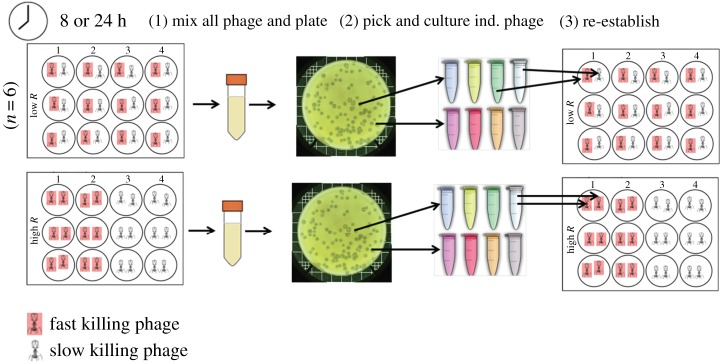
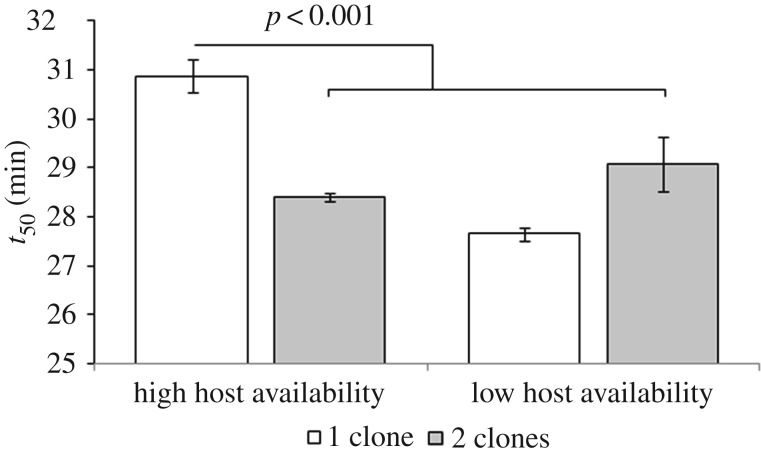
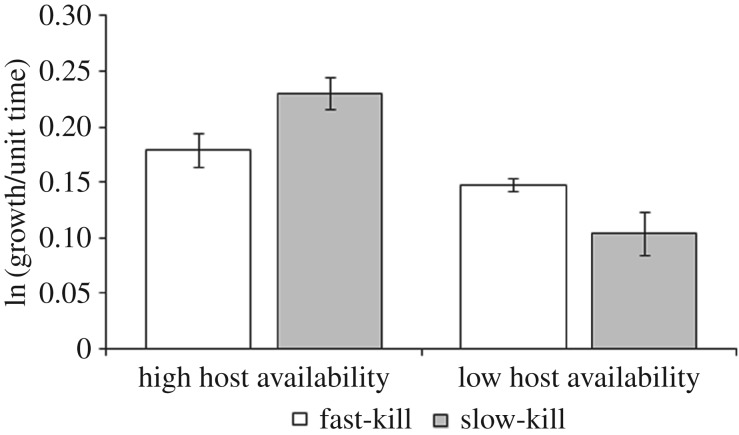
It is becoming increasingly clear that the evolution of infectious disease is influenced by host population structure. Theory predicts that parasites should be more 'prudent'-less transmissible-in spatially structured host populations. However, here we (i) highlight how low transmission, the phenotype being selected for in this in context, may also be achieved by rapacious host exploitation, if fast host exploitation confers a local, within-host competitive advantage and (ii) test this novel concept in a bacteria-virus system. We found that limited host availability and, to a lesser extent, low relatedness favour faster-killing parasites with reduced transmission. By contrast, high host availability and high relatedness favour slower-killing, more transmissible parasites. Our results suggest high, rather than low, virulence may be selected in spatially structured host-parasite communities where local competition and hence selection for a within-host fitness advantage is high.This article is part of the themed issue 'Opening the black box: re-examining the ecology and evolution of parasite transmission'.
越来越明显的是,传染病的进化受到宿主种群结构的影响。理论预测,在空间结构的宿主种群中,寄生虫应该更“谨慎”——传播性更低。然而,在这里我们(i)强调,在这种情况下被选择的低传播表型,如果快速的宿主利用赋予局部的、宿主内竞争优势,也可能通过贪婪的宿主利用来实现,并且(ii)在细菌-病毒系统中测试这一新概念。我们发现,有限的宿主可利用性以及在较小程度上的低亲缘关系有利于具有降低传播性的更快致死的寄生虫。相比之下,高宿主可利用性和高亲缘关系有利于致死速度较慢、传播性更强的寄生虫。我们的结果表明,在局部竞争以及因此对宿主内适应性优势的选择很高的空间结构宿主-寄生虫群落中,可能选择高毒力而非低毒力。本文是主题为“打开黑匣子:重新审视寄生虫传播的生态学和进化”特刊的一部分。