Thongtang Nuntakorn, Sitthananun Chaiyut, Sriussadaporn Sutin, Nitiyanant Wannee
Division of Endocrinology and Metabolism, Faculty of Medicine Siriraj Hospital, Mahidol University, 2 Wanglang Road, Bangkoknoi, Bangkok, 10700 Thailand.
J Diabetes Metab Disord. 2017 Feb 13;16:6. doi: 10.1186/s40200-017-0290-x. eCollection 2017.
Low dose statins are commonly used among Asians, because plasma low-density lipoprotein cholesterol (LDL-C) reductions similar to those observed in Westerners are achieved at lower doses. We aimed to assess the efficacy of low- and moderate-intensity statins for achieving plasma lipid targets in Thai type2 diabetes (T2D) and to evaluate factors associated with greater LDL-C reduction by statins.
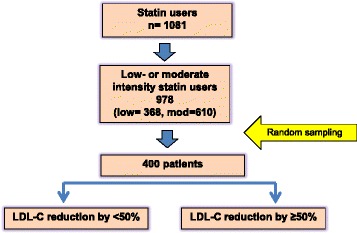
T2D patients who were treated with low- and moderate-intensity statins at the Siriraj Diabetes Clinic during the January 2013 to December 2014 study period were eligible for inclusion(n = 978), 400 patients were randomly recruited. Patients were classified into 1 of the following 2 groups according to their plasma LDL-C reductions by statins (N = 393); very favorable response (LDL-C reduction ≥50%) or less favorable response (LDL-C reduction <50%).
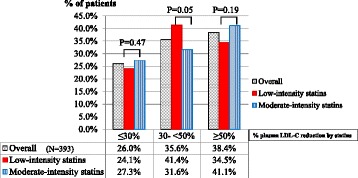
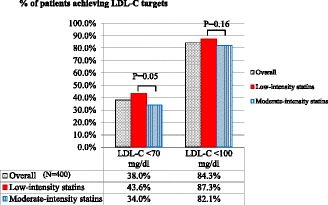
Of the 400 patients, 41.3% were low-intensity statin users. Mean age was 64.4 ± 12.7 years, 64% were female. Median duration of diabetes was 13.3 years and mean HbA1C was 8.1 ± 1.9%. Plasma LDL-C goal of <100 mg/dl and <70 mg/dl was achieved in 84.3% and 38.0% respectively, with no significant difference between the low- and moderate-intensity statin users. LDL-C reductions ≥50% can be achieved in 38.4%. Factors associated with very favorable responses from statins were age, hypertension, patients with stable or reduced weight, and better glycemic control.
Low- and moderate-intensity statins achieved plasma LDL-C goal of <100 mg/dl and <70 mg/dl in 84.3%, and 38.4% of the patients respectively. Due to the improved response to lower doses observed in Asians, a titration dosage strategy should be considered.
低剂量他汀类药物在亚洲人中普遍使用,因为在较低剂量下就能实现与西方人相似的血浆低密度脂蛋白胆固醇(LDL-C)降低水平。我们旨在评估低强度和中等强度他汀类药物在泰国2型糖尿病(T2D)患者中实现血脂目标的疗效,并评估与他汀类药物更大程度降低LDL-C相关的因素。
2013年1月至2014年12月研究期间,在诗里拉吉糖尿病诊所接受低强度和中等强度他汀类药物治疗的T2D患者符合纳入标准(n = 978),随机招募400名患者。根据他汀类药物治疗后患者血浆LDL-C的降低情况,将患者分为以下2组中的1组(N = 393):非常良好反应(LDL-C降低≥50%)或不太良好反应(LDL-C降低<50%)。
400名患者中,41.3%为低强度他汀类药物使用者。平均年龄为64.4±12.7岁,64%为女性。糖尿病中位病程为13.3年,平均糖化血红蛋白(HbA1C)为8.1±1.9%。血浆LDL-C目标<100mg/dl和<70mg/dl分别在84.3%和38.0%的患者中实现,低强度和中等强度他汀类药物使用者之间无显著差异。38.4%的患者LDL-C降低≥50%。与他汀类药物非常良好反应相关的因素包括年龄、高血压、体重稳定或减轻的患者以及更好的血糖控制。
低强度和中等强度他汀类药物分别使84.3%和38.4%的患者实现了血浆LDL-C目标<100mg/dl和<70mg/dl。由于亚洲人对较低剂量的反应有所改善,应考虑采用滴定剂量策略。