Hügle Thomas, Arnieri Ansgar, Bünter Margerita, Schären Stefan, Mündermann Annegret
Department of Rheumatology, University Hospital Basel, Basel, Switzerland.
Department of Rheumatology, Centre Hospitalier Universitaire Vaudois and University of Lausanne, Lausanne, Switzerland.
BMC Musculoskelet Disord. 2017 Mar 14;18(1):110. doi: 10.1186/s12891-017-1459-7.
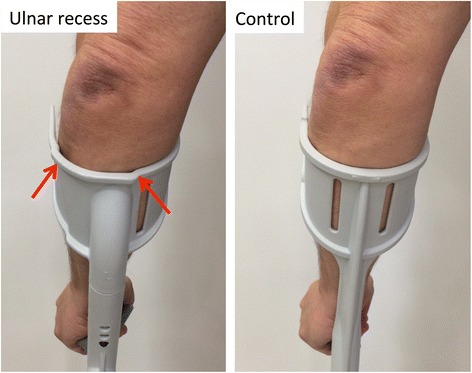
The use of forearm crutches has been associated with pain and neuropraxia along the ulnar bone. Whilst anatomic grips have improved comfort of crutch walking, to date anatomic forearm cuffs have not been clinically evaluated. The aim of this clinical pilot study was to determine if the use of forearm crutches with anatomic cuffs reduces pain and increases comfort and function in long-term users of forearm crutches during a 4-week period.
Prospective study in ten patients suffering from end-stage osteoarthritis of the lower extremity. All participants were long-term users of conventional forearm crutches. Participants used forearm crutches with an anatomically shaped cuff for 4-weeks. General health was assessed using the SF-36, and the crutches were evaluated using a newly developed questionnaire focusing on symptoms along the forearm.
Pain and paresthesia along the forearms decreased by 3.3 points (95% confidence interval difference (CI): [-5.0; -1.6], p = .004) and 3.5 points (95%CI: [-5.1; -1.9], p = .002), respectively, after using the crutches with the new anatomic cuff for 4 weeks. Comfort and sense of security of crutch use increased by 3.0 points (95%CI: [1.3; 4.7], p = .007) and 2.4 points (95%CI: [0.7; 4.1], p = .024). Cross-correlation analysis revealed correlations among items in the same item category and no correlations between items of different item categories of the new questionnaires.
An anatomically shaped cuff increases comfort of forearm crutches. Further research should confirm long-term clinical improvement.
This study was registered retrospectively in ISRCTN (TRN: ISRCTN 11135150 ) on 14/02/2017.
使用前臂拐杖与尺骨沿线疼痛和神经失用症有关。虽然解剖学握把提高了使用拐杖行走的舒适度,但迄今为止,解剖学前臂袖带尚未经过临床评估。这项临床试点研究的目的是确定在4周期间,使用带有解剖学袖带的前臂拐杖是否能减轻长期使用前臂拐杖的患者的疼痛,并提高舒适度和功能。
对10名下肢终末期骨关节炎患者进行前瞻性研究。所有参与者都是传统前臂拐杖的长期使用者。参与者使用带有解剖学形状袖带的前臂拐杖4周。使用SF-36评估总体健康状况,并使用一份新开发的、关注前臂症状的问卷对拐杖进行评估。
在使用带有新解剖学袖带的拐杖4周后,前臂的疼痛和感觉异常分别下降了3.3分(95%置信区间差异(CI):[-5.0;-1.6],p = 0.004)和3.5分(95%CI:[-5.1;-1.9],p = 0.002)。使用拐杖的舒适度和安全感分别提高了3.0分(95%CI:[1.3;4.7],p = 0.007)和2.4分(95%CI:[0.7;4.1],p = 0.024)。交叉相关性分析显示新问卷中同一项目类别的项目之间存在相关性,不同项目类别的项目之间不存在相关性。
解剖学形状的袖带提高了前臂拐杖的舒适度。进一步的研究应证实长期临床改善情况。
本研究于2017年2月14日在国际标准随机对照试验编号注册库(TRN:ISRCTN 11135150)进行了回顾性注册。