Mardanova Eugenia S, Blokhina Elena A, Tsybalova Liudmila M, Peyret Hadrien, Lomonossoff George P, Ravin Nikolai V
Institute of Bioengineering, Research Center of Biotechnology of the Russian Academy of SciencesMoscow, Russia; Research Institute of InfluenzaSt. Petersburg, Russia.
Research Institute of Influenza St. Petersburg, Russia.
Front Plant Sci. 2017 Feb 28;8:247. doi: 10.3389/fpls.2017.00247. eCollection 2017.
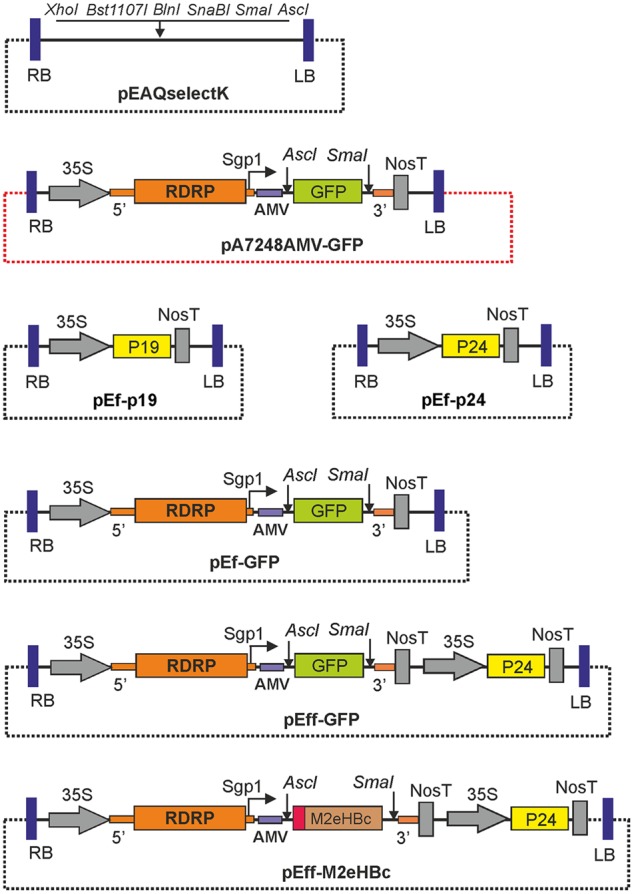
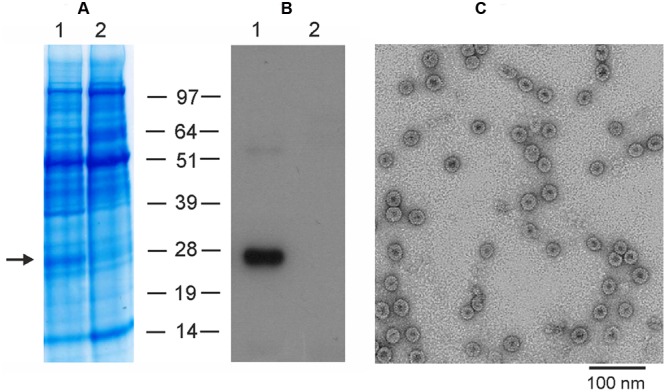
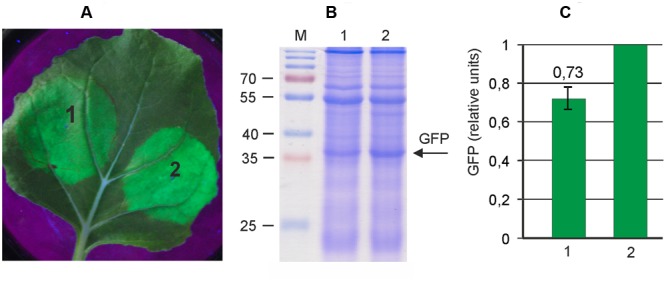
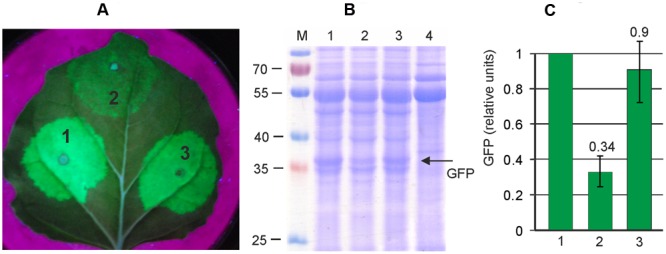
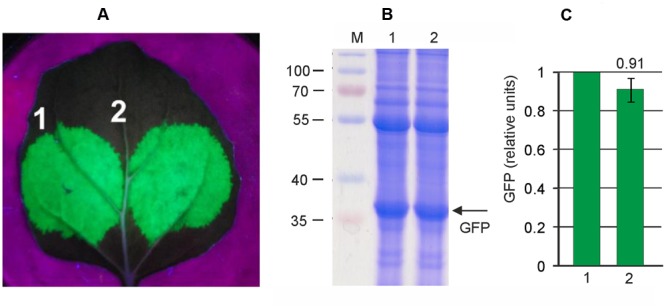
Agroinfiltration of plant leaves with binary vectors carrying a gene of interest within a plant viral vector is a rapid and efficient method for protein production in plants. Previously, we constructed a self-replicating vector, pA7248AMV, based on the genetic elements of potato virus X (PVX), and have shown that this vector can be used for the expression of recombinant proteins in . However, this vector is almost 18 kb long and therefore not convenient for genetic manipulation. Furthermore, for efficient expression of the target protein it should be co-agroinfiltrated with an additional binary vector expressing a suppressor of post-transcriptional gene silencing. Here, we improved this expression system by creating the novel pEff vector. Its backbone is about 5 kb shorter than the original vector and it contains an expression cassette for the silencing suppressor, P24, from grapevine leafroll-associated virus-2 alongside PVX genetic elements, thus eliminating the need of co-agroinfiltration. The pEff vector provides green fluorescent protein expression levels of up to 30% of total soluble protein. The novel vector was used for expression of the influenza vaccine candidate, M2eHBc, consisting of an extracellular domain of influenza virus M2 protein (M2e) fused to hepatitis B core antigen. Using the pEff system, M2eHBc was expressed to 5-10% of total soluble protein, several times higher than with original pA7248AMV vector. Plant-produced M2eHBc formed virus-like particles , as required for its use as a vaccine. The new self-replicating pEff vector could be used for fast and efficient production of various recombinant proteins in plants.
利用携带植物病毒载体中目的基因的双元载体对植物叶片进行农杆菌浸润,是一种在植物中生产蛋白质的快速有效方法。此前,我们基于马铃薯X病毒(PVX)的遗传元件构建了一个自我复制载体pA7248AMV,并已证明该载体可用于在植物中表达重组蛋白。然而,该载体长度近18 kb,因此不利于基因操作。此外,为了高效表达靶蛋白,它需要与另一个表达转录后基因沉默抑制子的双元载体共浸润。在此,我们通过创建新型pEff载体改进了该表达系统。它的骨架比原始载体短约5 kb,并且除了PVX遗传元件外,还包含来自葡萄卷叶相关病毒2的沉默抑制子P24的表达盒,从而无需共浸润。pEff载体的绿色荧光蛋白表达水平可达总可溶性蛋白的30%。该新型载体用于表达流感疫苗候选物M2eHBc,它由与乙型肝炎核心抗原融合的流感病毒M2蛋白胞外域(M2e)组成。使用pEff系统,M2eHBc的表达量达到总可溶性蛋白的5% - 10%,比原始的pA7248AMV载体高出数倍。植物产生的M2eHBc形成了病毒样颗粒,这是其作为疫苗使用所必需的。新的自我复制pEff载体可用于在植物中快速高效地生产各种重组蛋白。